Introduction
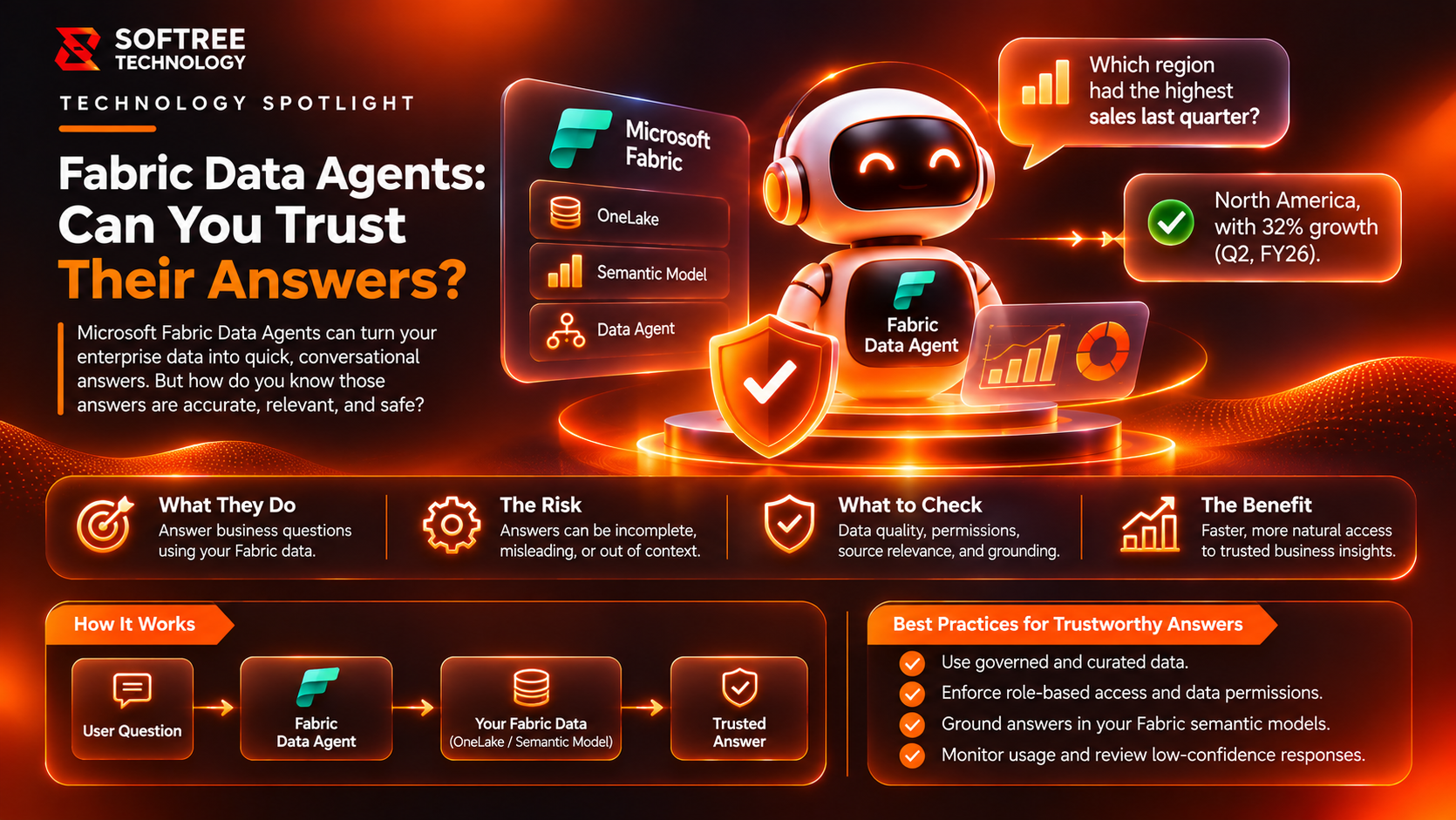
Fabric Data Agents allow business users to ask questions about business data using natural language. A user can ask, “Which product line had the highest year-over-year growth last quarter?” and receive a data-driven response without manually writing a query.
However, a fluent answer is not necessarily a correct answer.
The real challenge is ensuring that the agent understands the business question, selects the right data, applies the correct definitions and produces a result that can be verified. Organizations adopting Fabric Data Agents need systematic testing, clear business context, reliable data and ongoing monitoring to establish trust.
Key Takeaways
- Fabric Data Agents can generate SQL, DAX or KQL depending on supported data sources.
- Correct query execution does not automatically guarantee a correct business answer.
- Testing should cover question interpretation, query generation, execution and response quality.
- Business definitions, data quality and access permissions are essential to trustworthy results.
- Regression testing helps maintain reliability as data, instructions and configurations change.
How a Fabric Data Agent Reaches an Answer
A Fabric Data Agent provides a conversational interface for querying supported enterprise data. Depending on its connected sources and capabilities, it can interpret a natural-language question, generate SQL, DAX or KQL, execute the query and present the result in natural language.
The complete process involves multiple stages:
- Understanding the user's question
- Selecting the appropriate data source
- Interpreting tables, columns and relationships
- Generating the query
- Executing the query
- Summarising the result
A failure can occur at any stage. Testing only the final response may overlook incorrect source selection, query logic or result interpretation.
Why a Confident Answer Can Still Be Wrong
Consider a sales team asking for revenue this quarter. The organization may track booked revenue, invoiced revenue and recognised revenue.
If the agent selects the wrong measure, the calculation may be mathematically correct while the business answer is incorrect.
Common risks include:
- Ambiguous business terminology: Revenue, margin, churn and active customer may have organization-specific definitions.
- Incomplete context: Missing descriptions, relationships or instructions can lead to incorrect query choices.
- Incorrect time interpretation: Last month, year to date and previous quarter require precise date boundaries.
- Join and aggregation errors: Duplicate rows or incorrect relationships can distort totals.
- Incorrect answer summaries: A correct query result may be explained inaccurately.
- Access and governance issues: Role-specific permissions and restricted data must be validated.
A Practical Data-Agent Testing Strategy
A reliable testing approach should evaluate the complete question-to-answer workflow.
1. Validate the Data Foundation
Before testing the agent, verify:
- Source data freshness and completeness
- Data types and null handling
- Key uniqueness and relationship integrity
- Authoritative measures and business definitions
Incorrect underlying data cannot be corrected by an AI agent.
2. Test Context and Configuration
Review connected data sources, schema scope and instructions.
Ensure the agent understands business terminology, preferred measures, date rules, join logic and limitations. Representative examples can help clarify common questions without overfitting the agent to a small number of prompts.
3. Build a Representative Question Test Set
Include different question types:
- Simple business questions
- Multi-condition queries
- Synonyms and misspellings
- Ambiguous requests
- Boundary dates and empty-result cases
- Follow-up questions
- Unsupported or out-of-scope requests
For each test, document the expected interpretation, source, filters, calculations and acceptable answer.
4. Verify Generated Queries and Results
Where query details are available, inspect the generated SQL, DAX or KQL.
Validate the selected tables, joins, measures, filters and aggregations. Compare the result with an independent reference query or approved report.
Check the actual data before evaluating the natural-language explanation.
5. Test Permissions and Negative Scenarios
Use test identities with different access levels.
Confirm that restricted records and columns are not exposed. Test unsupported questions and unavailable data to ensure the agent communicates limitations instead of inventing answers.
6. Evaluate the Final Response
Assess whether the answer is:
- Factually correct
- Complete and relevant
- Clear and understandable
- Traceable to the underlying result
- Appropriately qualified
Important details such as reporting periods, units, filters and assumptions should not be omitted.
Example: Testing a Sales Question
Consider the following prompt:
“Show the top five regions by recognised revenue for the previous quarter.”
A QA test should verify:
- The previous quarter uses the correct reporting calendar.
- Recognised revenue matches the approved finance definition.
- Region comes from the correct dimension.
- Joins do not multiply revenue.
- Results are ranked in descending order.
- The response returns no more than five regions and handles ties appropriately.
- The answer includes the reporting period and currency.
The QA record should retain the original prompt, user role, expected interpretation, generated query where available, reference result, actual answer, defect classification and retest outcome.
Operational Controls and Release Readiness
Fabric Data Agents should be treated as products that evolve over time.
Run regression tests after changes to schemas, semantic models, instructions, example questions, permissions or platform behavior.
Before releasing an agent, confirm that:
- Business owners approve key definitions.
- High-priority test cases pass.
- Role-based access checks are complete.
- Known limitations are documented.
- Monitoring and escalation owners are assigned.
- Rollback or disablement procedures are understood.
Monitor user feedback and recurring query failures. Update the agent's context and regression tests together whenever issues are identified.
Conclusion
Fabric Data Agents can make business data easier to explore, but conversational convenience should not replace analytical discipline.
Trust comes from reliable data, clear business context, verified query logic, permission testing and repeatable evaluation. A strong data-agent QA process checks not only whether an answer sounds right, but whether the correct question was asked of the right data and whether the result can be defended.
Softree Technology can help teams strengthen AI and data quality assurance through practical test scenarios, data-driven workflow validation and release-readiness practices.
https://www.softreetechnology.com/