Introduction
Automated testing helps software teams validate applications faster and maintain consistent quality across frequent releases. However, as applications evolve, even small changes to button IDs, CSS selectors, DOM structures, layouts, or UI components can cause automated tests to fail.
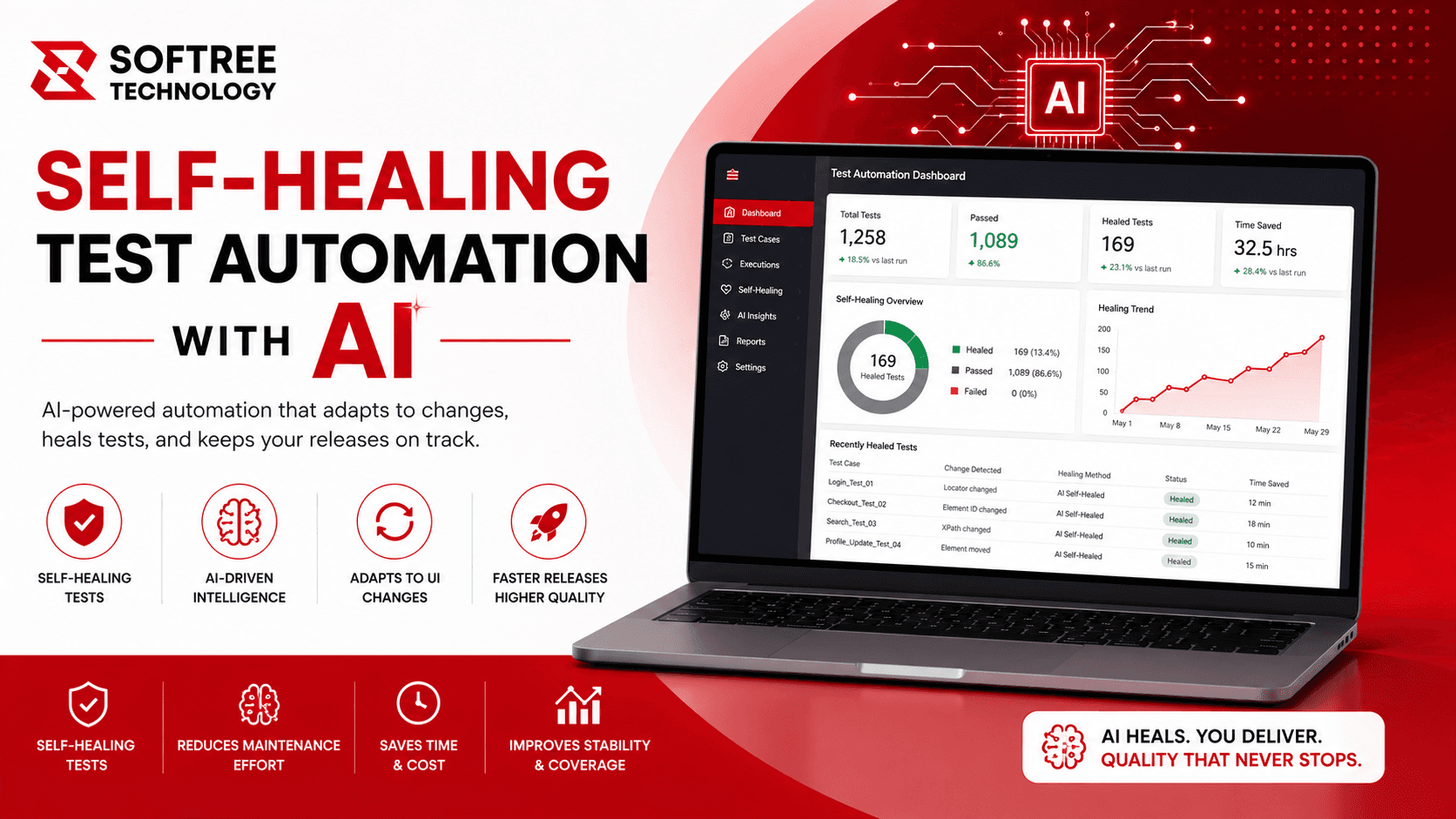
Self-healing test automation addresses this challenge by allowing automation systems to detect certain failures, identify alternative elements, validate the replacement, and continue test execution when the change is considered safe.
This guide explains what self-healing test automation is, why traditional automation breaks, how AI-based healing works, its benefits and limitations, implementation best practices, and how organizations can measure its effectiveness.
Quick Answer
Self-healing test automation enables automated tests to adapt to certain controlled UI changes without requiring immediate manual locator updates. When a test cannot find an expected element, the system can analyze characteristics such as text, attributes, DOM structure, accessibility properties, position, and historical information to identify a potential replacement.
AI-based approaches can further improve this process by comparing multiple signals and assigning confidence scores before deciding whether a test should automatically continue, require QA review, or fail for manual investigation.
Table of Contents
- What Is Self-Healing Test Automation?
- Why Traditional Test Automation Breaks
- How Self-Healing Automation Works
- Example of Self-Healing in Action
- AI-Based Self-Healing vs. Traditional Locator Strategies
- Benefits of Self-Healing Test Automation
- What Types of Changes Can Self-Healing Handle?
- What Self-Healing Cannot Reliably Fix
- The Role of AI in Self-Healing Automation
- Self-Healing Test Automation Architecture
- Self-Healing Automation Workflow
- Best Practices
- Risks of Self-Healing Automation
- How to Measure Self-Healing Effectiveness
- The Future of Self-Healing Test Automation
- Key Takeaways
- Conclusion
What Is Self-Healing Test Automation?
Self-healing test automation is an approach where an automated testing system can detect changes that cause a test step to fail and dynamically adjust its execution strategy. Rather than immediately stopping when an expected element cannot be located, the system can examine other characteristics of the page and search for an alternative element that may represent the same control.
These characteristics can include visible text, element type, attributes, DOM hierarchy, nearby elements, position, accessibility properties, historical locator information, and previous successful interactions.
For example, a test may originally use #login-button. If the application changes the ID while the button continues to perform the same function, traditional automation may fail. A self-healing system can identify the likely replacement, validate it, and continue execution when the replacement meets the required confidence level.
Why Traditional Test Automation Breaks
Traditional test automation often depends on fixed locators and predefined application structures. Changes to HTML structures, CSS classes, element IDs, XPath expressions, CSS selectors, component libraries, page layouts, or dynamically generated attributes can therefore cause automated tests to fail.
Importantly, an automation failure does not always mean that the application itself is defective. In many cases, the application continues to work correctly, but the test can no longer locate the element it was originally designed to interact with.
This creates additional maintenance work for QA teams. Test engineers may need to investigate the failure, update the locator, rerun the test, and verify that the change has not introduced another issue. When these changes occur frequently across large test suites, maintaining automation can consume considerable time and resources.
How Self-Healing Automation Works
Self-healing automation generally starts when a test step fails because an expected element cannot be located or interacted with. The system analyzes the original element and its characteristics, including its ID, name, class, XPath, CSS selector, text, role, ARIA attributes, parent-child relationships, and position within DOM.
The system then searches for alternative elements that could represent the same control. Multiple signals are compared to determine which candidate is most likely to be correct, and a confidence score can be assigned to the potential replacement.
Before allowing the test to continue, the system can validate whether the candidate is visible, enabled, contains the expected text, exists in the correct page context, and successfully performs the intended action. If the replacement meets the required criteria, the test can continue. The healing event can also be recorded for later QA review and auditing.
Example of Self-Healing in Action
Consider an e-commerce checkout application where the original checkout button uses the locator #checkout-btn. After a UI redesign, the development team changes the locator to #proceed-checkout, while the button continues to perform the same checkout function.
With traditional automation, the test may fail because the original locator no longer exists. A test engineer would need to identify the change, update the locator, and rerun the test.
With self-healing automation, the system can examine the button's text, element type, location, DOM context, and historical characteristics. If these signals indicate that the new element represents the original checkout control, the system can assign a confidence score, validate the candidate, and continue the test when the replacement is considered safe.
AI-Based Self-Healing vs. Traditional Locator Strategies
Traditional automation primarily depends on fixed locators, basic DOM analysis, and predefined test instructions. When an element changes, manual locator repair is generally required. This becomes increasingly difficult when applications change frequently or automation suites contain thousands of locators.
Self-healing automation introduces alternative locator discovery, advanced DOM analysis, historical execution information, dynamic UI adaptation, and confidence scoring. AI-based approaches can evaluate multiple signals to determine whether a different element is likely to represent the same control. This can reduce repetitive maintenance while improving regression test stability.
Benefits of Self-Healing Test Automation
One of the main benefits of self-healing automation is reduced test maintenance. Instead of requiring immediate manual intervention for every minor locator change, the system can automatically handle certain low-risk changes. This allows QA teams to spend more time on test strategy, functional validation, and defect investigation.
Self-healing can also improve automation stability by reducing failures caused by broken locators rather than genuine application defects. More stable automation can support larger regression suites with fewer interruptions, while healing logs can help development and QA teams identify UI changes that repeatedly affect automation.
What Types of Changes Can Self-Healing Handle?
Self-healing automation can be useful for controlled UI changes such as locator updates, attribute changes, CSS modifications, and some DOM structure changes. It can also assist with certain text changes when other signals confirm that the element continues to represent the same functionality.
For example, an element ID may change while its purpose remains unchanged. Similarly, a button label may change from "Login" to "Sign In." A self-healing system can evaluate additional information such as element structure, attributes, position, and historical behavior before determining whether the replacement is appropriate.
What Self-Healing Cannot Reliably Fix
Self-healing should not be treated as a solution for every automation failure. Major workflow changes, new or removed functionality, authentication redesigns, significant page restructuring, complex business-rule changes, and changes in expected behavior may require manual investigation.
Self-healing also cannot reliably resolve backend or API contract changes, data-related failures, performance problems, or security failures. A visually similar element may perform completely different business functionality, so blindly replacing a failed locator could potentially hide a genuine application defect.
The Role of AI in Self-Healing Automation
AI can strengthen self-healing by evaluating multiple signals instead of relying on a single locator. These signals can include element similarity, DOM context, text similarity, attribute similarity, historical behavior, page context, and accessibility information.
The system can use these signals to identify potential replacement elements and assign confidence scores. Based on the confidence level and risk associated with the action, the system can automatically heal the test, request QA review, or allow the test to fail for manual investigation.
Self-Healing Test Automation Architecture
A self-healing automation architecture can include the test suite, automation framework, locator manager, current DOM, historical execution data, AI or healing engine, candidate elements, confidence scoring, auto-healing logic, QA review, and final test results.
The process can be represented as:
Test Suite → Automation Framework → Locator Manager → AI/Healing Engine → Candidate Elements → Confidence Scoring → Auto-Heal or QA Review → Test Result
This approach allows the healing process to operate as part of the automation workflow while maintaining a review mechanism for uncertain or high-risk changes.
Self-Healing Automation Workflow
A successful implementation should begin with stable test automation rather than using self-healing to compensate for poorly designed tests. Teams should continue using reliable locators, reusable components, appropriate test architecture, clear test data, synchronization, and test isolation.
Self-healing can initially be restricted to low-risk locator failures. Confidence thresholds can then determine how the system handles different candidates. For example, an organization might allow very high-confidence candidates to heal automatically while sending medium-confidence candidates for QA review. These thresholds should be defined according to the organization's testing requirements and risk profile.
Best Practices
Self-healing should complement good automation practices rather than replace them. Teams should continue using stable locators wherever possible and combine multiple signals such as DOM structure, attributes, text, element type, accessibility properties, position, and parent-child relationships when identifying replacement elements.
Confidence thresholds should control automated decisions, and healing events should remain auditable. High-risk activities such as payments, approvals, publishing, deleting records, changing permissions, or sending sensitive information should receive stricter validation.
Teams should also review healing frequency. If the same tests repeatedly require healing, it may indicate unstable application design, poor locator strategies, or frequent UI changes that require a more permanent solution.
Risks of Self-Healing Automation
Although self-healing can reduce maintenance effort, it introduces risks that organizations need to manage. Incorrect healing could cause a test to interact with the wrong element, while silent test modification can make it difficult to understand why the test behaved differently from its original design.
There is also a risk that self-healing could mask genuine application defects. If an AI system selects a visually similar but functionally different element, an important change in application behavior could go unnoticed. Confidence thresholds, validation, logging, and human oversight are therefore essential.
How to Measure Self-Healing Effectiveness
Organizations can evaluate self-healing automation using metrics such as healing success rate, false healing rate, maintenance reduction, automation stability, mean time to repair, healing frequency, and defect detection.
A high healing rate alone should not be considered a measure of success. Organizations also need to determine whether healing is genuinely reducing maintenance effort while preserving test quality and ensuring that genuine application defects are still detected.
The Future of Self-Healing Test Automation
The future of self-healing automation is likely to involve AI using a broader range of signals, including application structure, test execution history, user workflows, requirements, defect history, visual information, accessibility metadata, API behavior, and production telemetry.
With access to these signals, AI can increasingly help determine whether a test failure represents an application defect, automation problem, environmental issue, changed requirement, or simple locator change. This can make automated testing more adaptive while retaining human validation for important decisions.
Key Takeaways
✓ Self-healing test automation can reduce repetitive test maintenance caused by certain UI and locator changes.
✓ AI can evaluate multiple signals, identify alternative elements, and use confidence scoring to determine whether a test can safely continue.
✓ Self-healing is most suitable for controlled UI changes and should not be expected to resolve major functional, business-rule, API, security, or data-related failures.
✓ Confidence thresholds, healing logs, risk-based validation, and QA oversight are important for maintaining test quality.
Conclusion
Self-healing test automation provides a more adaptive approach to automated testing by detecting failed interactions, identifying potential replacement elements, validating those replacements, and recovering from certain application UI changes. This can help organizations improve automation stability while reducing repetitive maintenance work as applications evolve.
The objective should not be to make automation completely independent of human oversight. A more reliable approach combines AI-driven adaptation with stable automation architecture, confidence thresholds, detailed healing logs, risk-based validation, and QA review.
Learn more about AI solutions and services from Softree Technology:
https://www.softreetechnology.com/