Introduction: Low-Code Success Creates a New Operating Challenge
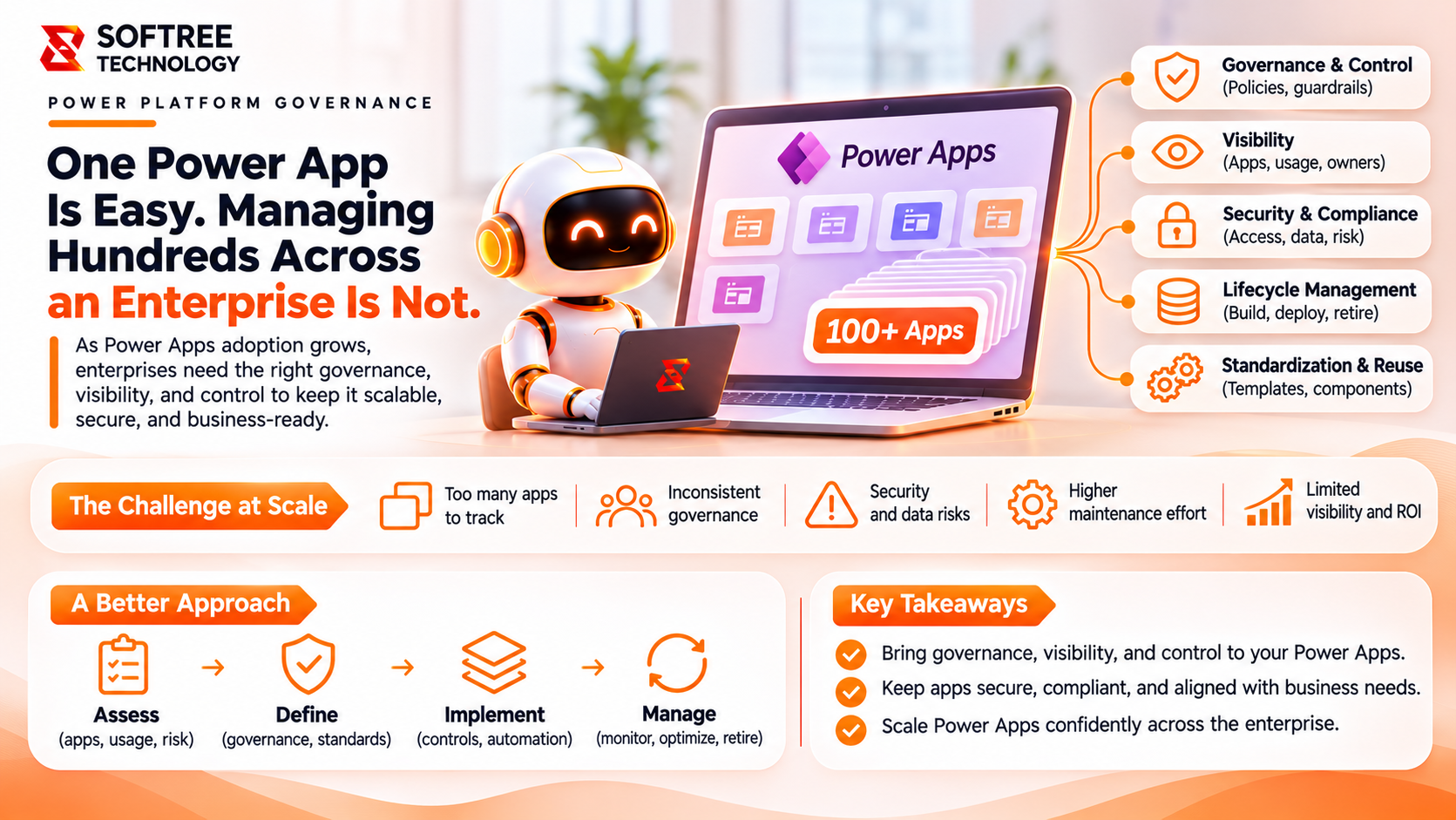
A single Power App can solve a team's process gap in days. A few more can remove spreadsheet handoffs, simplify approvals, and give employees better access to business information. As adoption grows, however, the same speed that makes Microsoft Power Platform valuable can create an enterprise management challenge: hundreds of apps, flows, connectors, environments, owners, and data paths may emerge across the organization.
The issue is not that employees are building applications. Citizen development is often a productive source of innovation. The challenge is ensuring that applications remain discoverable, secure, supportable, and aligned with business requirements as they move from personal productivity tools to business-critical assets.
Effective Power Platform governance is therefore not a blanket restriction on makers. It is a scalable operating model that sets clear guardrails, provides the right environment for each workload, and makes responsible development easier than unmanaged development.
Key Takeaways
Power Platform governance helps organizations maintain visibility, protect business data, manage application lifecycles, and support citizen development at scale. A practical governance model combines environment strategy, connector policies, identity controls, ownership standards, lifecycle management, and maker enablement. The goal is to control risk without slowing low-risk innovation.
What We Learned
Why Enterprise App Sprawl Happens
App sprawl is usually the result of several normal adoption patterns happening at once:
- Distributed creation: Business teams build apps independently to solve local needs.
- Unclear ownership: An app remains active after its original maker changes roles or leaves.
- Environment proliferation: Teams create environments without consistent purpose, lifecycle, or access rules.
- Connector and data exposure: Flows and apps connect to systems with differing sensitivity and control requirements.
- Duplicate applications: Multiple apps address similar processes, but there is no reliable inventory or reuse mechanism.
- Lifecycle gaps: Prototypes are not reviewed, archived, transferred, or retired when obsolete.
These patterns can increase operational risk through unsupported apps, excessive privileges, data movement across unapproved services, fragile flows, and unclear incident accountability.
Governance needs to address the entire lifecycle—not only the moment an app is created.
Governance Objectives: Control Risk While Preserving Maker Momentum
A practical enterprise governance program should aim to:
- Maintain an accurate inventory of apps, flows, environments, connectors, owners, and usage.
- Apply data protection and access policies consistently based on risk and business purpose.
- Separate experimentation from production workloads with an intentional environment strategy.
- Define ownership, support, review, and retirement expectations for business-critical applications.
- Enable makers with reusable patterns, templates, training, and a clear path to production.
- Measure adoption and risk so governance can improve using evidence rather than assumptions.
A Scalable Power Platform Governance Architecture
Governance consists of several coordinated layers.
The Power Platform admin center provides administrative visibility and controls. Environment strategy establishes where solutions are built and deployed. Data policies help define which services can exchange organizational data. Identity and access controls determine who can create, use, and administer assets. Lifecycle and ALM practices manage solution movement, change, ownership, and retirement.
A Center of Excellence (CoE) can coordinate standards, enablement, and adoption reporting across these layers.
1. Environment Strategy
Define environment purpose before provisioning at scale. A common pattern distinguishes personal or team productivity, development, test, and production environments, with stricter controls for production.
Environment creation should have a clear owner, intended audience, data classification, and lifecycle. Use managed environments and platform administration capabilities where they fit the organization's licensing and operating model.
2. Data Policies and Connector Governance
Establish data policies that classify connectors into permitted groups and prevent sensitive organizational data from being combined with inappropriate services.
Review exceptions through a documented process. Policies should be understandable to makers: explain what is blocked, why it is blocked, and what approved alternative they can use.
Validate policy behavior with representative apps and flows before broad rollout.
3. Identity, Ownership, and Least Privilege
Use role-based administrative access and least-privilege principles.
Business-critical apps should have named business owners and technical support contacts, with an ownership-transfer procedure. Where service accounts or application identities are used, document their purpose, permissions, credential handling, and rotation expectations.
Avoid designs that depend on one maker's personal account.
4. Center of Excellence and Maker Enablement
A CoE or enablement function can publish development standards, reusable components, environment guidance, support paths, and training.
It should partner with business teams—not become a bottleneck for every small prototype.
A tiered model works well: makers can experiment within low-risk guardrails, while apps that handle sensitive data or support critical operations enter a more rigorous review path.
Implementation Approach: From Inventory to Continuous Governance
A structured implementation approach can help organizations establish governance without disrupting existing development.
- Discover: Collect app, flow, environment, connector, ownership, and usage information. Confirm inventory data is current and unknown owners are surfaced.
- Classify: Assign risk tiers using factors such as data sensitivity, user population, business criticality, external connectivity, and operational impact.
- Set guardrails: Define environment purpose, data policies, access standards, naming conventions, and minimum lifecycle expectations.
- Enable makers: Provide templates, approved connectors, solution packaging guidance, and a help channel for design questions.
- Review production candidates: Assess security, data handling, accessibility, error handling, monitoring, support ownership, and change management.
- Operate and improve: Monitor adoption, policy exceptions, orphaned assets, usage, and incidents; refine controls based on findings.
Validation Scenarios Governance Teams Should Test
Governance controls should be validated like any other enterprise system.
For example, test whether:
- A maker can create an app in an approved environment but is blocked from using a restricted connector.
- A production app can be transferred to a new owner without breaking connections.
- A flow fails safely when an upstream service is unavailable.
- An app with no active owner is flagged for review.
- Legitimate business exceptions can be approved, documented, and periodically re-evaluated.
Metrics: Measure Governance Health, Not Just App Counts
Useful indicators include:
- Percentage of assets with verified owners.
- Production apps with documented support contacts.
- Environments aligned to approved purposes.
- Policy exceptions awaiting review.
- Inactive assets pending retirement.
- Adoption of reusable components.
These measures should be treated as operational indicators—not as a claim that a specific governance design guarantees a particular outcome.
Common Pitfalls
- Applying restrictive policies without maker communication or an approved alternative.
- Treating every app as equally risky instead of using proportional review tiers.
- Creating a CoE that centralizes every decision and slows low-risk innovation.
- Relying on inventory snapshots without validating ownership and usage over time.
- Promoting prototypes to production without ALM, monitoring, support, and recovery planning.
Next Steps: Governance Is an Innovation Enabler
Hundreds of Power Apps do not automatically represent a problem. They can represent a successful digital enablement strategy—provided the organization can understand, protect, support, and evolve them.
Enterprise Power Platform governance combines platform controls, environment design, data protection, lifecycle management, and maker enablement into a coherent operating model.
The goal is not to slow down every maker. It is to make safe, supportable development the easiest path, while ensuring that solutions with greater business impact receive the right level of oversight.
Softree Technology helps organizations explore Microsoft Power Platform governance, application development, workflow automation, and adoption strategies.
Scaling Power Platform across your organization? Connect with Softree Technology to discuss governance practices that balance innovation, security, and operational sustainability.
https://www.softreetechnology.com/services/offshore-power-platform-development