Introduction: Data Access Is Not the Same as Business Understanding
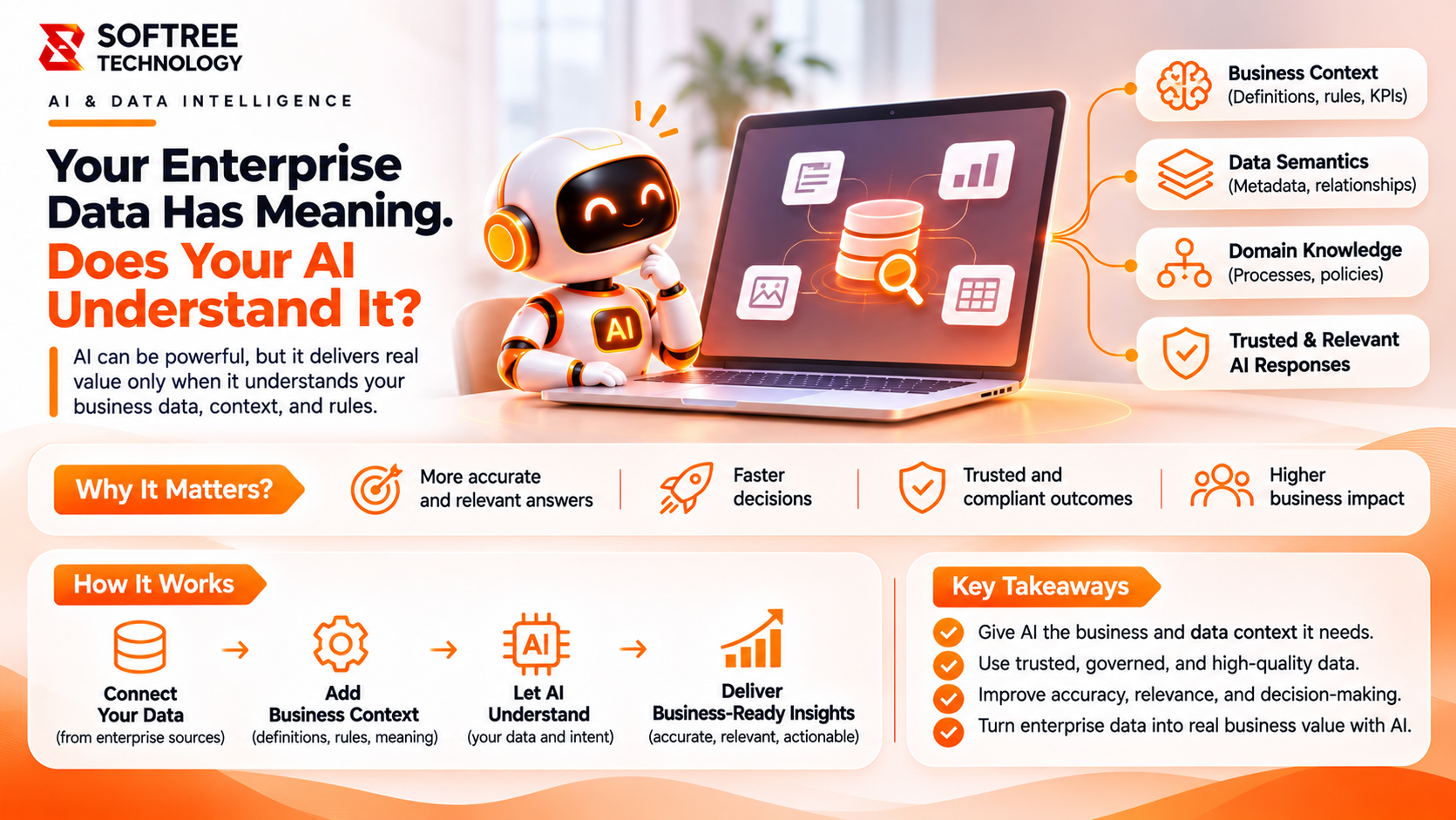
Enterprise AI can retrieve rows, summarize reports, and generate answers from data. Yet a technically correct response can still be misleading if the system does not understand what a business term means, how entities relate, or which metric definition the organization trusts.
Consider a question such as, “Which customer accounts are at risk?” The answer depends on the organization's definition of customer, risk, account status, time window, and relevant indicators. These concepts may be spread across operational systems, lakehouse tables, reports, and business rules. Without shared context, an AI agent may infer relationships or calculations that do not align with the enterprise's meaning.
Microsoft Fabric IQ is designed to bring business context to enterprise data. It connects data foundations with curated analytics and business concepts so people and AI experiences can reason using a more consistent vocabulary.
Key Takeaways
Fabric IQ brings together capabilities such as OneLake, Power BI semantic models, and ontology-based operational context to help analytics and AI experiences understand enterprise data in business terms. Semantic models provide governed measures and relationships, while ontology can represent explicit business entities, properties, relationships, and rules.
However, business context does not automatically guarantee accurate AI responses. Data quality, freshness, governance, permissions, and validation remain essential.
What We Learned
What Is Fabric IQ?
Fabric IQ is a set of related capabilities within Microsoft Fabric that elevates data into business language.
Rather than treating every table and column as isolated technical objects, it helps define and reuse concepts such as Customer, Shipment, Asset, Order, or Breach, including their properties, relationships, metrics, and rules.
The intention is to make context reusable across analytics, applications, and AI agents.
Fabric IQ should be viewed as a context layer and collection of capabilities—not as a replacement for data engineering, data quality, access controls, or business ownership.
The Context Layers: From Unified Data to Business Concepts
OneLake: A Unified Data Foundation
OneLake provides the shared data foundation. Data may be brought together or made available through Fabric patterns such as shortcuts and mirroring, subject to architecture and source constraints.
A unified foundation can reduce fragmentation, but it does not resolve conflicting business definitions by itself. Data ownership, lineage, access, and quality remain essential.
Power BI Semantic Models: Curated Measures and Relationships
Semantic models provide business-facing analytics structures, including measures, dimensions, hierarchies, and relationships.
They are especially valuable when an organization already has trusted KPI definitions.
For example, “Net Revenue” should be represented by a governed measure rather than independently recalculated by each report or agent.
Ontology: Explicit Business Entities and Relationships
An ontology represents business concepts in a machine-understandable form.
It can define:
- Entity types and properties.
- Relationships between business entities.
- Rules and metrics.
- Mappings to enterprise data.
This helps bridge the gap between physical schemas and how the business describes its operations.
Microsoft documents ontology in Fabric IQ as a preview capability. Teams should assess current availability, limitations, and production suitability before relying on it for critical workloads.
How Business Context Can Improve AI Reasoning
With a shared context layer, an agent can be grounded in governed definitions rather than relying only on prompt instructions or schema names.
A Shipment concept might relate to a Customer, Carrier, Route, and Delivery Event.
A metric such as On-time Delivery Rate can reference an agreed calculation. Rules can specify which statuses count as delivered, which time zone applies, and what qualifies as a breach.
This does not mean an agent becomes infallible. Context improves the basis for interpretation, but answers still require validation, permission-aware access, traceability, and appropriate human review—especially when an answer could trigger an operational decision.
Illustrative Enterprise Scenario: Shipment Exception Analysis
Imagine a distribution organization that wants to ask:
“Which shipments are likely to miss their delivery commitment, and what should the operations team investigate?”
This is an illustrative scenario, not a customer case study or a report of measured results.
The workflow could look like this:
- The data foundation provides shipment events, carrier details, customer commitments, and operational records in Fabric-accessible data sources.
- A semantic model defines approved measures such as on-time delivery rate, backlog, and exception counts.
- An ontology describes Shipment, Customer, Carrier, Route, and Delivery Commitment, along with their relationships and relevant rules.
- A data agent or another AI experience uses the governed context to answer questions, identify related entities, and explain which metrics or records support the response.
- An operations user validates the explanation and decides whether to investigate, escalate, or take an approved action.
The practical value is not simply a more fluent answer. It is the possibility of an answer that reflects the organization's own concepts, approved metrics, and relationships—and can be checked against its sources.
A Practical Implementation Approach
Organizations can begin with a bounded business domain rather than modeling the entire enterprise at once.
- Start with a specific business question and decision.
- Identify authoritative data sources, owners, refresh expectations, access restrictions, and known quality issues.
- Reuse existing Power BI semantic models where they already contain trusted measures and relationships.
- Define core ontology concepts, including entity types, properties, relationships, rules, and metrics.
- Bind concepts to supported Fabric data sources and verify mappings.
- Connect an eligible agent or analytical experience to the context and configure permissions.
- Test representative questions, ambiguous terms, missing data, conflicting records, and restricted-user scenarios.
- Release incrementally, monitor answer quality and data freshness, and manage changes to models and ontology definitions.
Validation and Governance: Context Must Be Trustworthy
A context layer should be treated as a governed product.
Validation should include semantic consistency, source mapping correctness, relationship integrity, measure reconciliation, access control, and change impact.
Recommended validation checks include:
- Metric reconciliation: Compare agent-referenced values with approved semantic-model measures.
- Entity mapping: Verify that each business entity binds to the intended source fields and records.
- Relationship checks: Test cardinality, missing links, and unexpected joins.
- Terminology checks: Ensure synonyms and ambiguous labels resolve consistently or prompt clarification.
- Permission checks: Confirm answers do not reveal data beyond the user's authorized scope.
- Freshness and lineage: Communicate when source data was last updated and maintain traceability.
- Change regression: Re-run a question suite after updates to semantic models, ontology, source mappings, or agent instructions.
Architecture Considerations and Common Pitfalls
- Do not confuse a semantic model with a complete ontology. Curated measures and relationships are valuable, while explicit business concepts and operational rules may require additional modeling.
- Avoid duplicating KPI logic across reports, prompts, and agent instructions. Reuse governed definitions wherever possible.
- Do not model every concept before proving value in a focused domain.
- Treat preview capabilities carefully. Confirm support, limitations, licensing, and production guidance against current Microsoft documentation.
- Preserve data security and governance across the context layer. A shared vocabulary should not imply broad access to underlying records.
- Keep business stakeholders involved. Technical teams can implement mappings, but domain experts must validate meaning.
What Success Should Look Like
Instead of promising an arbitrary accuracy improvement, define measurable acceptance criteria for the selected domain.
Examples include:
- Agreement with approved KPI calculations.
- Percentage of questions answered with traceable supporting data.
- Resolution rate for ambiguous terminology.
- Successful permission tests.
- Time required for a business analyst to validate an answer.
Establish a baseline and evaluate results with a representative question set before expanding.
Next Steps: AI Needs a Shared Language for the Business
Enterprise data is valuable because it describes the business—not merely because it is stored in tables.
Fabric IQ brings together a unified data foundation, curated semantic models, and ontology-based context to help analytics and AI experiences interpret information in business terms.
The strongest implementations combine explicit business definitions, high-quality and governed data, careful architecture, disciplined validation, and human accountability.
Softree Technology helps organizations explore Microsoft Fabric, Power BI, enterprise data architecture, and AI-powered analytics initiatives.
Planning to make your enterprise data more AI-ready? Connect with Softree Technology to explore how governed business context can support more reliable AI experiences.
https://www.softreetechnology.com/services/microsoft-fabric-development-services