Introduction
Power Apps are moving beyond traditional screens, forms, and workflows toward applications that can understand requests, access business context, and take actions. This shift changes how applications need to be designed. Adding an AI agent is not simply about adding a conversational interface; the application also needs reliable business data, controlled actions, security, governance, monitoring, and a clear deployment strategy.
Quick Answer
AI-enabled Power Apps combine the familiar Power Apps experience with an AI agent layer that can understand user requests, retrieve relevant business information, and initiate approved actions. Copilot Studio can provide agent orchestration, Dataverse can provide structured business context, and Power Automate can execute workflows and business processes. For production use, these capabilities should be supported by appropriate permissions, human approval where required, monitoring, and application lifecycle management.
Why Power Apps Architecture Is Changing
A traditional Power App generally relies on predefined screens, forms, business rules, and workflows. Users navigate through the application to find information, update records, and initiate processes. This works well for predictable processes, but users increasingly expect applications to understand what they need without requiring them to know every step of the underlying workflow.
An AI agent introduces an interpretation layer. A user can describe a business requirement in natural language, and the agent can determine which information is relevant and which approved action should be performed. For example, a sales employee could ask, “Show me overdue customer accounts and create follow-up tasks for accounts over $50,000.” The agent can interpret the request, retrieve relevant data, apply business logic, and initiate an appropriate workflow.
Microsoft's current Copilot Studio architecture guidance also emphasizes defining the agent's dependencies, integrations, security, governance, performance, and lifecycle as part of the overall solution architecture.
What Role Does Each Power Platform Component Play?
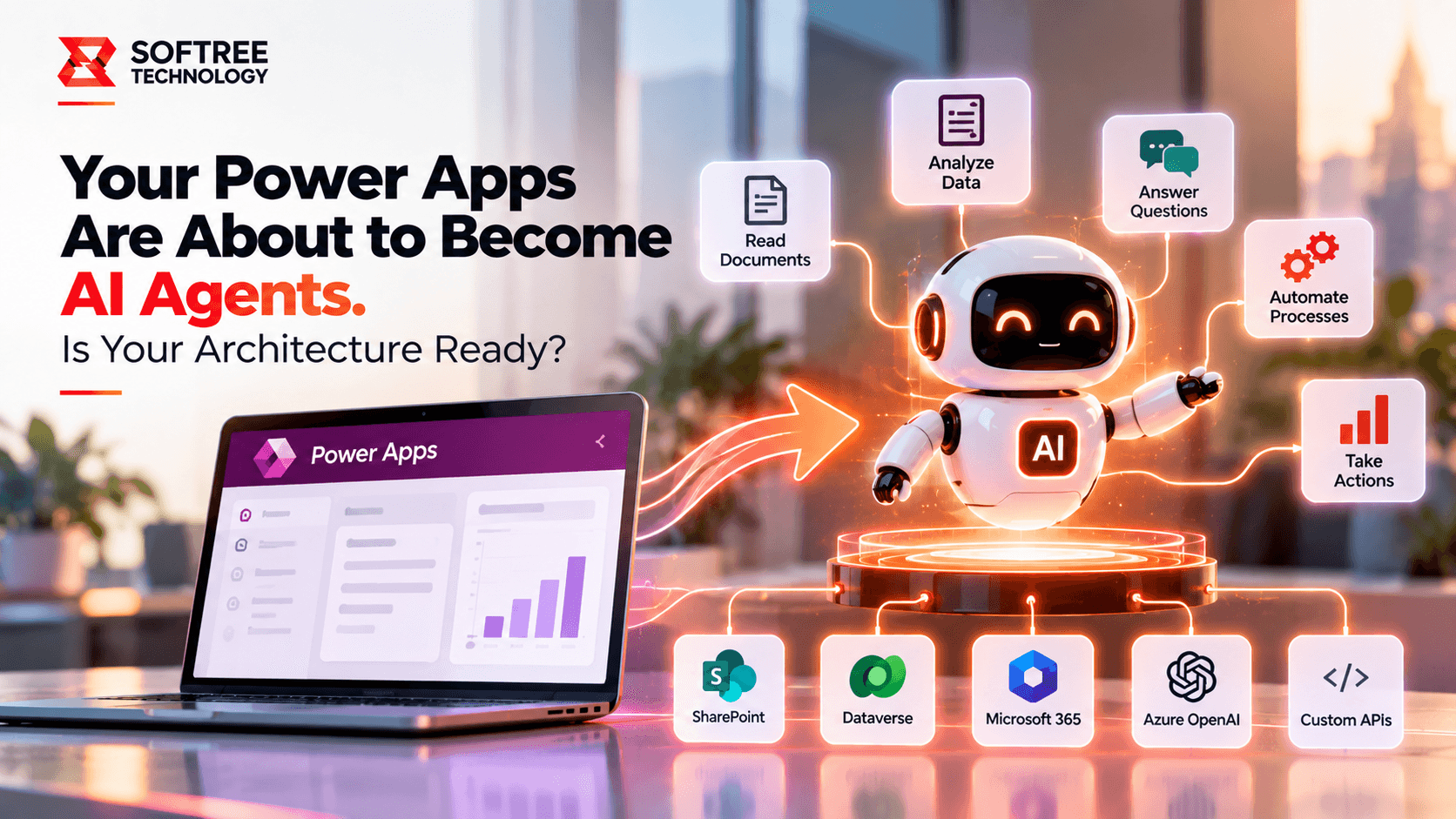
Power Apps remains the application experience where users interact with business information and processes. Copilot Studio adds the AI agent capabilities, including orchestration, knowledge, and actions. Dataverse provides structured business data and relationships that can give the agent relevant context.
Power Automate connects the agent to workflows, approvals, notifications, and business actions. APIs and connectors can extend the application to external enterprise systems, while identity and access controls help determine what users and agents can access. Monitoring and analytics provide visibility into application usage, performance, and agent behavior.
This approach is also reflected in Microsoft's reference architectures, which show Copilot Studio agents working with Power Apps, Dataverse, Power Automate, APIs, and external business systems for different application scenarios.
What Problem Does an AI Agent Solve?
The main value of an AI agent is not simply answering questions. It is helping users move from understanding information to completing a business task.
Consider a sales application. A salesperson may open a customer record and ask why revenue has declined and what action should be taken next. The agent can use customer and opportunity information from Dataverse, apply relevant business knowledge, provide an analysis, and then use Power Automate to create a task or notify a sales manager.
The important architectural principle is that the agent should not become an unrestricted user of the organization's data. Its knowledge sources, tools, permissions, and actions should be clearly defined.
When Should You Use AI Agents in Power Apps?
AI agents are useful when employees frequently ask questions about business data, processes involve multiple steps or systems, users need contextual recommendations, or workflows contain variable decision paths. They can also be useful when employees repeatedly search for information or perform actions across different systems.
However, not every Power App needs an AI agent. A simple form, button, or deterministic workflow may already solve the problem effectively. If a process follows fixed rules and does not require interpretation or contextual decision-making, introducing AI can add unnecessary complexity. The source recommends using AI where interpretation, context, or dynamic action selection provides meaningful value while keeping deterministic business rules deterministic.
How Do You Prepare a Power App for Production AI?
Production readiness should be considered from the beginning rather than after the agent has been built. The business use case and the agent's responsibilities should be clearly defined, and the Dataverse data model and backend integrations should be reviewed.
Security should cover authentication, least-privilege access, sensitive data protection, and data-loss-prevention and connector policies. The AI layer should have tested instructions, validated knowledge sources, explicitly defined actions, and human escalation when necessary.
Operational readiness is equally important. Teams should test failure scenarios, monitor performance, establish feedback processes, and separate development, testing, and production environments. Solution-based ALM and a documented deployment process can help maintain consistency as the application evolves.
Microsoft's current architecture guidance similarly emphasizes security, reliability, operational excellence, performance, and continuous improvement when designing and operating Power Platform and Copilot Studio workloads.
A Practical Production Example
Imagine a Power Apps sales application used by a distributed sales team. Instead of manually searching customer records, opportunity history, and previous activities, a salesperson can ask the agent for an explanation of a revenue decline.
The agent retrieves the relevant information from Dataverse, evaluates the available business context, and produces a recommendation. If the next step requires an operational action, Power Automate can create a follow-up task or notify the appropriate manager. This keeps the conversational experience inside Power Apps while connecting the AI capability to defined business data and controlled workflows.
Microsoft also documents reference architectures where Copilot Studio agents work with Power Platform components and external systems to support business processes, demonstrating that agent capabilities can be integrated into broader application and automation environments.
Production Readiness Checklist
Before deploying an AI-powered Power App, teams should confirm that the business use case is clearly defined, agent responsibilities are scoped, data sources are reliable, permissions are appropriate, actions are explicitly defined, sensitive information is protected, monitoring is enabled, failure scenarios have been tested, and development, testing, and production environments are properly separated.
As an offshore engineering partner, Softree provides India-based Power Platform engineering teams that can support development, testing, delivery, modernization, and ongoing optimization.
Explore Softree's Power Platform Development Services:
https://www.softreetechnology.com/services/offshore-power-platform-development