Introduction
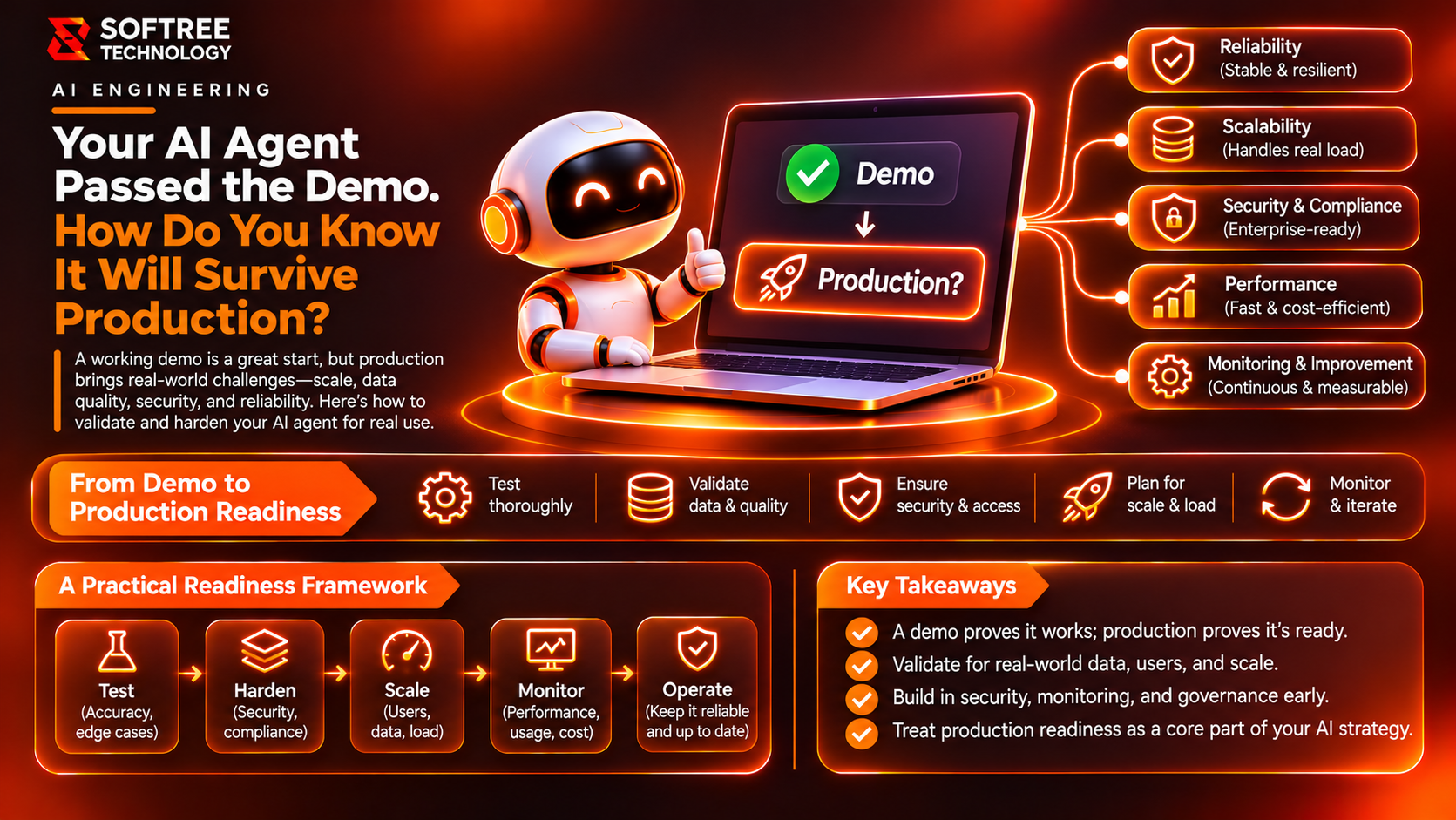
An AI agent may perform impressively during a demonstration. It answers prepared questions, retrieves information, and calls the right tools. But production introduces different users, incomplete inputs, unexpected requests, API failures, and multi-step tasks.
A successful demo proves that an agent can work in a controlled scenario. It does not prove that it will behave consistently, safely, or accurately at scale. Amazon Bedrock AgentCore Evaluations helps teams assess agent behavior before and after deployment.
Key Takeaways
Amazon Bedrock AgentCore Evaluations provides built-in and custom evaluators to assess AI agent interactions. Teams can use on-demand evaluations to investigate selected interactions and online evaluations to assess sampled production traffic. Sessions, traces, and spans help identify where failures occur, supporting continuous quality improvement without guaranteeing error-free agents.
What We Learned
1. Why a Successful Demo Is Not Enough
Demonstrations typically cover a limited set of expected requests. Real users introduce different wording, missing information, ambiguous instructions, and tasks requiring multiple tool calls.
An agent may sound convincing while selecting the wrong tool, skipping an action, or reporting success when an external system failed.
Production testing must examine:
- Whether the agent understood the user's goal.
- Whether it selected the appropriate tool.
- Whether it used returned information accurately.
- Whether the requested task was actually completed.
2. How Amazon Bedrock AgentCore Evaluations Works
AgentCore Evaluations helps teams assess agent behavior using execution data.
- Sessions: Group related interactions.
- Traces: Record an agent execution.
- Spans: Represent individual operations, including model calls and tool invocations.
- Built-in evaluators: Assess common dimensions such as correctness, helpfulness, and tool selection.
- Custom evaluators: Apply application-specific instructions and business rules.
These components help teams investigate overall outcomes and identify specific points of failure.
3. On-Demand vs. Online Evaluation
AgentCore Evaluations supports two evaluation approaches.
On-demand evaluation
Use it to:
- Investigate a reported interaction.
- Validate a prompt or model change.
- Review selected traces.
- Perform regression checks after updates.
Online evaluation
Use it to:
- Assess sampled production interactions.
- Monitor quality trends after deployment.
- Identify recurring failure patterns.
- Support continuous agent improvement.
Combining both approaches supports development testing and post-deployment monitoring.
4. Example: Evaluating an AI Customer Support Agent
Consider an AI customer support agent that answers order questions, checks delivery status, and initiates eligible service requests.
Evaluation can examine whether the agent:
- Understands the customer's request.
- Selects the correct order lookup tool.
- Uses returned information accurately.
- Completes the requested task.
- Confirms an action before reporting success.
For a refund request, the system should verify that the refund action was successfully completed before the agent communicates confirmation.
This approach evaluates actual task execution rather than relying only on the quality of the agent's response.
5. Four Things to Get Right Before Production
Test realistic scenarios: Build representative datasets covering normal requests, ambiguous inputs, edge cases, and multi-step tasks.
Measure relevant dimensions: Assess correctness, response quality, faithfulness, instruction following, tool selection, and goal completion where applicable.
Add business-specific evaluators: Create custom checks for approval rules, required fields, prohibited actions, and application-specific requirements.
Monitor after deployment: Review sampled production interactions, investigate low-scoring results, and re-evaluate after changing prompts, models, tools, or workflows.
6. Evaluation Is Not the Entire Testing Strategy
AgentCore Evaluations supports agent quality assessment, but it does not replace:
- Functional testing.
- Security reviews.
- Access controls.
- Load and performance testing.
- Human approval for high-impact actions.
- Failure recovery and rollback procedures.
A production-ready AI agent requires these controls alongside evaluation.
Next Steps
Start by defining success criteria for important agent workflows and building a representative test dataset.
Run on-demand evaluations during development and before releases. After deployment, configure online evaluation for relevant production traffic, investigate recurring failures, and improve the agent based on observed behavior.
Softree Technology helps organizations design, evaluate, and improve AI-powered workflows with practical integrations, appropriate controls, and measurable quality objectives.
Ready to evaluate your AI agent before scaling? Connect with Softree Technology to explore AI agent development and evaluation strategies.
https://www.softreetechnology.com/solutions/ai-agents-development