Introduction
Not every AI request needs the most powerful or expensive model. A short summarization task, a customer question, and a complex reasoning workflow can have very different requirements for quality, latency, and cost. Sending every request to the same premium model can increase AI spending without necessarily improving the result.
Microsoft Foundry Model Router provides a way to route requests across an eligible pool of AI models, helping organizations select an appropriate model based on their workload requirements.
The key question for enterprise AI teams is not simply which model is best, but which model is best for each request.
Key Takeaways
Model routing can help organizations manage multi-model AI workloads without building separate routing logic for every application. Microsoft Foundry Model Router provides routing modes such as Balanced, Cost, and Quality, allowing teams to make model-selection decisions based on their priorities.
Key points include:
- Not every request requires the same model capability.
- Different workloads can have different quality, latency, and cost requirements.
- Model Router can simplify access to multiple eligible models.
- Routing should be evaluated using representative enterprise workloads.
- Cost savings and performance improvements should be measured rather than assumed.
How Microsoft Foundry Model Router Works
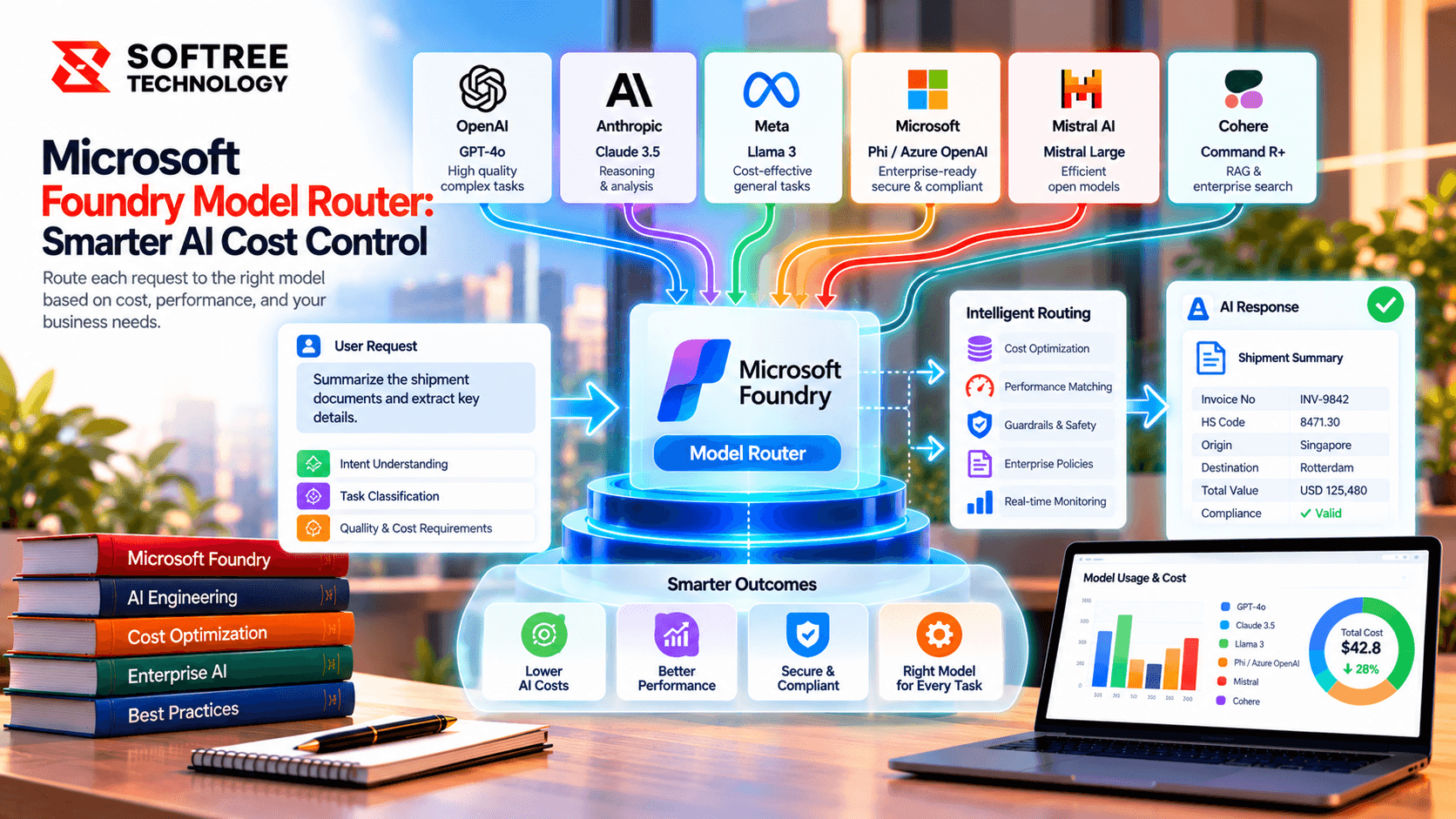
A typical application sends a request to the Model Router rather than directly selecting one model for every interaction. The router evaluates the request against the configured routing strategy and selects an eligible model.
The available routing modes allow teams to prioritize different objectives:
- Balanced: Provides a trade-off between quality and cost.
- Cost: Prioritizes more cost-conscious model selection.
- Quality: Prioritizes model capability and response quality.
This approach allows an organization to work with multiple models while keeping model-selection logic behind a common routing layer.
Why Model Routing Matters for Enterprise AI
Enterprise AI workloads are rarely uniform. A single application may handle simple classification, content generation, summarization, question answering, and complex reasoning.
Using one high-end model for every task can create unnecessary cost and latency. On the other hand, using a lower-cost model everywhere may affect response quality for tasks that require stronger reasoning.
Model routing introduces a more flexible approach by allowing the model choice to reflect the requirements of the request.
For example:
- Simple summaries may not require a premium reasoning model.
- Routine classification may prioritize cost and speed.
- Complex reasoning may justify a more capable model.
- Business-critical responses may require stronger quality controls.
Real-World Example
Consider an enterprise support application that receives thousands of employee requests.
A simple request such as summarizing an internal ticket may not require the same model capability as a complex request that requires reasoning across multiple pieces of business information.
With model routing, these requests can be handled through an appropriate routing strategy rather than forcing every interaction through the same model.
The objective is not simply to use cheaper models. It is to find an appropriate balance between response quality, latency, and cost for the workload.
What We Learned
Model routing is most useful when an organization has multiple AI workloads with different requirements. Before implementing it, teams should evaluate representative prompts and establish measurable baselines.
Important evaluation areas include:
- Response quality
- Latency
- Token consumption
- Request cost
- Error rates
- User satisfaction
- Model selection consistency
Model Router does not guarantee lower costs or better answers. Its value depends on the models available, routing configuration, workload characteristics, and evaluation criteria.
Next Steps
Organizations considering Microsoft Foundry Model Router should start by identifying workloads where model requirements vary. Test representative requests across eligible models and compare quality, latency, and cost before moving routing decisions into production.
Softree Technology helps businesses design and build enterprise AI architectures across Azure, AWS, data platforms, integrations, security, governance, and agentic AI. We can help evaluate where model routing fits into your AI architecture and design an approach aligned with your workload requirements.
https://www.softreetechnology.com/