Executive Summary
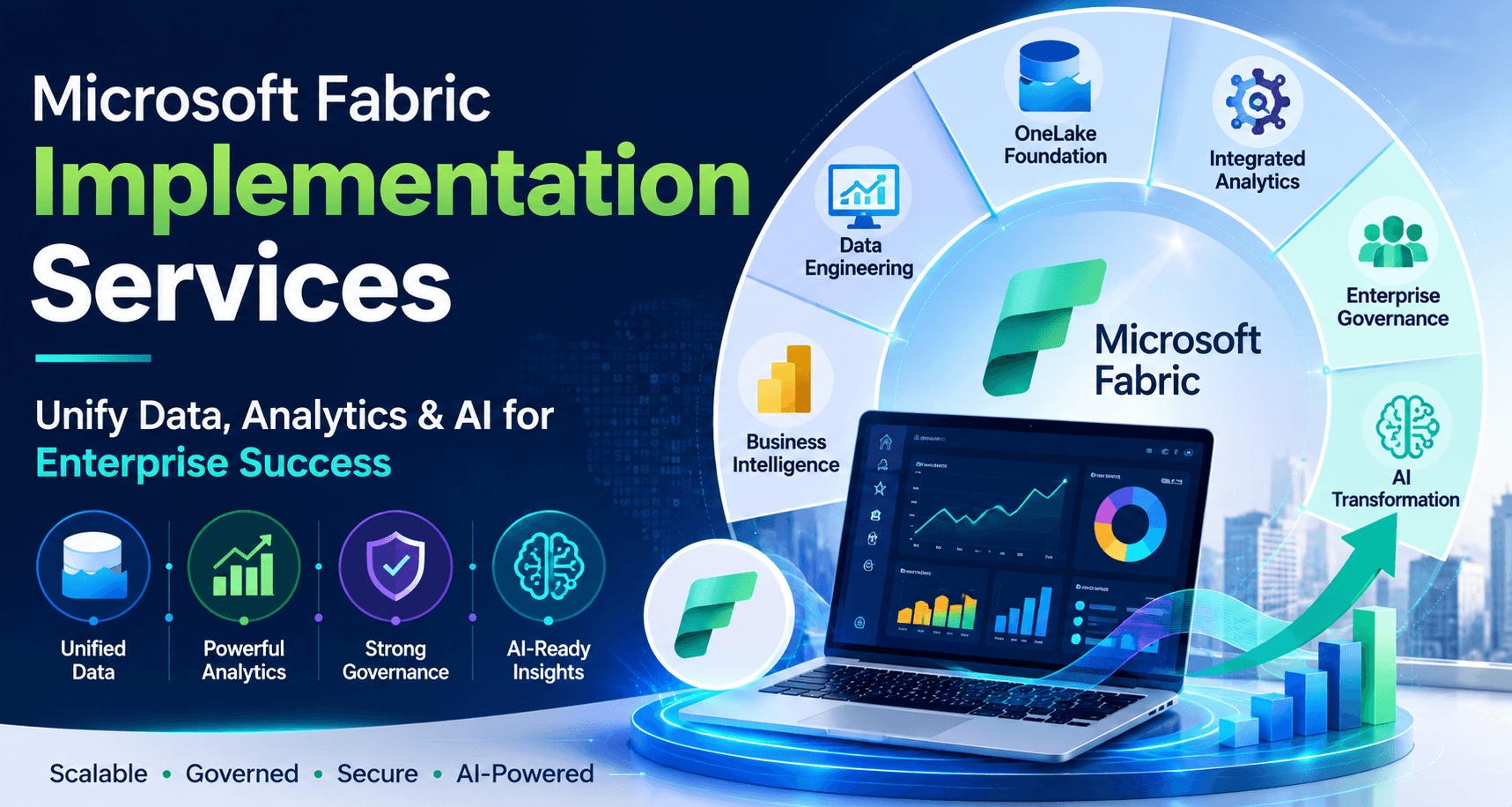
Microsoft Fabric Implementation Services enable enterprises to unify analytics, governance, data engineering, and AI workloads within a single SaaS ecosystem. By leveraging OneLake and an integrated analytics architecture, organizations can reduce complexity, improve data quality, and accelerate business innovation.
Introduction
Microsoft Fabric Implementation Services have become a strategic priority for organizations seeking to modernize their analytics ecosystem and unlock business value from data. Traditional data platforms often require multiple disconnected tools, creating complexity, governance challenges, and increased operational costs. Microsoft Fabric addresses these challenges through an integrated data platform that unifies data engineering, analytics, governance, and AI capabilities.
Organizations working with an experienced Microsoft Fabric Partner can accelerate deployment, reduce implementation risks, and maximize return on investment. This guide explains the enterprise adoption framework, implementation strategy, best practices, and business benefits of Microsoft Fabric.
Business Challenges Facing Modern Enterprises
Many enterprises struggle with fragmented data architectures, inconsistent reporting, limited governance visibility, and complex integrations between multiple analytics tools. Common challenges include:
• Data silos across business units
• High infrastructure and maintenance costs
• Slow reporting and analytics cycles
• Limited data governance and compliance visibility
• Difficulty scaling AI and machine learning initiatives
• Complex integration between analytics platforms
These challenges prevent organizations from becoming truly data-driven and limit their ability to generate actionable insights.
Benefits & ROI
Organizations adopting Microsoft Fabric Implementation Services typically achieve:
• Faster analytics delivery and reporting
• Reduced platform and operational costs
• Improved data quality and governance
• Accelerated AI and machine learning initiatives
• Enhanced collaboration across business teams
• Better decision-making through real-time insights
• Simplified analytics architecture
ROI is often realized through reduced licensing complexity, lower infrastructure management overhead, improved productivity, and faster time-to-insight.
Microsoft Fabric Implementation Strategy
Microsoft Fabric provides an end-to-end analytics platform built around OneLake, enabling organizations to unify data storage, processing, governance, and analytics.
Key implementation objectives include:
• Establishing a centralized data foundation with OneLake
• Creating scalable data engineering pipelines
• Enabling enterprise-wide analytics and reporting
• Implementing robust data governance controls
• Supporting AI transformation initiatives
• Reducing operational complexity through platform consolidation
A structured Microsoft Fabric implementation strategy ensures alignment between business goals, technical architecture, governance requirements, and future scalability.
Key Benefits and Business ROI
Organizations gain faster reporting cycles, lower infrastructure costs, stronger governance, improved collaboration, AI readiness, and better decision-making capabilities.
Enterprise Use Cases
1. Enterprise Data Warehousing
Centralize enterprise data assets and support large-scale reporting.
2. Customer Analytics
Create unified customer views for personalization and customer experience optimization.
3. Financial Analytics
Improve forecasting, budgeting, and operational reporting.
4. Supply Chain Intelligence
Monitor inventory, logistics, and operational performance in real time.
5. AI Transformation Programs
Build governed data foundations that support machine learning and generative AI initiatives.
6. Regulatory Compliance & Governance
Implement enterprise-grade governance, security, and compliance controls.
Best Practices
Establish governance early, standardize data models, implement security controls from day one, adopt phased deployments, and continuously optimize workloads based on business outcomes.
Implementation Approach
Phase 1: Assessment & Strategy
Evaluate existing analytics architecture, business goals, and governance requirements.
Phase 2: Architecture Design
Design scalable data platform architecture, integration patterns, and governance controls.
Phase 3: Data Migration & Integration
Migrate data assets and establish automated data integration pipelines.
Phase 4: Analytics & Reporting Enablement
Deploy dashboards, reporting solutions, and self-service analytics capabilities.
Phase 5: Governance & Security
Implement enterprise governance, monitoring, compliance, and security frameworks.
Phase 6: Optimization & AI Readiness
Optimize workloads and prepare data foundations for advanced AI transformation initiatives.
Why Choose Softree Technology
Softree Technology delivers end-to-end Fabric deployment services, governance consulting, analytics modernization, and AI transformation support backed by proven implementation methodologies.
CTA
Accelerate your digital transformation journey with Softree Technology's Microsoft Fabric Implementation Services. Our experts help organizations design, deploy, govern, and optimize Microsoft Fabric environments that support enterprise analytics, data governance, and AI transformation initiatives.
Whether you are modernizing a legacy analytics platform, building a scalable data foundation, or preparing for enterprise AI adoption, Softree Technology delivers strategic guidance, technical expertise, and proven implementation methodologies that help maximize business value and long-term success.