Introduction
Modern enterprise applications rely heavily on APIs to connect microservices, databases, payment providers, authentication systems, CRM and ERP platforms, mobile applications, web applications, and third-party services. As these API ecosystems become larger and more interconnected, ensuring reliability, security, and consistent performance becomes increasingly important.
Traditional API automation provides reliable test execution, but creating comprehensive test scenarios, test data, assertions, and validation logic can still require significant manual effort. Generative AI introduces an opportunity to accelerate these activities by using API specifications, schemas, business rules, historical defects, and existing test cases as context for generating candidate tests.
Quick Answer
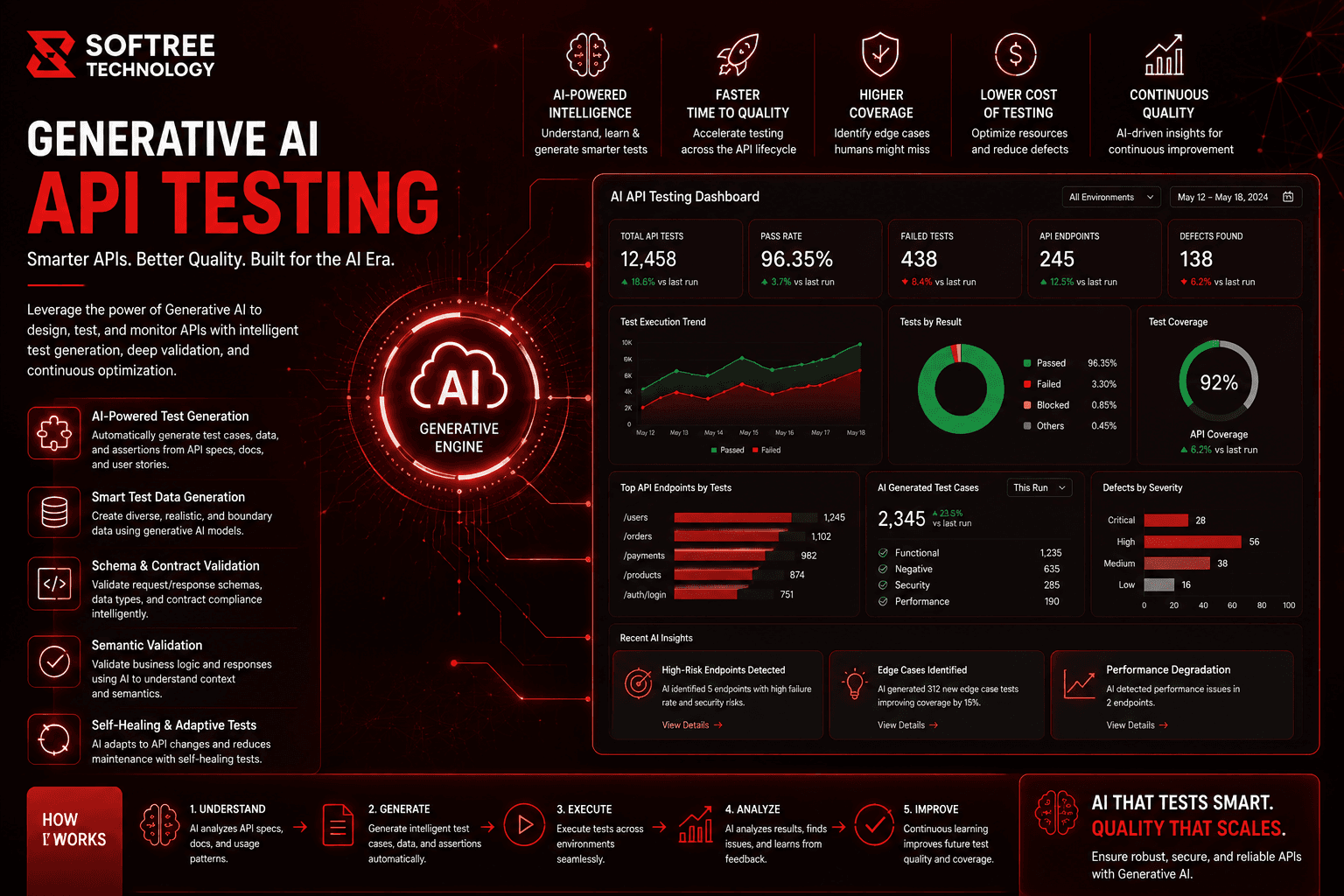
Generative AI for API testing uses AI models to generate test cases, scenarios, request payloads, test data, assertions, negative cases, boundary conditions, validation rules, and automation scripts. It can also assist with API failure analysis and defect detection. The strongest approach combines AI-assisted testing with traditional API automation and human QA review.
Table of Contents
- What Is API Testing?
- Why API Testing Is Becoming More Important
- What Is Generative AI for API Testing?
- How Generative AI Can Automate API Test Creation
- AI-Powered API Test Data Generation
- API Validation With Generative AI
- AI-Powered Defect Detection
- Generative AI for Negative API Testing
- Generative AI and API Security Testing
- Benefits of Generative AI for API Testing
- Challenges and Limitations
- How to Implement Generative AI for API Testing
- The Future of Generative AI for API Testing
- Conclusion
What Is API Testing?
API testing validates whether an API behaves as expected under different conditions. Testing can cover functional behavior, response validation, status codes, authentication, authorization, schema validation, error handling, boundary conditions, performance, negative scenarios, and security.
Because APIs sit at the center of many modern application architectures, failures in an API can affect multiple connected applications and business processes. As the number of endpoints and integrations increases, manually designing and maintaining comprehensive API tests becomes increasingly difficult.
Why API Testing Is Becoming More Important
Microservices, cloud applications, mobile platforms, and distributed enterprise architectures have increased the number of APIs organizations need to manage and test. An enterprise platform may expose hundreds or thousands of endpoints, with each endpoint supporting different methods, parameters, headers, authentication mechanisms, response structures, error conditions, and data combinations.
Traditional automation addresses test execution, but test creation can remain a bottleneck. Generative AI can help by generating candidate scenarios, test data, assertions, and validation logic from API specifications and available business context.
What Is Generative AI for API Testing?
Generative AI can analyze information such as OpenAPI or Swagger documentation, endpoint definitions, request and response schemas, authentication requirements, existing test cases, historical defects, and business rules. From this information, it can generate candidate test cases, scenarios, request payloads, test data, assertions, negative cases, boundary conditions, validation rules, and automation scripts.
This allows QA engineers to start with AI-generated candidates instead of creating every API test from scratch.
How Generative AI Can Automate API Test Creation
Consider an API that creates customer accounts. Traditional testing may require manually creating scenarios for valid customer creation, missing fields, invalid email addresses, duplicate customers, invalid phone numbers, maximum field lengths, empty requests, invalid authentication, and unsupported content types. Generative AI can analyze the API contract and generate a broader set of candidate scenarios for QA engineers to review and automate.
When an API specification defines requirements such as mandatory fields, email formats, country codes, and age limits, AI can generate both positive and negative scenarios around those rules. This can significantly accelerate the initial test-design process.
AI-Powered API Test Data Generation
Test data is often one of the most time-consuming parts of API testing. A single endpoint may require hundreds of combinations to test different business rules and edge cases. Generative AI can create structured data for valid requests, invalid requests, boundary values, randomized scenarios, negative cases, data combinations, and edge cases.
For an order API, for example, AI can generate combinations involving product quantities, currencies, discounts, tax rates, customer types, shipping locations, and payment methods. AI can also identify useful boundary values instead of simply generating random values.
API Validation With Generative AI
API testing involves more than checking whether a request returns HTTP 200. Responses may contain multiple fields and business relationships that need to be validated. Generative AI can help identify additional assertions and relationships that may not be captured by simple predefined checks.
For example, an order API may return product details, quantity, price, tax, discount, and total amount. AI can suggest validating whether the total amount is consistent with these values according to the applicable business rules. This extends API validation beyond basic status-code and field-level checks.
AI-Powered Defect Detection
API failures can generate status codes, response bodies, error messages, request payloads, headers, logs, and trace information. Generative AI can analyze this evidence, summarize the failure, and identify potential patterns or causes for QA engineers to investigate.
For example, if multiple order-creation tests begin returning HTTP 500 responses after a deployment and the failures are concentrated around international addresses, AI can highlight this pattern and help the QA team focus its investigation. Final defect diagnosis should still be verified by a human tester.
Generative AI for Negative API Testing
Negative testing verifies that APIs handle invalid and unexpected requests safely and predictably. Generative AI can suggest scenarios involving missing or invalid parameters, empty strings, null values, incorrect data types, oversized payloads, unsupported HTTP methods, invalid authentication, expired tokens, unauthorized access, duplicate requests, and malformed JSON.
These scenarios can help QA teams uncover weaknesses in error handling and validate how APIs respond when users or connected systems provide unexpected inputs.
Generative AI and API Security Testing
AI can also assist with generating candidate security scenarios around authentication, authorization, invalid credentials, expired tokens, access to another user's resources, excessive input, unexpected parameters, and improper error exposure.
For example, an API may successfully authenticate a user but fail to verify whether that user has permission to access a particular resource. AI-generated authorization scenarios can help testers identify and evaluate such possibilities. Security scenarios should always be reviewed before execution, particularly when testing production environments.
Benefits of Generative AI for API Testing
Generative AI can accelerate test creation by generating candidate scenarios much faster than creating every case manually. It can also increase scenario coverage by identifying positive, negative, boundary, and edge-case scenarios that testers may otherwise overlook.
It can reduce repetitive work around test payloads and assertions, speed up test-data generation, assist with failure analysis, simplify the analysis of large API specifications, and support shift-left testing by helping QA teams create tests earlier in the development lifecycle.
Challenges and Limitations
AI-generated tests still require human validation. A technically valid test may not represent an actual business requirement, while an AI model may occasionally infer a business rule that is not part of the API contract. QA engineers should therefore validate generated tests against authoritative requirements and API documentation.
Data privacy is another consideration because API testing may involve customer or business-sensitive information. Organizations should establish appropriate controls around the data provided to AI systems. Generated tests also require maintenance when APIs change, and not every scenario needs to be automated.
How to Implement Generative AI for API Testing
Start with high-value APIs that are business-critical, frequently changed, heavily integrated, difficult to test manually, and supported by strong documentation. Accurate OpenAPI, Swagger, or equivalent specifications provide useful context for generating meaningful test scenarios.
Use AI to generate positive tests, negative tests, boundary cases, validation scenarios, authentication tests, and error-handling scenarios. QA engineers should then review the generated tests against requirements, API specifications, business rules, and security requirements before approved scenarios are automated.
Once stable, integrate the automated tests into pull requests, builds, deployment pipelines, and regression cycles. Historical test failures can then provide additional context for future test generation and prioritization.
The Future of Generative AI for API Testing
API testing is moving toward increasingly intelligent and adaptive approaches. AI can already assist with test creation, data generation, validation, and failure analysis. As these capabilities become more integrated into development workflows, testing can become a continuous activity rather than a final stage before release.
A potential workflow is Requirement → API Design → AI Test Generation → QA Review → Automated Execution → Failure Analysis → Defect Detection → Regression Testing. The key will remain maintaining the right balance between AI automation and human QA expertise.
Key Takeaways
✓ Generative AI can accelerate API test-case and test-scenario creation.
✓ AI can generate test data, negative scenarios, boundary cases, and additional validation opportunities.
✓ AI can assist with API failure analysis and potential defect detection.
✓ Human QA review remains essential for validating AI-generated tests, business rules, security scenarios, and final results.
Conclusion
APIs have become a fundamental component of modern enterprise software, and the growing complexity of API ecosystems makes comprehensive testing increasingly important. Traditional API automation provides reliable execution, but creating and maintaining large test suites can require substantial effort.
Generative AI provides a way to accelerate API testing by helping teams generate test cases, create test data, identify negative scenarios, suggest validations, analyze failures, and support defect detection. When combined with established API automation frameworks, AI can help QA teams improve productivity and coverage while maintaining human oversight.
Transform API Testing With Softree Technology
Softree Technology helps organizations modernize QA and testing processes using AI, automation, API testing, Microsoft technologies, and enterprise quality engineering practices. From automated API validation and test automation to AI-assisted testing strategies, Softree can help organizations build scalable approaches for improving software quality and accelerating delivery.