Introduction
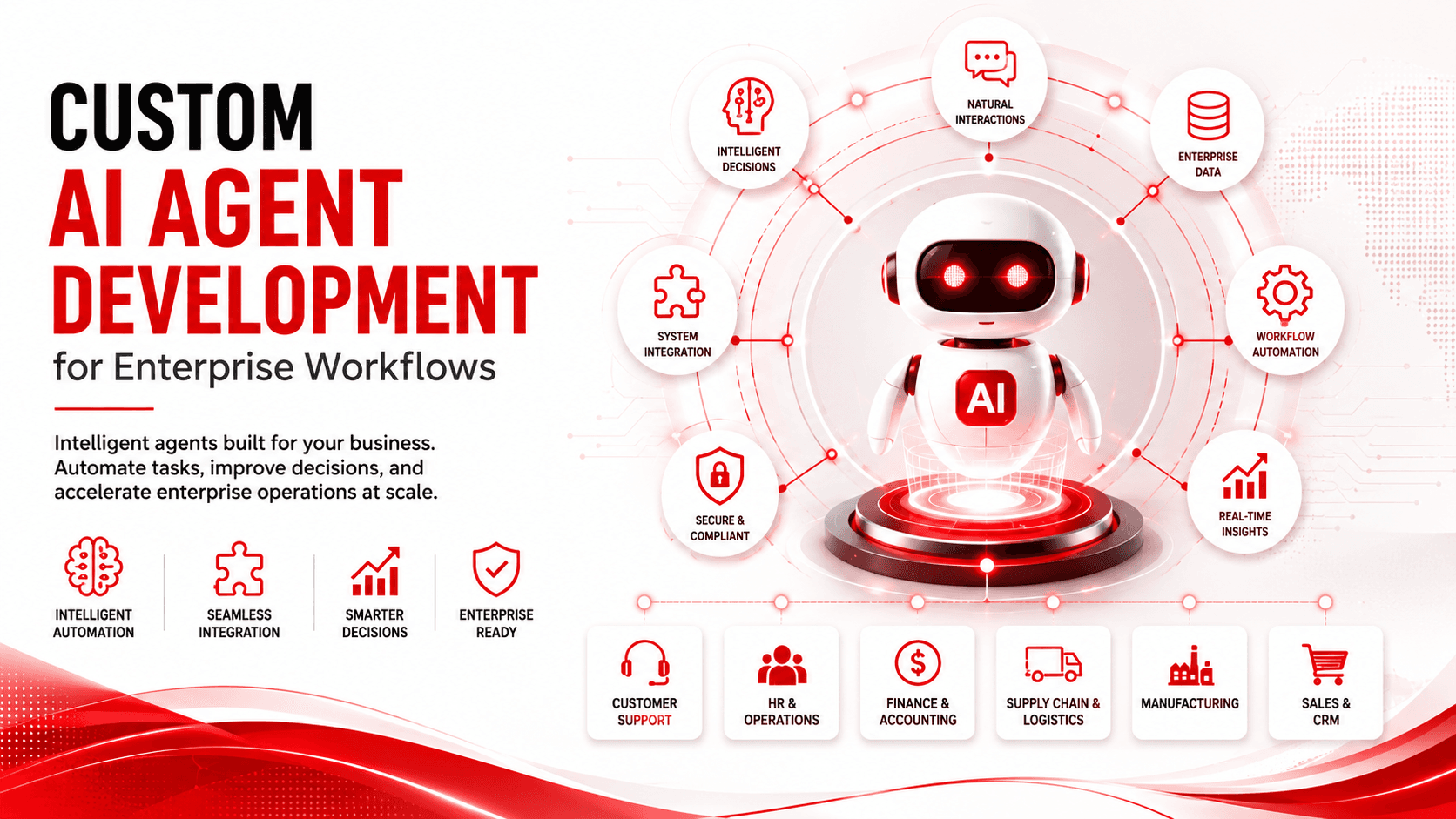
Artificial Intelligence is rapidly moving beyond simple automation and conversational chatbots. Enterprises today are investing in intelligent systems capable of understanding business context, making informed decisions, and executing complex tasks with minimal human intervention. At the center of this transformation are custom AI agents—purpose-built digital workers designed to automate enterprise-specific processes, interact with business applications, and continuously improve operational performance.
Unlike generic AI assistants that provide broad responses, custom AI agents are developed around an organization's unique business processes, industry requirements, compliance standards, and operational goals. They can access enterprise knowledge, integrate with existing systems, collaborate with employees, and execute workflows across multiple departments. Whether supporting customer service, finance, healthcare, logistics, or manufacturing, these agents enable organizations to scale operations while maintaining accuracy, consistency, and governance.
As digital transformation accelerates, enterprises are recognizing that competitive advantage no longer comes from deploying AI alone. It comes from designing AI agents that understand business objectives and work seamlessly alongside employees. Custom AI Agent Development provides organizations with the flexibility to create intelligent solutions that align with operational priorities, improve decision-making, and support sustainable business growth.
Why Enterprises Need Custom AI Agents
Most organizations already use enterprise applications such as ERP systems, CRM platforms, collaboration tools, and workflow automation solutions. While these technologies have improved efficiency, they often require employees to switch between multiple systems, manually collect information, and perform repetitive administrative work before business decisions can be made. As organizations grow, these disconnected processes become increasingly difficult to manage, creating operational bottlenecks and reducing productivity.
Custom AI agents solve this challenge by acting as intelligent digital employees that understand how an organization operates. Rather than following rigid predefined rules, they interpret business context, retrieve information from connected systems, analyze available data, and determine the most appropriate action based on organizational policies. Because they are built specifically for enterprise requirements, custom AI agents can support industry-specific workflows, regulatory compliance, and internal business logic that generic AI tools cannot easily accommodate.
Another reason enterprises invest in custom AI agent development is scalability. Off-the-shelf AI assistants are designed for broad use cases and often lack the flexibility needed to support complex operational environments. Custom-built agents can evolve alongside the business, integrating new data sources, adapting to changing workflows, and supporting additional departments without requiring organizations to redesign their entire technology landscape. This creates a long-term digital foundation that improves agility while maximizing the value of existing technology investments.
How Custom AI Agents Transform Enterprise Workflows
Custom AI agents transform enterprise workflows by connecting people, business applications, and operational processes into one intelligent execution layer. Instead of simply responding to user prompts, these agents proactively monitor business events, analyze operational data, recommend actions, and trigger workflows that accelerate business outcomes. They function as collaborative digital workers, supporting employees while automating repetitive activities across the organization.
For example, a customer inquiry can automatically trigger an AI agent that retrieves account information, checks order history, reviews inventory availability, drafts a personalized response, and initiates follow-up actions without requiring employees to manually access multiple systems. Similarly, in healthcare, AI agents can coordinate patient scheduling, verify insurance information, communicate appointment reminders, and assist operational teams in managing clinical workflows. Within finance, they can review invoices, validate purchase orders, detect anomalies, and route approvals based on predefined business policies.
Because custom AI agents integrate with enterprise platforms such as Microsoft Power Platform, Copilot Studio, Dynamics 365, Microsoft Fabric, Azure OpenAI, and other business applications, organizations gain a unified operational environment where data flows seamlessly between departments. Employees spend less time on administrative coordination and more time focusing on strategic initiatives, customer engagement, and innovation. The result is an intelligent enterprise where automation extends beyond individual tasks to support complete business processes, enabling faster decision-making, improved operational resilience, and a superior customer experience.
Business Benefits & ROI
Investing in custom AI agent development delivers value far beyond task automation. Organizations gain intelligent digital capabilities that improve operational efficiency, accelerate decision-making, and create a more agile business environment. By reducing repetitive administrative work, AI agents enable employees to focus on higher-value activities such as innovation, customer engagement, and strategic planning. This shift not only improves workforce productivity but also increases employee satisfaction by eliminating time-consuming manual processes.
Another major benefit is consistency. Unlike manual operations that may vary depending on individual experience or workload, custom AI agents execute business processes according to predefined policies and governance rules. This improves compliance, minimizes human error, and ensures standardized execution across departments and locations. Enterprises also benefit from real-time access to operational insights, allowing leaders to monitor workflow performance, identify bottlenecks, and make informed decisions using accurate business data.
From a financial perspective, custom AI agents reduce operational costs by automating repetitive workflows, shortening processing times, and improving resource utilization. Organizations often experience faster service delivery, better customer experiences, and improved return on technology investments because AI agents work seamlessly with existing enterprise systems rather than replacing them. As business requirements evolve, these agents can be expanded with new capabilities, ensuring long-term scalability and continuous operational improvement.
Enterprise Use Cases
Custom AI agents are transforming enterprise operations across industries by supporting business-specific workflows that require intelligence, coordination, and automation. In healthcare, they streamline patient scheduling, appointment reminders, care coordination, and administrative operations while improving patient experiences. Financial institutions use AI agents to automate customer onboarding, fraud detection, compliance verification, and loan processing with greater accuracy and speed. Manufacturing organizations deploy intelligent agents to monitor production environments, coordinate predictive maintenance, optimize inventory, and support quality management.
Logistics companies rely on AI agents to manage shipment tracking, warehouse operations, route optimization, and supplier coordination, enabling more resilient supply chains. Human resources teams automate recruitment, employee onboarding, policy assistance, and internal support requests, while customer service departments use AI agents to resolve inquiries, recommend solutions, and provide personalized support around the clock. Regardless of the industry, custom AI agents deliver measurable improvements by connecting people, processes, and enterprise systems into intelligent business workflows.
Best Practices for Successful AI Agent Development
Successful AI agent development begins with a clear understanding of business objectives rather than technology capabilities. Organizations should identify operational challenges where AI can deliver measurable value, such as reducing processing times, improving customer service, increasing productivity, or enhancing decision-making. Defining these outcomes early helps ensure that AI initiatives remain aligned with strategic business goals instead of becoming isolated technology projects.
Equally important is designing AI agents around enterprise workflows rather than forcing employees to adapt to new processes. The most effective solutions integrate seamlessly with existing ERP systems, CRM platforms, collaboration tools, document repositories, and business applications. This allows organizations to extend the value of their current technology investments while minimizing disruption during implementation.
Data quality and governance should also be considered from the outset. AI agents rely on trusted, well-managed enterprise data to produce accurate recommendations and automate business decisions. Establishing strong governance policies, role-based access controls, security measures, and compliance frameworks ensures that AI operates responsibly while protecting sensitive business information.
Organizations should also adopt a phased implementation strategy. Beginning with a high-impact business process allows teams to validate performance, gather user feedback, and refine capabilities before expanding AI agents across additional departments. Continuous monitoring, performance measurement, and ongoing optimization ensure that AI agents evolve alongside changing business requirements and continue delivering long-term operational value.
Conclusion
Custom AI Agent Development is helping organizations transform enterprise workflows by combining artificial intelligence with business-specific processes and enterprise systems. Rather than relying on one-size-fits-all AI solutions, businesses can build intelligent agents that automate repetitive tasks, support informed decision-making, improve operational efficiency, and scale alongside evolving business needs.
At Softree Technology, we help organizations design, develop, and deploy secure, enterprise-grade custom AI agents tailored to their unique workflows and business objectives. Leveraging technologies such as Microsoft Copilot Studio, Azure OpenAI, Power Platform, Microsoft Fabric, and Dynamics 365, our team delivers AI solutions that integrate seamlessly with existing systems while ensuring governance, scalability, and long-term business value.
Whether you're looking to streamline operations, enhance customer experiences, or accelerate your digital transformation journey, Softree Technology can help you build intelligent AI agents that drive measurable business outcomes and prepare your enterprise for the future.
Whether you're looking to streamline operations, enhance customer experiences, or accelerate your digital transformation journey, Softree Technology can help you build intelligent AI agents that drive measurable business outcomes and prepare your enterprise for the future.
Learn more: https://www.softreetechnology.com/
Contact us: https://www.softreetechnology.com/contact-us