Executive Summary
As organizations continue their digital transformation journey, enterprise automation has become a strategic priority rather than an operational convenience. Over the past decade, businesses have invested heavily in workflow automation, cloud platforms, ERP systems, CRM solutions, and artificial intelligence to streamline operations and improve productivity. While these investments have delivered measurable benefits, many enterprises still struggle with fragmented processes, disconnected applications, and isolated automation initiatives that fail to work together seamlessly.
This is where AI Workflow Orchestration is transforming enterprise operations. Instead of automating individual tasks, AI Workflow Orchestration connects people, AI agents, business workflows, enterprise applications, and data into one intelligent operational ecosystem. It enables organizations to coordinate complex business processes across multiple departments while making faster, context-aware decisions powered by artificial intelligence. From customer service and finance to healthcare, manufacturing, and logistics, enterprises are increasingly adopting orchestration platforms to improve agility, reduce operational costs, and deliver superior customer experiences.
Rather than viewing automation as a collection of isolated tools, modern organizations are building intelligent business ecosystems where AI continuously supports decision-making, automates repetitive activities, and coordinates workflows across the entire enterprise.
Why Enterprises Need AI Workflow Orchestration
Most organizations have already automated parts of their business. Finance teams use automated approval workflows, HR departments digitize employee onboarding, customer service teams deploy AI chatbots, and operations rely on ERP and CRM systems to manage daily activities. Although these technologies improve efficiency within individual departments, they often operate independently, creating disconnected processes that require manual intervention to complete end-to-end business operations.
For example, processing a customer order may involve multiple systems including sales, finance, inventory, logistics, and customer support. If each department uses separate workflows without orchestration, employees must manually transfer information between systems, monitor approvals, and coordinate activities across teams. This fragmented approach slows decision-making, increases operational costs, and reduces visibility into overall business performance.
AI Workflow Orchestration addresses this challenge by acting as the intelligence layer that connects enterprise systems, business processes, and AI-powered decision-making. Instead of simply following predefined rules, orchestrated workflows analyze business context, evaluate available information, and determine the most appropriate action before automatically executing tasks or involving employees when necessary.
This capability enables organizations to respond more quickly to changing business conditions while reducing repetitive manual work. Executives gain greater visibility into operational performance, managers can monitor workflows in real time, and employees spend less time coordinating administrative activities. As businesses continue to adopt cloud technologies, AI solutions, and connected enterprise platforms, orchestration provides the foundation needed to ensure these investments work together as a unified operational ecosystem rather than isolated technology projects.
Ultimately, AI Workflow Orchestration shifts organizations from task automation to intelligent business execution, enabling faster decisions, improved collaboration, and more resilient enterprise operations.
How AI Workflow Orchestration Transforms Business Operations
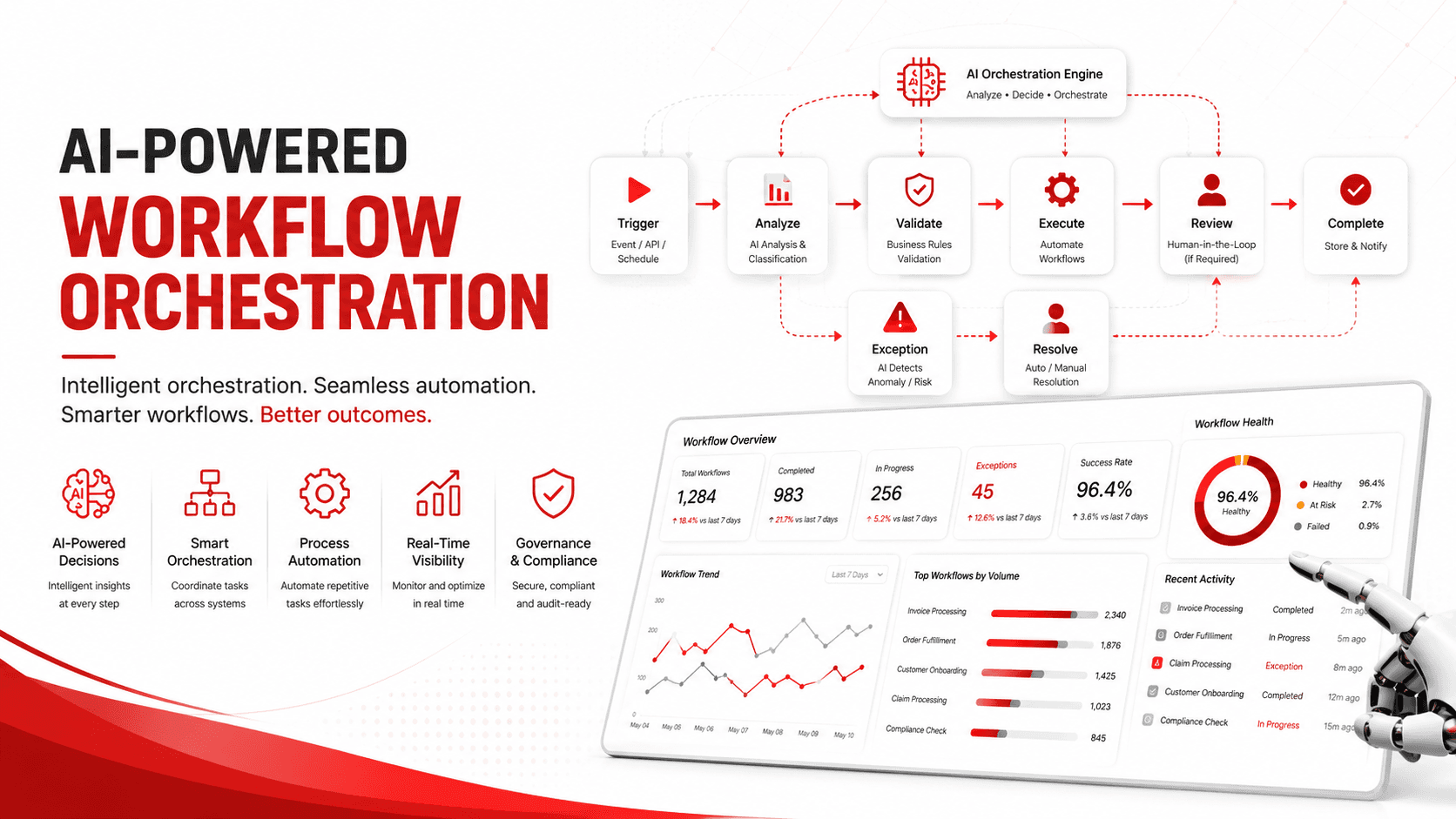
Unlike traditional workflow automation, which executes predefined sequences of tasks, AI Workflow Orchestration introduces intelligence throughout the entire business process. Every workflow begins with a business event, such as a customer placing an order, a patient scheduling an appointment, or an employee submitting a request. Instead of immediately triggering a fixed sequence of actions, the orchestration platform first gathers relevant information from connected enterprise systems, evaluates the current business context, and determines the most appropriate response using AI.
This intelligent approach enables workflows to adapt dynamically rather than relying on static rules. AI agents can analyse historical trends, assess operational priorities, identify potential risks, and recommend actions before executing business processes. When human expertise is required, workflows automatically route approvals to the appropriate stakeholders while continuing to monitor progress and coordinate downstream activities.
Another significant advantage of AI Workflow Orchestration is its ability to integrate multiple technologies into a single operational framework. Enterprise platforms such as Microsoft Power Automate, Copilot Studio, Dynamics 365, Microsoft Fabric, Azure OpenAI, and Power BI can work together seamlessly, allowing organizations to automate complex cross-functional processes while maintaining governance and compliance.
Beyond operational efficiency, orchestration creates a connected digital environment where business data continuously flows between departments. Executives receive real-time insights, operational teams gain complete visibility into workflow performance, and AI agents continuously improve recommendations based on previous outcomes. This combination of intelligent automation, enterprise integration, and continuous optimization enables organizations to build scalable digital operations capable of supporting future growth while responding rapidly to changing business requirements.
Business Benefits & ROI
AI Workflow Orchestration delivers measurable business value by connecting technology investments into a unified operational ecosystem. Instead of managing isolated automation initiatives across different departments, organizations gain an intelligent platform capable of coordinating workflows, enterprise applications, AI agents, and employees in real time. This integrated approach reduces operational complexity while improving business agility and decision-making.
One of the most significant advantages is improved operational efficiency. By eliminating repetitive manual coordination between systems and teams, organizations reduce processing times, minimize human errors, and accelerate business execution. Employees no longer spend valuable hours transferring information between applications or monitoring workflow progress manually. Instead, AI-powered orchestration continuously manages these activities while ensuring processes remain aligned with business policies and compliance requirements.
Organizations also benefit from enhanced customer experiences. Faster response times, personalized interactions, proactive communication, and intelligent service recommendations improve customer satisfaction across every touchpoint. Since workflows are connected across departments, customers experience consistent service rather than fragmented interactions caused by disconnected systems.
Enterprise Use Cases
AI Workflow Orchestration is already delivering measurable value across industries. Healthcare organizations coordinate patient scheduling, clinical workflows, hospital operations, and patient communication through intelligent automation. Financial institutions streamline loan approvals, fraud detection, compliance reviews, and customer onboarding while maintaining strict regulatory standards. Manufacturers orchestrate production planning, predictive maintenance, supplier collaboration, and inventory optimization to improve operational resilience. Logistics companies use AI-powered orchestration to optimize warehouse operations, transportation planning, shipment tracking, and route optimization, enabling faster deliveries and lower operational costs. Human resources teams automate recruitment, onboarding, employee support, and performance management, while sales and customer service departments orchestrate lead qualification, opportunity management, proposal generation, customer onboarding, and support workflows.
Beyond efficiency gains, orchestration provides executives with real-time visibility into business performance. Connected dashboards, predictive analytics, and AI-driven insights enable leadership teams to make informed strategic decisions while continuously identifying opportunities for optimization. The result is an enterprise capable of adapting quickly to changing business conditions while maximizing the return on existing technology investments.
Best Practices for Successful Implementation
Implementing AI Workflow Orchestration successfully requires a strategic business approach rather than simply deploying new technology. Organizations should begin by identifying high-value business processes that involve multiple departments, repetitive manual activities, and measurable business outcomes. Focusing on processes such as customer onboarding, procurement approvals, patient scheduling, financial operations, or supply chain coordination allows organizations to demonstrate early success while building confidence for broader enterprise adoption.
Business objectives should remain the primary driver of every orchestration initiative. Rather than automating activities for the sake of automation, organizations should define measurable outcomes such as reduced processing time, improved customer satisfaction, lower operational costs, faster approvals, or increased employee productivity. These objectives provide clear benchmarks for evaluating success and ensuring long-term business value.
Data quality and governance also play a critical role in AI-powered orchestration. AI agents depend on accurate, secure, and well-governed enterprise data to make reliable recommendations. Organizations should establish strong governance policies, role-based access controls, compliance monitoring, and data quality standards before expanding AI capabilities across the enterprise.
Finally, successful implementations recognize that AI complements human expertise rather than replacing it. Intelligent workflows should automate repetitive tasks while involving employees whenever strategic decisions, regulatory approvals, or complex exceptions require human judgment. This balanced approach builds trust in AI while enabling organizations to achieve greater operational efficiency without sacrificing governance, accountability, or business control.
Conclusion
AI Workflow Orchestration represents the next evolution of enterprise automation. As organizations continue investing in AI, cloud technologies, and digital transformation initiatives, the ability to connect people, processes, enterprise systems, and AI agents into one intelligent operational ecosystem will become a key competitive advantage. Rather than automating isolated tasks, orchestration enables businesses to create adaptive, data-driven operations that improve efficiency, accelerate decision-making, and deliver better customer experiences.
Rather than automating isolated tasks, organizations are building intelligent ecosystems where AI agents, workflows, enterprise applications, and employees collaborate to deliver measurable business outcomes. As operational complexity continues to increase, disconnected automation initiatives will no longer be sufficient. Future-ready enterprises require orchestration platforms capable of coordinating people, processes, systems, and AI in real time. Organizations that invest in AI Workflow Orchestration today establish the digital foundation needed to improve agility, strengthen resilience, optimize operations, and accelerate innovation for years to come.
Ready to Orchestrate Intelligent Enterprise Operations?
Modern enterprises need more than automation—they need connected, intelligent operations that adapt in real time.
At Softree Technology we help organizations design and implement enterprise AI solutions that combine AI Workflow Orchestration, AI Agents, Microsoft technologies, and intelligent automation to build scalable, future-ready business operations. Whether your goal is to modernize internal processes, improve customer engagement, or accelerate digital transformation, our team can help you develop an orchestration strategy that delivers measurable business value and long-term operational excellence.
Contact Softree Technology today to discover how AI Workflow Orchestration can transform your enterprise into an intelligent, connected, and future-ready organization.