Introduction
Enterprise applications continuously evolve as teams introduce new features, fix defects, modify APIs, update integrations, and change user interfaces. These changes can unintentionally affect functionality that was previously working correctly. Regression testing helps verify that existing functionality continues to work after application changes, but large enterprise applications can have thousands of test cases, making complete regression testing increasingly time-consuming and resource-intensive.
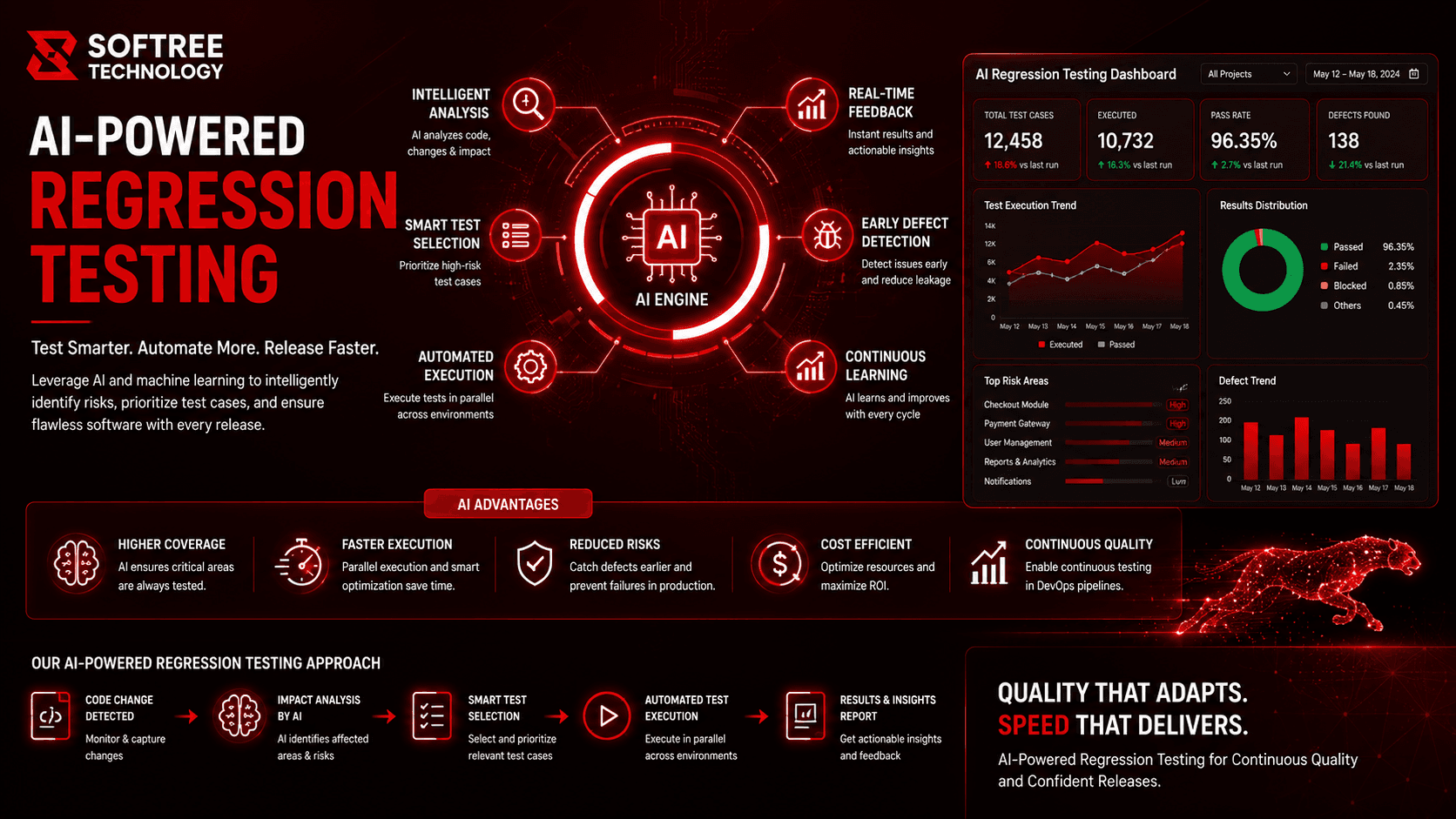
This blog explains how AI-powered regression testing can make testing more intelligent by analyzing application changes, historical test results, defect patterns, dependencies, business criticality, and test coverage.
Quick Answer
AI-powered regression testing uses artificial intelligence and machine learning to help teams determine which tests are most relevant to current application changes. Instead of executing every test equally, AI can prioritize high-risk tests, identify potential coverage gaps, analyze failure patterns, support test data generation, and assist with automation maintenance. The goal is not to eliminate regression testing but to make it smarter, more targeted, and aligned with application risk and business priorities.
Table of Contents
- What Is Regression Testing?
- Why Traditional Regression Testing Struggles at Enterprise Scale
- What Is AI-Powered Regression Testing?
- How AI Improves Regression Testing
- Key Capabilities of AI-Powered Regression Testing
- AI-Based Test Case Prioritization
- Improving Test Coverage With AI
- AI-Powered Regression Testing in Enterprise Environments
- Benefits of AI-Powered Regression Testing
- Challenges and Considerations
- How to Implement AI-Powered Regression Testing
- The Future of AI in Regression Testing
- Key Takeaways
- Conclusion
What Is Regression Testing?
Regression testing is the process of verifying that existing application functionality continues to work correctly after changes are introduced. These changes can include new features, bug fixes, API modifications, integrations, and user-interface updates. For example, a change to a payment integration can potentially affect shopping cart functionality, order creation, authentication, tax calculation, inventory updates, payment confirmation, notifications, and reporting.
The challenge is that enterprise applications can contain thousands of tests. Running the complete suite after every application change can therefore consume significant time and computing resources.
Why Traditional Regression Testing Struggles at Enterprise Scale
Traditional regression testing remains essential for software quality assurance, but large applications create challenges around test-suite size, execution time, test maintenance, and risk identification. Mature applications can accumulate tests covering features, user roles, browsers, devices, APIs, integrations, workflows, and different data conditions.
A complete regression suite may take hours to execute, potentially becoming a bottleneck in CI/CD pipelines. At the same time, a small code change may affect only a limited part of the application, while traditional approaches can still execute many unrelated tests because determining the exact impact manually is difficult.
What Is AI-Powered Regression Testing?
AI-powered regression testing uses artificial intelligence and machine learning to make regression testing more intelligent, adaptive, and efficient. AI can analyze application changes, historical test results, defect history, code changes, failure patterns, dependencies, business criticality, and existing test coverage.
Based on this information, AI can help determine which tests are most relevant to a particular change and which should be executed first. Instead of simply reducing the number of tests, the approach focuses on making better decisions about which tests should run, when they should run, and why they matter.
How AI Improves Regression Testing
AI can analyze recent application changes and identify test cases that are likely to be affected. For example, when changes are made to an authentication service, AI can prioritize tests associated with login, password reset, session management, permissions, single sign-on, and authentication APIs. This allows critical validation to happen earlier.
AI can also rank tests based on factors such as recent code changes, historical failures, defect frequency, business criticality, code complexity, execution history, and dependency relationships. Historical failure analysis can further help identify components that repeatedly cause failures after changes.
Key Capabilities of AI-Powered Regression Testing
Test Case Prioritization
AI can rank test cases according to current application risk and business importance. This allows teams to identify which tests should be executed first when release timelines are short.
Change Impact Analysis
AI can analyze relationships between application components and test cases. If a payment service changes, for example, AI-assisted impact analysis can identify related workflows and prioritize the appropriate regression tests instead of treating the entire application as equally affected.
Intelligent Test Selection
Historical execution data can help identify tests that are likely to provide the greatest value for a particular application change. Organizations can use targeted, risk-based regression during faster development cycles while retaining full regression testing when required.
Self-Healing Test Automation
AI can assist with automation maintenance when UI elements change. Changes to IDs, CSS selectors, positions, labels, or DOM structures can cause automated tests to fail even when functionality remains unchanged. AI-assisted automation can potentially identify alternative ways to locate the same element, reducing some test-maintenance effort.
Test Data Generation
AI can help generate realistic test scenarios using business rules, data relationships, boundary conditions, historical scenarios, and negative cases. This can help teams test combinations such as products, discounts, taxes, currencies, and payment methods with less manual preparation.
AI-Based Test Case Prioritization
Test prioritization is particularly useful when regression suites contain thousands of tests. For example, if a regression suite contains 10,000 test cases, executing every test before every deployment may not be practical. AI can rank tests using recent changes, failure history, business criticality, defect history, dependencies, and historical execution performance.
The highest-priority tests can run first so teams receive critical feedback sooner. Lower-ranked tests are not necessarily removed; instead, testing becomes more strategic and risk-based.
Improving Test Coverage With AI
Testing speed is only one part of software quality. Coverage is equally important because a faster test suite that misses important scenarios may not provide sufficient confidence. AI can identify potential coverage gaps by analyzing requirements, user stories, existing test cases, defect reports, application workflows, API specifications, and historical production incidents.
For example, a new international payment feature may require scenarios involving currency conversion, invalid currencies, exchange rates, payment failures, regional restrictions, duplicate transactions, timeouts, and refunds. AI can suggest potential scenarios that QA teams can review and incorporate into their testing strategy.
AI-Powered Regression Testing in Enterprise Environments
Enterprise applications are well suited to AI-assisted regression testing because they generate large amounts of historical testing and defect data. In a Microsoft 365 environment, for example, a change to a SharePoint solution could potentially affect lists, libraries, permissions, pages, workflows, Power Automate flows, Power Apps, APIs, search, navigation, localization, and external integrations.
The same approach can be applied to ERP systems, CRM platforms, banking applications, logistics platforms, healthcare software, e-commerce platforms, SaaS products, and API ecosystems. The larger and more interconnected the application, the greater the potential value of intelligent test selection.
Benefits of AI-Powered Regression Testing
AI-powered regression testing can help organizations obtain critical testing feedback earlier by prioritizing relevant tests. This can support faster CI/CD pipelines and shorter release cycles.
It can also help QA teams spend more time analyzing quality risks instead of manually deciding which tests to execute. AI can support improved test coverage, reduced automation maintenance, earlier defect detection, and more data-driven testing decisions based on historical testing and defect information.
Challenges and Considerations
AI-powered testing is not a replacement for a well-designed QA strategy. Its recommendations depend heavily on the quality of available testing data. Incomplete test results, inconsistent defect tracking, or poorly maintained test cases can reduce the effectiveness of AI recommendations.
AI predictions can also produce false positives and false negatives, making human review important. Integration can be another challenge because AI-powered testing may need to connect with automation frameworks, CI/CD pipelines, source control, test management platforms, defect tracking systems, and monitoring tools. Security and privacy must also be considered when testing involves sensitive enterprise data.
How to Implement AI-Powered Regression Testing
Assess the Existing Regression Suite
Review the current number of test cases, execution time, flaky tests, duplicate tests, coverage gaps, and frequently failing areas.
Collect Historical Testing Data
Gather test results, defect history, application changes, test execution duration, failed components, and release history. This information provides the foundation for AI-assisted analysis.
Start With Test Prioritization
Risk-based test prioritization is a practical starting point. AI can initially recommend which tests should run first based on current application risk.
Integrate With CI/CD
Once AI recommendations become reliable, integrate AI-assisted test selection into CI/CD workflows to support faster and more targeted regression cycles.
Measure the Results
Track regression execution time, defect detection rate, test coverage, escaped defects, test maintenance effort, and pipeline duration to determine whether the implementation is delivering measurable value.
Keep Humans in the Loop
QA engineers should review AI-generated recommendations and continuously improve the testing strategy. AI should complement QA expertise rather than replace it.
The Future of AI in Regression Testing
Regression testing is likely to become increasingly adaptive as AI systems learn from code changes, test outcomes, production incidents, defect trends, user behavior, and application architecture.
The future of AI-assisted testing can help organizations answer three important questions: What changed? What could be affected? What should we test first? This creates a more dynamic approach to quality engineering while keeping human expertise central to business requirements, risk, usability, and customer expectations.
Key Takeaways
✓ AI-powered regression testing helps prioritize tests based on application changes, risk, historical results, and business criticality.
✓ AI can support intelligent test selection, change impact analysis, coverage improvement, self-healing automation, and test data generation.
✓ AI can help enterprises reduce unnecessary test execution while delivering critical testing feedback earlier.
✓ Human QA expertise remains essential for reviewing AI recommendations, managing risk, and maintaining software quality.
Conclusion
Regression testing remains essential for maintaining software quality, but traditional approaches can become difficult to scale as enterprise applications grow. AI-powered regression testing provides an opportunity to make testing more intelligent by analyzing application changes, historical results, defect patterns, dependencies, and business risks.
Rather than simply running more tests, organizations can focus on running the right tests at the right time. AI can help prioritize high-risk scenarios, identify coverage gaps, analyze failures, generate test data, and reduce certain types of automation maintenance.
If your organization is looking to modernize its QA and software testing strategy, Softree can help you combine AI, test automation, and quality engineering to build a scalable approach for faster and more reliable software releases.
https://www.softreetechnology.com/