Introduction
Delivering high-quality software has become a competitive necessity for modern enterprises. Organizations today need to support multiple platforms, release new features quickly, maintain application security, and deliver seamless digital experiences while keeping development and testing costs under control. As applications become more complex, traditional in-house testing approaches can struggle to keep up with shorter release cycles and growing quality requirements.
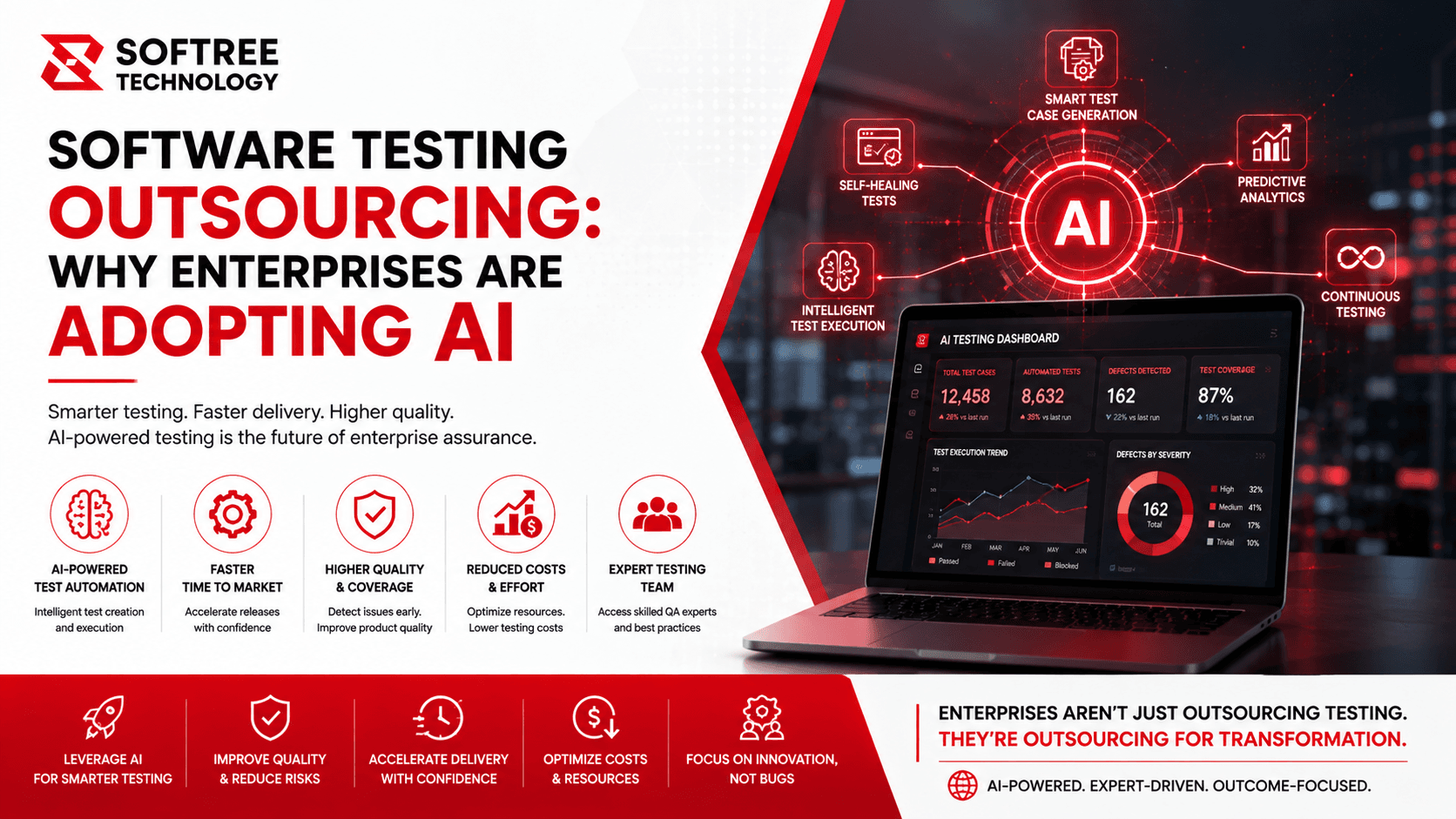
Software Testing Outsourcing provides organizations with access to experienced QA professionals, specialized testing expertise, scalable resources, and modern automation technologies. With the growing adoption of artificial intelligence, outsourced QA services are also becoming more intelligent and efficient through AI-powered test automation, predictive analytics, automated test generation, and continuous testing.
In this article, you'll learn how Software Testing Outsourcing works, why enterprises are increasingly adopting outsourced QA, how AI is transforming software testing, the key benefits and use cases, and the best practices organizations should follow when implementing an outsourced testing strategy.
Quick Answer
Software Testing Outsourcing is the practice of partnering with an external QA provider to manage software testing activities using specialized expertise, advanced testing tools, automation frameworks, and proven methodologies. It enables organizations to scale their testing capabilities according to project requirements without maintaining a large permanent QA team.
When combined with AI-powered automation, outsourced testing can help organizations improve test coverage, identify defects earlier, accelerate release cycles, reduce repetitive testing effort, and maintain consistent software quality across applications and platforms.
Table of Contents
- What is Software Testing Outsourcing?
- Why is Software Testing Outsourcing Important?
- How Does Software Testing Outsourcing Work?
- How AI is Transforming Software Testing
- Key Software Testing Services
- Benefits of Software Testing Outsourcing
- Common Use Cases
- Best Practices
- Common Mistakes to Avoid
- Key Takeaways
- Conclusion
What is Software Testing Outsourcing?
Software Testing Outsourcing is the practice of partnering with an external quality assurance provider to plan, execute, manage, and continuously improve software testing activities. Instead of building and maintaining a large in-house QA team for every testing requirement, organizations can work with specialized testing professionals who bring experience across different technologies, industries, platforms, and development methodologies.
An outsourced QA partner can support the entire software testing lifecycle, starting from test planning and requirement analysis through test execution, defect management, automation, performance validation, and release readiness. This model also allows businesses to access specialized skills without having to hire and train separate teams for every testing discipline.
Depending on the application and business requirements, outsourced QA services can include functional testing, regression testing, automation testing, performance testing, security testing, API testing, mobile application testing, cloud testing, accessibility testing, and AI-powered test automation.
Why is Software Testing Outsourcing Important?
Modern software environments are becoming increasingly complex. Enterprises now work with cloud platforms, APIs, microservices, mobile applications, distributed systems, AI applications, and continuously changing digital products. At the same time, Agile and DevOps practices require organizations to release software faster and test applications continuously throughout the development lifecycle.
This combination creates significant pressure on internal QA teams. Software Testing Outsourcing helps organizations address these challenges by providing access to experienced QA professionals and scalable testing resources. Instead of expanding internal teams every time testing requirements increase, organizations can work with an external partner that can adjust resources and testing capabilities according to project needs.
Outsourcing can also help organizations introduce modern testing practices such as continuous testing, AI-powered automation, intelligent regression testing, and risk-based testing without having to build these capabilities completely from scratch.
How Does Software Testing Outsourcing Work?
A successful outsourced testing engagement generally begins with understanding the organization's application, business objectives, quality requirements, technology stack, and release process. The QA team then defines an appropriate testing strategy based on these requirements and identifies the testing methodologies, tools, frameworks, and automation opportunities.
Once the strategy is established, testers execute functional, regression, performance, security, API, and other required testing activities. AI-powered testing can further improve the process by helping generate test cases, identify high-risk areas, optimize regression suites, and detect potential defects more efficiently.
Testing is then integrated into Agile and DevOps workflows so that quality validation happens continuously instead of being treated as a final step before release. Defects are tracked and prioritized according to their impact, while test results and quality metrics are continuously monitored to support release decisions.
A typical outsourced QA process can be summarized as:
Requirements → Test Planning → Test Automation → Test Execution → Defect Detection → Continuous Testing → Release
How AI is Transforming Software Testing
Artificial intelligence is changing how software testing is planned, executed, and optimized. Traditional automation can reduce repetitive manual work, but AI-powered testing can go further by analyzing application behavior, identifying patterns, generating test scenarios, and helping QA teams focus on higher-value testing activities.
AI can support automated test case generation, intelligent test execution, self-healing automation, defect prediction, test prioritization, and regression test optimization. For example, self-healing automation can help maintain automated test scripts when application interfaces change, reducing the amount of manual maintenance required from QA teams.
AI can also analyze historical defect data and application behavior to identify areas that may require additional testing. This enables organizations to move toward more risk-based and predictive quality assurance rather than relying entirely on traditional test execution approaches.
As a result, AI-powered QA can help enterprises increase testing coverage while reducing repetitive manual effort and supporting faster software releases.
Key Software Testing Services
A comprehensive Software Testing Outsourcing partner can provide multiple testing capabilities based on the organization's application and business requirements. Functional testing validates whether the application behaves according to its intended requirements, while regression testing ensures that new changes do not negatively affect existing functionality.
Automation testing helps organizations execute repetitive test scenarios faster and more consistently, while performance testing evaluates application speed, stability, scalability, and responsiveness under different workloads. Security testing focuses on identifying vulnerabilities and protecting applications against potential security threats.
API testing validates communication between different software components, while mobile application testing evaluates applications across different devices, operating systems, screen sizes, and network conditions. Cloud testing validates applications running in cloud environments, and accessibility testing helps ensure that digital products can be used by people with different accessibility needs.
AI-powered test automation can be integrated across these testing areas to improve efficiency, coverage, and overall QA productivity.
Benefits of Software Testing Outsourcing
One of the major advantages of Software Testing Outsourcing is cost optimization. Organizations can reduce the need to maintain large permanent QA teams while still accessing specialized testing expertise when required. Outsourcing also provides greater flexibility because testing resources can be increased or reduced based on project requirements.
Another important benefit is faster time-to-market. Experienced QA teams and automation frameworks can help organizations execute testing more efficiently and identify defects earlier in the development lifecycle. This allows development teams to resolve issues before they become expensive production problems.
Outsourcing can also improve testing coverage by providing access to specialists across automation, performance, security, mobile, API, cloud, and other testing disciplines. When combined with AI-powered testing, organizations can further improve automation efficiency, optimize regression testing, and identify high-risk areas earlier.
Overall, Software Testing Outsourcing can help organizations achieve better software quality, faster releases, improved customer experiences, and more scalable quality assurance operations.
Common Use Cases
Software Testing Outsourcing is widely applicable across industries because modern organizations depend heavily on digital applications and software platforms.
In healthcare, outsourced QA teams can support testing for electronic health records, telemedicine applications, healthcare portals, and medical technology platforms. Testing helps ensure that these systems remain reliable, secure, and accessible.
In banking and financial services, QA teams can test online banking platforms, payment systems, financial applications, APIs, and customer-facing applications where reliability and security are critical.
Retail and e-commerce organizations can use outsourced testing for shopping applications, customer portals, payment processes, inventory systems, and high-traffic digital platforms. Manufacturing companies can use QA outsourcing for ERP systems, industrial IoT platforms, supply chain applications, and connected devices.
For SaaS and technology companies, outsourced testing can support enterprise applications, cloud platforms, APIs, AI applications, and continuously evolving software products.
Best Practices for Software Testing Outsourcing
Organizations should begin by defining clear quality objectives and measurable QA KPIs. These objectives help both the internal team and external QA provider understand what success looks like and how testing performance will be evaluated.
Choosing the right QA partner is equally important. Organizations should evaluate a provider based not only on cost but also on technical expertise, industry experience, testing capabilities, communication processes, security practices, automation experience, and ability to scale.
Testing should also be integrated into Agile and DevOps processes rather than being treated as a separate activity at the end of development. Continuous communication between internal development teams and outsourced QA teams helps ensure that testing remains aligned with product changes and business priorities.
Organizations should also gradually expand AI-powered automation based on actual testing requirements. Rather than automating everything immediately, teams should identify repetitive, high-value, and stable test scenarios where automation can provide measurable benefits.
Common Mistakes to Avoid
Organizations can face challenges when implementing outsourced QA if the engagement is based primarily on cost rather than quality and expertise. Selecting a provider only because it offers the lowest price can result in limited testing coverage, poor communication, or inadequate technical capabilities.
Another common mistake is involving QA too late in the development lifecycle. When testing begins only after development is completed, defects can become more expensive and time-consuming to resolve. Integrating QA throughout development helps identify problems earlier.
Organizations should also avoid ignoring automation opportunities and failing to establish clear communication processes. Internal and external teams should have clearly defined responsibilities, regular communication channels, measurable KPIs, and transparent defect-management processes.
Key Takeaways
Software Testing Outsourcing enables enterprises to access specialized QA expertise, scalable resources, advanced testing frameworks, and modern automation capabilities without maintaining a large in-house testing organization.
AI is making outsourced QA more efficient by supporting automated test generation, intelligent regression testing, self-healing automation, predictive analytics, and risk-based testing. When combined with continuous testing and DevOps practices, these capabilities can help organizations release software faster while maintaining consistent quality.
The most successful outsourcing strategies focus on measurable quality objectives, strong collaboration, appropriate automation, continuous testing, and selecting a QA partner with the right technical and industry expertise.
Conclusion
Modern software development demands speed, reliability, security, scalability, and continuous innovation. As applications become more complex and release cycles become shorter, organizations need testing strategies that can scale with their development requirements.
Software Testing Outsourcing provides enterprises with access to experienced QA professionals, specialized testing capabilities, scalable resources, and advanced automation technologies. The growing use of AI is further transforming outsourced QA by enabling intelligent test automation, predictive quality analysis, self-healing testing, and more efficient regression testing.
At Softree Technology, we help organizations build reliable, secure, and high-performing applications through comprehensive Software Testing Outsourcing services. Our expertise includes functional testing, automation testing, performance testing, security testing, AI-powered quality assurance, and DevSecOps integration. By combining experienced QA professionals with modern testing technologies, we help businesses accelerate software delivery, improve testing efficiency, and enhance overall software quality.
Learn more about our software quality engineering and digital transformation services at https://www.softreetechnology.com/ or connect with our experts to explore how AI-powered testing can improve your software development lifecycle.