Introduction
Creating comprehensive test cases is an important part of software quality assurance, but it can become time-consuming as applications become larger and more complex. QA teams need to cover functional requirements, positive and negative scenarios, boundary conditions, integrations, user workflows, and potential edge cases.
AI test case generation provides a way to assist this process by analyzing requirements, user stories, application specifications, existing test cases, and business rules to generate candidate test scenarios. Instead of creating every test case manually, QA engineers can use AI-generated scenarios as a starting point and focus their expertise on reviewing, refining, and validating them.
Quick Answer
AI test case generation uses artificial intelligence to create candidate test cases from requirements, user stories, application behavior, API specifications, business rules, and existing testing information. AI can generate positive scenarios, negative cases, boundary conditions, edge cases, and different user workflows. The generated cases should be reviewed by QA professionals before being added to the official test suite.
Table of Contents
- What Is AI Test Case Generation?
- Why Traditional Test Case Creation Can Be Challenging
- How AI Test Case Generation Works
- Types of Test Cases AI Can Generate
- AI Test Case Generation for Different Applications
- Benefits of AI-Generated Test Cases
- Challenges and Limitations
- Best Practices
- How to Implement AI Test Case Generation
- Key Takeaways
- Conclusion
What Is AI Test Case Generation?
AI test case generation is the use of artificial intelligence to assist QA teams in creating software test scenarios. AI can analyze requirements, user stories, acceptance criteria, API documentation, application specifications, existing tests, and business rules to identify possible testing conditions.
For example, if a requirement states that users must enter a valid email address during registration, AI can generate scenarios for a valid email, invalid email format, missing email, duplicate email, unusually long email address, and boundary conditions. QA engineers can then review these scenarios and determine which should become part of the final test suite.
Why Traditional Test Case Creation Can Be Challenging
Manual test design requires testers to understand requirements, identify expected behavior, think through negative conditions, create boundary cases, and maintain test cases as the application changes. For large enterprise applications, this can result in thousands of test cases across different features, roles, integrations, devices, and data conditions.
Requirements can also change frequently. When a feature is modified, QA teams may need to review existing tests and create additional scenarios. AI can help accelerate this process by analyzing updated requirements and suggesting new or modified test cases.
How AI Test Case Generation Works
The process generally begins with providing the AI system with relevant testing context. This may include requirements, user stories, acceptance criteria, API specifications, business rules, existing test cases, or application documentation.
The AI analyzes this information and identifies expected behaviors, input conditions, dependencies, and potential risks. It can then generate candidate test cases covering normal workflows as well as negative and boundary scenarios.
The generated tests are reviewed by QA engineers, refined where necessary, and then added to the appropriate automation or test-management workflow.
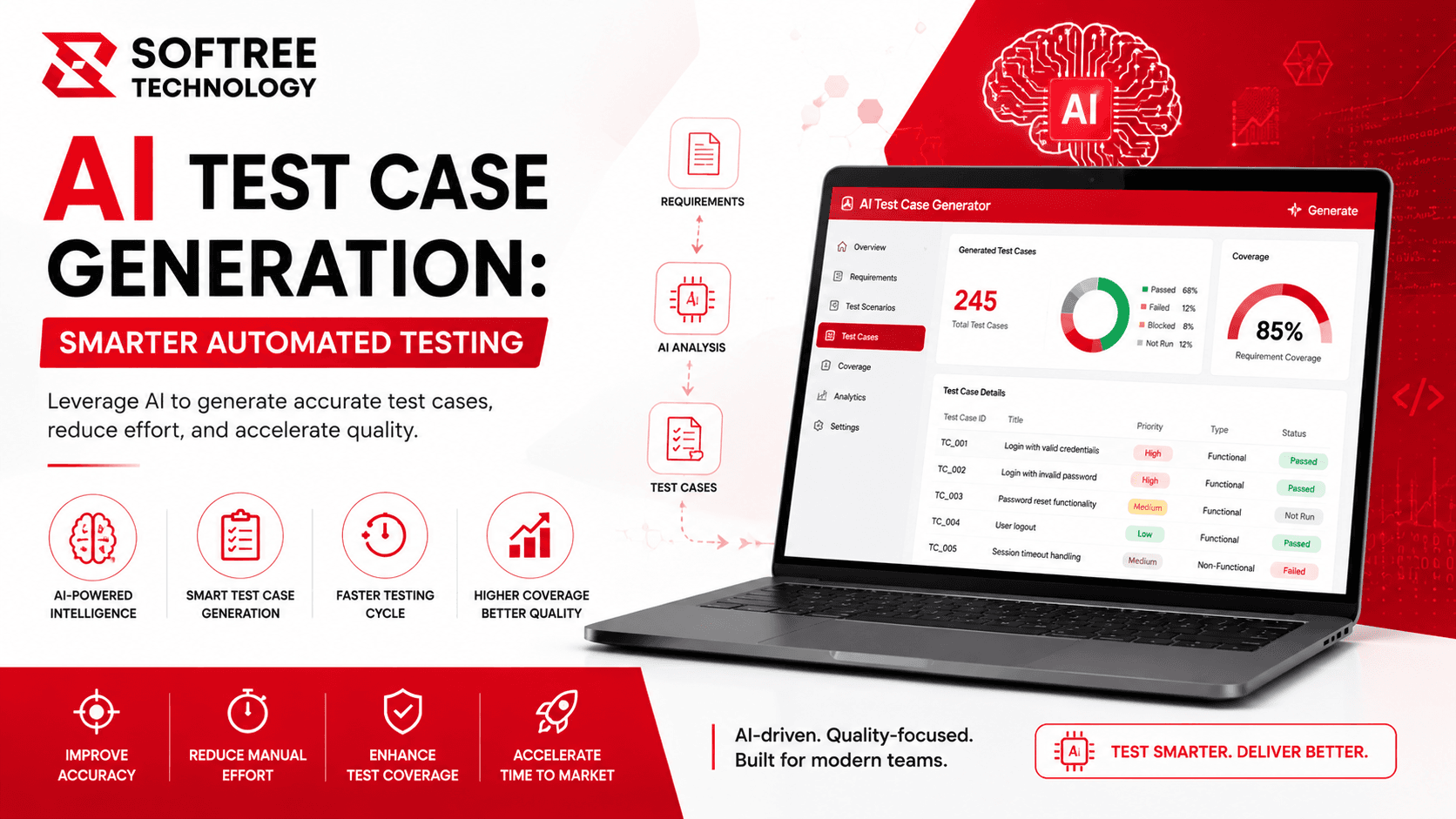
Requirement → AI Analysis → Test Scenario Generation → QA Review → Test Case Refinement → Automation / Execution
Types of Test Cases AI Can Generate
Positive Test Cases
AI can generate scenarios that verify expected application behavior using valid inputs and normal user workflows. These cases confirm that the application performs its intended functions correctly.
Negative Test Cases
AI can identify scenarios involving invalid inputs, missing fields, incorrect formats, unauthorized requests, invalid states, and unexpected user behavior. Negative testing helps verify that applications handle incorrect conditions appropriately.
Boundary Test Cases
Boundary conditions are often important because defects can occur at the limits of accepted values. AI can generate scenarios around minimum and maximum values, field lengths, quantities, dates, limits, and thresholds defined by business requirements.
Edge Cases
AI can help identify less common combinations and unusual conditions that may be difficult to think through manually. Examples include duplicate transactions, empty responses, unusual character combinations, conflicting inputs, and unexpected sequences of actions.
Integration Test Cases
For applications that depend on APIs, databases, external services, or enterprise systems, AI can generate scenarios around successful integrations, failures, timeouts, invalid responses, unavailable services, and inconsistent data.
AI Test Case Generation for Web Applications
For web applications, AI can generate scenarios around registration, login, navigation, search, forms, checkout, user permissions, browser behavior, and responsive layouts. The generated tests can include both standard user journeys and unusual interactions.
AI can also use application requirements and existing test cases to identify missing scenarios and suggest additional coverage for important workflows.
AI Test Case Generation for API Testing
API testing provides another strong use case for AI-generated test cases. AI can analyze API specifications such as OpenAPI or Swagger definitions to identify endpoints, parameters, request structures, response schemas, authentication requirements, and expected status codes.
Based on this information, AI can generate valid requests, invalid payloads, missing parameters, boundary values, authentication scenarios, authorization cases, and error-handling tests.
AI Test Case Generation for Enterprise Applications
Enterprise applications often contain complex workflows involving multiple roles, systems, integrations, and business rules. AI can help QA teams analyze these relationships and generate scenarios covering different user roles, approval processes, business conditions, integrations, and exception paths.
This can be particularly useful for ERP, CRM, finance, healthcare, logistics, banking, SaaS, and other systems where a single business process may involve multiple connected components.
Benefits of AI Test Case Generation
AI can reduce the manual effort required to create initial test scenarios and help QA teams generate a broader range of possible test conditions. This can allow testers to spend more time on risk analysis, exploratory testing, defect investigation, and business validation.
AI can also help identify potential gaps in existing test coverage. By comparing requirements and application behavior against existing tests, an AI system can suggest scenarios that may not currently be covered.
Another benefit is consistency. AI-generated test cases can follow defined structures and formats, making it easier for teams to maintain standardized test documentation across projects.
Challenges and Limitations
AI-generated test cases should not automatically be treated as correct. AI may misunderstand a requirement, generate duplicate scenarios, or create a technically valid test that does not represent an actual business requirement.
Human review therefore remains important. QA engineers should validate generated cases against requirements, acceptance criteria, business rules, security requirements, and expected application behavior.
Data quality is also important. If the source requirements are incomplete or inconsistent, the generated test cases may reflect those limitations. Organizations should therefore improve requirement quality and establish clear sources of truth before relying heavily on AI-generated testing.
Best Practices
Start with a focused testing use case and provide AI with reliable requirements and application context. Define the expected format for generated test cases so results can be reviewed consistently.
Use AI as an assistant rather than replacing QA judgment. Generated scenarios should go through human review before they are included in production regression suites.
Organizations should also track the quality of generated tests by measuring useful coverage, duplicate scenarios, rejected test cases, defect detection, and maintenance effort. This helps determine whether AI is actually improving the testing process.
How to Implement AI Test Case Generation
Begin by assessing the existing testing process and identifying areas where manual test creation consumes significant effort. Select a suitable application, feature, API, or workflow as the initial use case.
Next, provide the AI system with requirements, user stories, acceptance criteria, API specifications, business rules, or existing test cases. Configure the generation process to produce positive, negative, boundary, edge, and integration scenarios where relevant.
QA engineers should then review and refine the generated cases before adding them to the test-management or automation framework. Once the process becomes reliable, AI-generated test cases can be incorporated into regression planning and CI/CD workflows.
Key Takeaways
✓ AI can accelerate the creation of software test cases.
✓ AI can generate positive, negative, boundary, edge, and integration scenarios.
✓ AI-generated tests can help identify potential coverage gaps.
✓ QA engineers should review and validate AI-generated test cases before execution.
✓ The strongest approach combines AI-assisted test generation with human QA expertise.
Conclusion
AI test case generation can help organizations make software testing faster and more comprehensive by assisting QA teams with scenario creation. By analyzing requirements, business rules, application specifications, and existing tests, AI can generate candidate scenarios that cover both common workflows and less obvious conditions.
The goal is not to replace QA engineers but to reduce repetitive test-design work and give testers more time to focus on quality risks, business behavior, exploratory testing, and defect analysis.
If your organization is looking to modernize software testing with AI, automate test-case creation, or improve QA coverage, Softree Technlogy can help design and implement AI-assisted testing solutions aligned with your software quality and delivery requirements.
Learn more about AI solutions and services from Softree Technology:
https://www.softreetechnology.com/