Introduction
In today's fast-paced digital economy, delivering high-quality software quickly has become a competitive necessity. Organizations are under increasing pressure to release new features, support multiple platforms, maintain reliable user experiences, and manage growing cybersecurity requirements.
Software testing has also become more complex as applications expand across cloud environments, mobile devices, APIs, microservices, and AI-powered platforms. Maintaining all the required testing capabilities internally can require significant investment in people, infrastructure, tools, and specialized expertise.
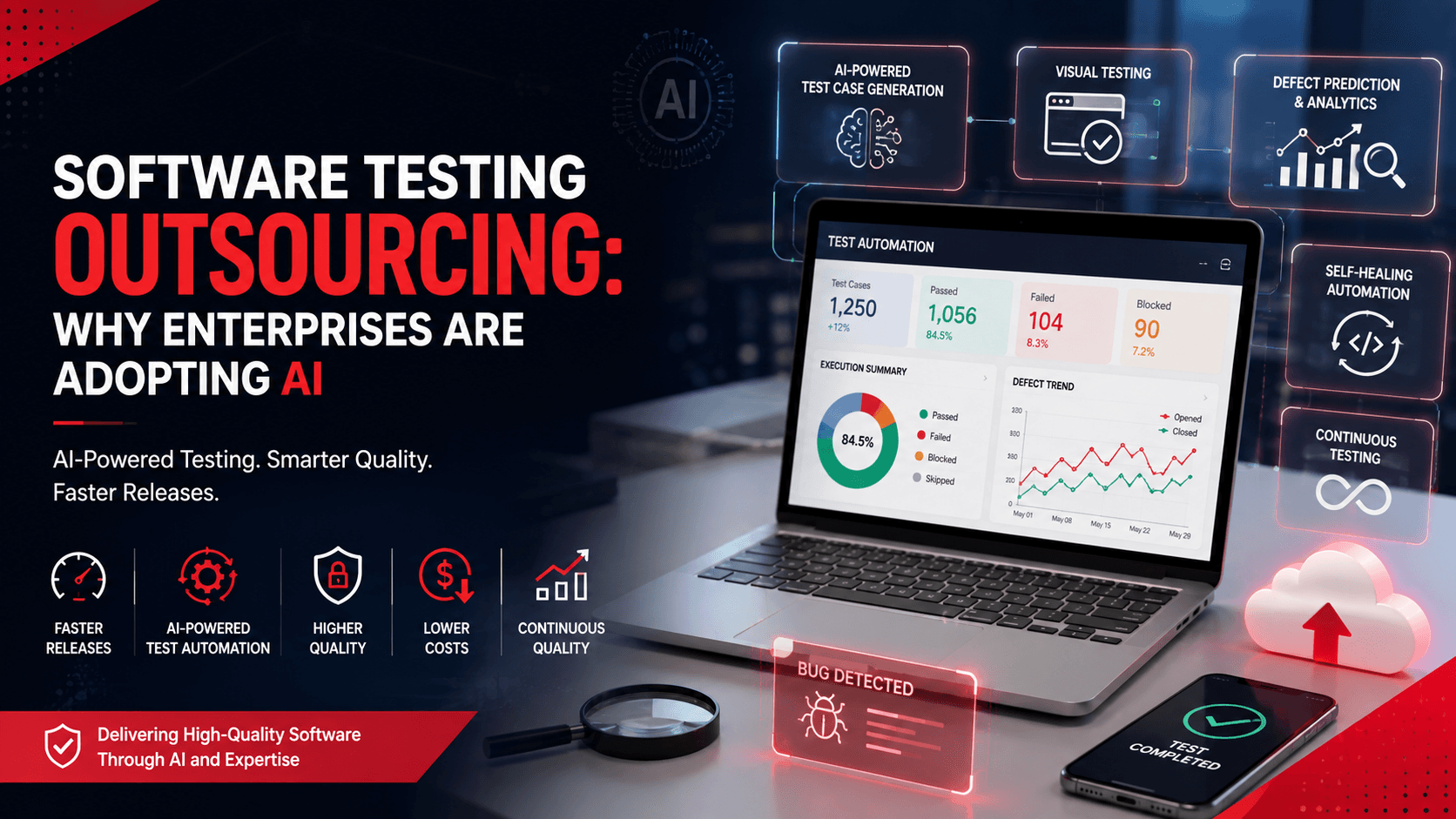
Software Testing Outsourcing provides organizations with access to experienced QA professionals and scalable testing resources. When combined with Artificial Intelligence, outsourced testing can automate repetitive activities, identify high-risk areas, detect defects earlier, and support continuous testing throughout the software development lifecycle.
Quick Answer
Software Testing Outsourcing is the practice of using an external QA partner to plan, execute, manage, and optimize software testing activities.
AI makes outsourced testing more intelligent by helping generate test cases, prioritize high-risk scenarios, optimize regression testing, detect defects earlier, and maintain automation scripts.
The key takeaway is that enterprises can combine specialized QA expertise, scalable resources, automation, and AI to improve software quality while reducing testing costs and release bottlenecks.
Table of Contents
- What Is Software Testing Outsourcing?
- Why Are Enterprises Choosing Software Testing Outsourcing?
- How AI Is Transforming Software Testing Outsourcing
- Key Benefits of Software Testing Outsourcing
- Types of Software Testing That Can Be Outsourced
- AI-Powered QA Services
- Best Practices for Successful Software Testing Outsourcing
- Industries Benefiting From Software Testing Outsourcing
- Challenges Solved by Software Testing Outsourcing
- The Future of AI in Software Testing Outsourcing
- Why Choose a Professional Software Testing Partner?
- Key Takeaways
- Conclusion
What Is Software Testing Outsourcing?
Software Testing Outsourcing involves partnering with an external QA provider to plan, execute, manage, and optimize software testing activities.
Instead of building and maintaining a large in-house testing team, organizations can work with dedicated testing specialists who provide domain expertise, testing methodologies, advanced tools, and scalable resources.
Common outsourced testing services include:
- Functional Testing
- Regression Testing
- Automation Testing
- Performance Testing
- Security Testing
- API Testing
- Mobile Application Testing
- Cloud Testing
- Accessibility Testing
- AI-powered Test Automation
Outsourcing allows internal teams to focus on product innovation and core business objectives while maintaining comprehensive software quality.
Why Are Enterprises Choosing Software Testing Outsourcing?
Modern applications span multiple platforms, cloud environments, APIs, microservices, and AI-powered systems. This growing complexity makes comprehensive quality assurance increasingly difficult to manage internally.
Organizations are increasingly outsourcing testing to gain access to specialized professionals, proven testing methodologies, and advanced automation capabilities.
Key business drivers include:
- Faster product releases
- Improved software quality
- Cost optimization
- Access to specialized QA expertise
- Scalable testing resources
- AI-driven automation
- Continuous testing support
How AI Is Transforming Software Testing Outsourcing
Artificial Intelligence is changing software testing by making testing activities smarter, faster, and more efficient. AI-powered QA teams can automate repetitive activities, identify high-risk areas, and optimize test execution.
Intelligent Test Automation
AI-powered automation can:
- Automatically generate test cases
- Identify redundant tests
- Prioritize high-risk scenarios
- Self-heal broken automation scripts
- Optimize regression testing
These capabilities reduce manual effort while improving test coverage.
Faster Defect Detection
AI can analyze application behavior and historical defect information to identify potential issues earlier.
This supports:
- Early bug detection
- Predictive risk analysis
- Reduced production defects
- Improved software stability
Continuous Testing
AI supports continuous testing throughout modern DevOps pipelines through:
- Automated test execution
- Continuous regression testing
- Real-time quality monitoring
- Immediate developer feedback
Key Benefits of Software Testing Outsourcing
Cost Optimization
Maintaining an internal QA organization can require substantial investment in recruitment, training, infrastructure, testing tools, and ongoing maintenance.
Outsourcing can help organizations:
- Reduce operational expenses
- Minimize recruitment costs
- Avoid expensive testing infrastructure
- Pay for only the testing services they require
Access to Experienced QA Professionals
External QA providers can provide specialists with experience across web applications, mobile platforms, cloud environments, enterprise software, healthcare systems, financial applications, and AI-powered solutions.
Faster Time-to-Market
Dedicated QA teams can work alongside development teams to identify defects earlier and streamline testing cycles.
This can support:
- Faster release cycles
- Reduced testing bottlenecks
- Improved collaboration
- Accelerated software delivery
Scalability
Testing requirements can change throughout a project. Outsourced teams can scale resources according to project size, release schedules, peak workloads, and specialized testing requirements.
Improved Software Quality
Comprehensive testing improves functional accuracy, performance, security, reliability, and user experience, which can contribute to higher customer satisfaction and lower maintenance costs.
Types of Software Testing That Can Be Outsourced
Functional Testing
Ensures that applications perform according to defined business requirements.
Automation Testing
Uses automation frameworks and AI capabilities to execute repetitive test cases consistently and efficiently.
Regression Testing
Verifies that new application changes do not introduce defects into existing functionality.
Performance Testing
Evaluates:
- Load handling
- Scalability
- Response times
- System stability
Security Testing
Identifies potential vulnerabilities involving:
- Authentication
- Authorization
- Data exposure
- API security
- Configuration weaknesses
API Testing
Validates communication between applications and ensures integrations operate securely and reliably.
Mobile Application Testing
Tests applications across Android, iOS, tablets, different screen sizes, and operating systems.
Cloud Testing
Evaluates cloud-native applications for performance, security, and scalability across different environments.
AI-Powered QA Services
Modern AI-powered QA services extend traditional testing capabilities through intelligent automation and predictive analysis.
Intelligent Test Case Generation
AI can create test scenarios based on application changes and user behavior.
Self-Healing Automation
Automation scripts can adapt to minor UI changes, reducing ongoing maintenance effort.
Predictive Analytics
AI can identify high-risk application modules that are more likely to contain defects, allowing QA teams to prioritize testing.
Visual Testing
AI can compare application screens across browsers and devices to identify unexpected visual differences.
Defect Classification
Machine learning can categorize defects and help teams identify recurring patterns and issues.
Best Practices for Successful Software Testing Outsourcing
Define Clear Objectives
Establish testing goals, quality metrics, and expected outcomes before engaging an outsourcing partner.
Choose the Right QA Partner
Evaluate providers based on:
- Industry experience
- Technical expertise
- AI-enabled testing capabilities
- Proven delivery methodologies
- Security compliance certifications
Integrate With Agile and DevOps
Outsourced QA teams should participate in sprint planning, daily stand-ups, and CI/CD workflows to remain aligned with development activities.
Prioritize Communication
Maintain regular communication through:
- Weekly status meetings
- Shared dashboards
- Real-time reporting
- Collaboration platforms
Focus on Continuous Improvement
Measure testing performance using KPIs such as:
- Defect detection rate
- Test automation coverage
- Release quality
- Test execution time
- Customer satisfaction
Industries Benefiting From Software Testing Outsourcing
Software testing outsourcing can support organizations across multiple industries.
Healthcare
- Electronic health records
- Medical devices
- Telemedicine platforms
- Regulatory compliance
Banking and Financial Services
- Online banking
- Payment systems
- Fraud detection platforms
- Financial applications
Retail and E-Commerce
- Online stores
- Mobile shopping applications
- Inventory systems
- Customer portals
Manufacturing
- ERP platforms
- Industrial IoT
- Supply chain applications
- Production management systems
Technology and SaaS
- Enterprise software
- Cloud platforms
- AI applications
- APIs
- Collaboration tools
Challenges Solved by Software Testing Outsourcing
Organizations commonly face:
- Limited internal QA resources
- Tight release deadlines
- Increasing application complexity
- Rising testing costs
- Shortages of automation specialists
Combining outsourced QA teams with AI-powered testing can address these challenges through intelligent automation, scalable resources, and standardized testing processes.
The Future of AI in Software Testing Outsourcing
AI will continue to expand the capabilities of software quality assurance.
Emerging areas include:
- Autonomous testing
- Generative AI for test creation
- Predictive defect analysis
- Self-maintaining automation frameworks
- AI-driven performance optimization
- Intelligent test reporting
As these capabilities evolve, outsourced QA teams can provide greater efficiency, accuracy, and business value.
Why Choose a Professional Software Testing Partner?
An experienced QA partner can help organizations:
- Reduce testing costs
- Improve software quality
- Accelerate release cycles
- Access specialized expertise
- Scale testing resources when required
- Adopt AI-powered testing technologies
- Support regulatory compliance
The right partner can become an extension of the development team, allowing internal teams to focus on innovation while maintaining reliable software quality.
Key Takeaways
- Software Testing Outsourcing provides access to specialized QA expertise and scalable testing resources.
- AI can automate repetitive testing activities and improve test coverage.
- Predictive analytics can help identify high-risk areas earlier.
- Continuous testing supports faster and more reliable software releases.
- Outsourcing can help reduce testing costs and recruitment requirements.
- A strong QA partner should integrate with Agile and DevOps practices.
- Continuous measurement and improvement are essential for long-term testing efficiency.
Conclusion
Modern software development requires organizations to balance speed, quality, security, and continuous innovation. Software Testing Outsourcing combines experienced QA professionals, scalable delivery models, and AI-powered testing capabilities to help organizations meet these demands.
From intelligent test automation and predictive analytics to continuous testing and faster release cycles, AI is changing how enterprises approach software quality assurance. Organizations that adopt outsourced AI-driven testing can improve software quality while optimizing costs and supporting faster digital delivery.
Software Testing Outsourcing is increasingly becoming a strategic approach for organizations looking to deliver secure, reliable, and high-performing software in a competitive market.
Visit Softree Technology at https://www.softreetechnology.com/ to explore AI-powered software testing and QA solutions.