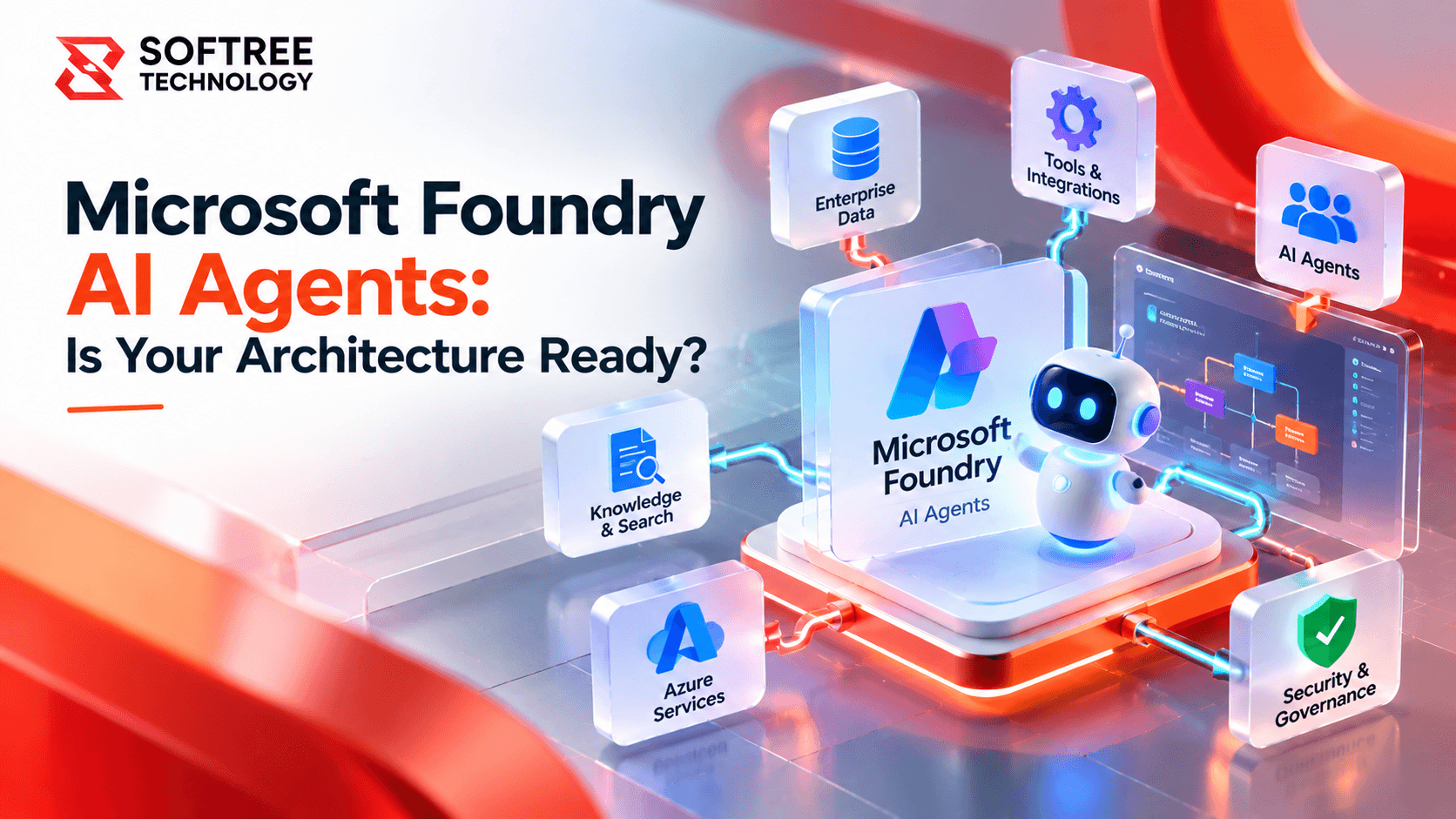
AI models are becoming more capable, but a production AI agent needs more than a strong model. It must securely access business data, use approved tools and APIs, maintain identity and authorization, and provide visibility into its execution. Microsoft Foundry brings models, agent services, tools, connected data, security, networking, and observability together to support AI applications and agents at scale. Microsoft Foundry Agent Service is a managed platform for building, deploying, and scaling AI agents, with runtime, tools, identity, security, and observability capabilities.
Why AI Architecture Matters More Than the Model
Choosing an AI model is only one part of building an agent. An enterprise agent may need to retrieve information, call APIs, interact with applications, and make decisions based on business context. Without the right architecture, these capabilities can create security, integration, monitoring, and operational challenges.
Microsoft Foundry addresses this broader architecture by bringing together AI models, agent runtime capabilities, tools, connected data, identity, security, networking, and observability. The source architecture describes the model as providing intelligence while the surrounding architecture provides control, context, integration, and scale.
What Is Microsoft Foundry?
Microsoft Foundry is an Azure platform for building and operating AI applications and agents. Foundry Agent Service provides a managed environment for hosting and scaling agents, while Foundry also provides capabilities for tools, identity, RBAC, networking, monitoring, and connected data.
Foundry Agent Service supports different approaches to agent development, including prompt agents and hosted agents, allowing organizations to choose how much of the agent runtime and application code they manage.
The important distinction is that the AI model does not operate in isolation. The agent needs an environment where it can access the right information, use approved tools, and operate within defined security and governance boundaries.
How a Microsoft Foundry AI Agent Works
A production agent typically sits between a user-facing application and the enterprise systems it needs to access.
User / Business Application ↓ Microsoft Foundry Project ↓ Foundry Agent Service ↓ AI Models + Tools / APIs ↓ Azure AI Search + Enterprise Systems ↓ Enterprise Knowledge
The agent receives a request, reasons about the task using its configured model, determines whether additional information or tools are required, retrieves relevant knowledge, calls authorized business APIs, and returns a response or completes an action. The source architecture also places Microsoft Entra ID, RBAC, network controls, tracing, Application Insights, and Azure Monitor around these interactions.
Microsoft's architecture guidance similarly describes Foundry as a layered architecture involving Foundry resources, projects, connected Azure services, governance, security, and observability.
The Core Architecture Components
Foundry Agent Service provides the managed runtime for hosting and scaling production agents.
AI Models provide the reasoning and generation capabilities behind the agent.
Tools and APIs allow the agent to interact with business applications and enterprise systems.
Azure AI Search can provide knowledge retrieval when an agent needs grounded information from enterprise data.
Microsoft Entra ID and RBAC control authentication and authorization for agents and connected resources.
Application Insights and Azure Monitor provide telemetry and visibility into agent execution and operational issues.
Microsoft's current Agent Service documentation also lists managed toolboxes, tracing, metrics, evaluations, Application Insights integration, Entra identity, RBAC, and virtual network isolation among its capabilities.
Real-World Example: Enterprise IT Support Agent
Consider an IT support agent that helps employees investigate application problems.
An employee asks why a business application is not working. The agent can retrieve approved troubleshooting documentation through Azure AI Search, access an authorized IT service API, and provide an answer based on the available information.
The architecture determines what the agent is allowed to access. Microsoft Entra ID and RBAC can control permissions, while monitoring and tracing provide visibility into agent activity. The result is an AI agent operating within a controlled enterprise architecture rather than simply a chatbot.
When Should You Use Microsoft Foundry?
Microsoft Foundry becomes relevant when an AI workload needs more than a simple model request. It is suited to scenarios where agents need enterprise tools or APIs, managed workflows, enterprise identity and monitoring, or controlled access to data and networks.
For a simple application that only sends prompts to a model without tool calls or enterprise integrations, a simpler model-based architecture may be sufficient. Microsoft's architecture guidance also notes that standalone Azure OpenAI resources can be appropriate when the workload only requires model completions without agent hosting or evaluation.
What Does a Production-Ready Architecture Need?
A production architecture should start with the agent's business responsibility and identify exactly which data and systems it needs. Access should follow least-privilege principles, with authentication and authorization configured through Microsoft Entra ID and RBAC.
Tool and API connections should be secured, enterprise knowledge retrieval should be designed deliberately, and monitoring should be enabled from the beginning. Development and production environments should also be separated, with agent behavior evaluated before production release.
Microsoft Foundry provides capabilities for tracing, evaluation, monitoring, access control, networking, and governance that can support these production requirements.
Production Checklist
- Define the agent's business responsibility.
- Identify required data and enterprise systems.
- Apply least-privilege access.
- Configure Microsoft Entra ID and RBAC.
- Secure tool and API connections.
- Design enterprise knowledge retrieval.
- Enable monitoring and tracing.
- Separate development and production environments.
- Evaluate agent behavior before release.
- Review networking and data-isolation requirements.
Key Takeaway
A more capable AI model does not automatically create a production-ready AI system. Enterprise agents need architecture around identity, data, tools, security, networking, monitoring, and governance. Microsoft Foundry provides managed capabilities for building and operating these agents, while the architecture determines how those capabilities are connected and controlled.
The goal is not simply to make an AI model smarter. It is to create an agent that can operate reliably and securely within the systems, data, and processes of an organization.
Build Production-Ready AI Agents with Softree
Softree Technology helps businesses design and build production-ready AI solutions across Azure, AWS, and enterprise systems, covering agent architecture, integrations, data, identity, security, governance, and deployment.
https://www.softreetechnology.com/