Introduction
AI is only as reliable as the data and business context behind it. Connecting a powerful model to a large dataset does not automatically produce trustworthy results. If data is incomplete, duplicated, outdated, poorly governed, or missing business meaning, an AI application can return answers that sound convincing but are difficult to validate.
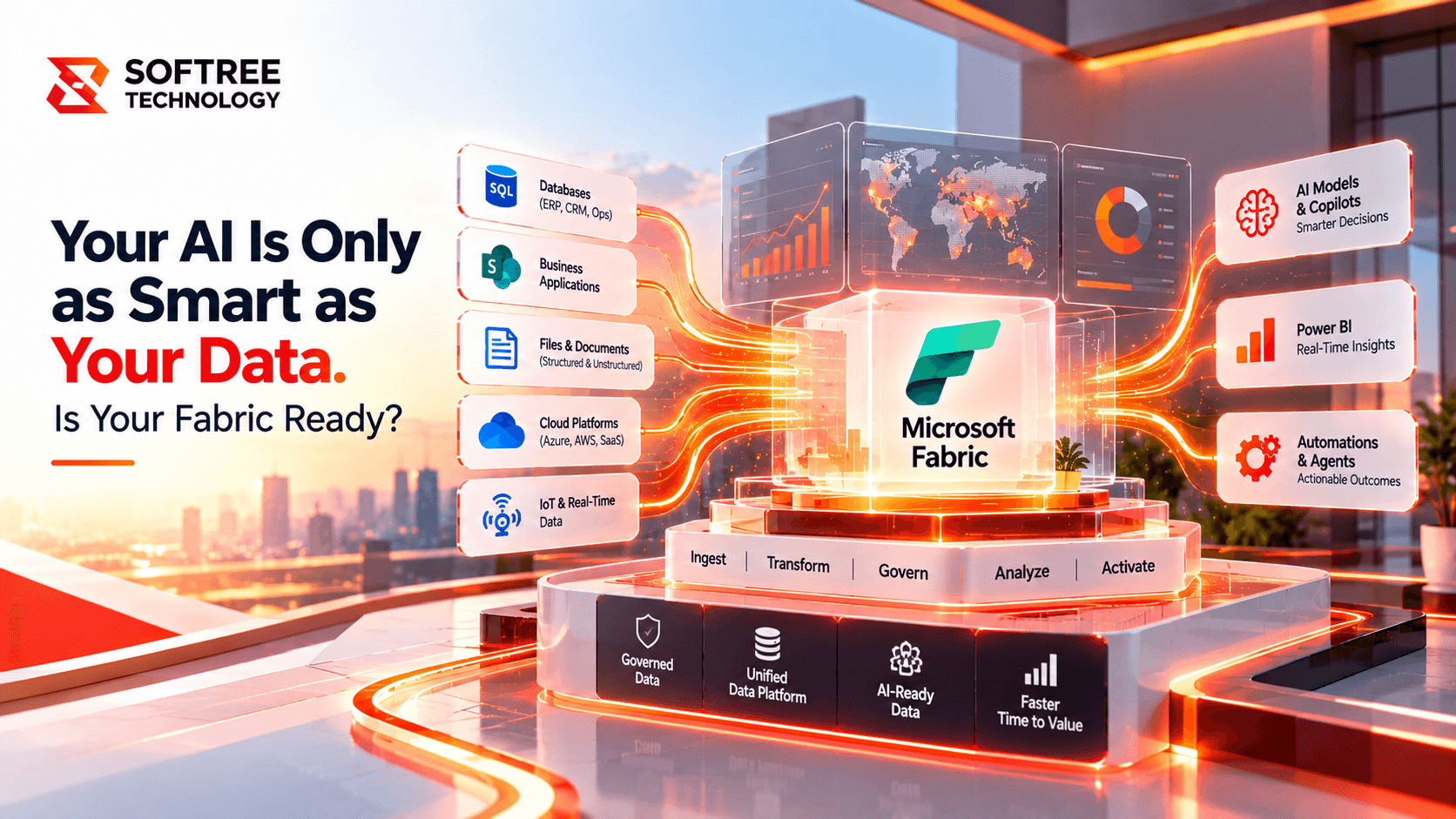
This is where Microsoft Fabric AI becomes important. Microsoft Fabric brings data engineering, analytics, governance, and AI capabilities together around OneLake, creating a foundation for organizations preparing enterprise data for AI applications and agents.
Quick Answer: What Makes Data AI-Ready?
AI-ready data is not simply a large volume of information. It needs to be accurate, complete, consistent, fresh, governed, secure, and understandable in business terms. AI systems need enough context to determine what data means, which information is relevant, and whether the user is authorized to access it.
Microsoft Fabric can provide the platform foundation, but organizations still need to prepare and govern their data before relying on AI-generated answers.
What Does AI-Ready Data Actually Mean?
Before introducing AI, organizations should evaluate the quality of the data that AI will consume.
Accuracy: Business-critical values should match trusted source systems and agreed definitions.
Completeness: Important fields, records, and business events should not be systematically missing.
Consistency: Concepts such as customer, product, order, employee, revenue, and inventory should have consistent definitions across systems.
Freshness: Data should be updated frequently enough for the decisions the AI application supports.
Lineage and ownership: Teams should understand where important data originates and who is responsible for it.
Security and governance: Users and AI experiences should only receive information they are authorized to access.
Business context: Tables, columns, metrics, and semantic models need meaningful descriptions so AI can understand business meaning rather than relying only on technical names.
Where Microsoft Fabric Fits
Microsoft Fabric provides an integrated environment for ingesting, storing, transforming, analyzing, and serving enterprise data, with OneLake acting as its shared data foundation. Microsoft describes OneLake as the unified logical data lake for Fabric workloads, allowing data to be accessed across different experiences without creating unnecessary copies.
This can reduce some of the fragmentation that makes enterprise AI difficult. However, putting data into OneLake does not automatically make it AI-ready. A poorly defined table remains poorly defined after it reaches OneLake.
Data quality, governance, semantic meaning, access controls, and ownership still require deliberate attention.
How Fabric Data Agents Use Enterprise Data
Fabric Data Agents allow users to ask questions in natural language over supported enterprise data sources. Depending on the configuration, these can include lakehouses, warehouses, Power BI semantic models, KQL databases, and other supported Fabric data sources.
Microsoft's current documentation describes Fabric Data Agents as conversational interfaces over governed enterprise data, with support for natural-language questions and access controls. They can be configured with instructions, examples, and domain-specific guidance to improve relevance.
That changes the testing question. It is no longer enough to ask whether the system can retrieve data. Organizations need to determine whether the agent retrieves the right data, understands the business question, applies the correct context, and produces an answer that can be validated.
Test the Data Before Testing the AI
A reliable Fabric AI implementation should start with the underlying data foundation.
Organizations should:
- Validate source-to-target mappings and transformation rules.
- Check for nulls, duplicates, unexpected values, and stale records.
- Confirm definitions for important metrics such as revenue, customer status, shipment status, and inventory.
- Verify that permissions prevent unauthorized information from being exposed.
- Confirm that data refreshes complete within the required business window.
- Review whether tables, columns, semantic models, and descriptions represent the intended business context.
This foundation makes it easier to distinguish a data problem from an AI configuration or response-generation problem.
Then Test the AI Experience
Once the data foundation is trustworthy, test the agent with representative questions.
Include different types of questions:
- Known-answer questions: Does the response match the trusted source?
- Filtered questions: Does the agent apply the correct region, product, customer, or date scope?
- Ambiguous questions: Does the agent ask for clarification or use an explicitly defined context?
- Unsupported questions: Does the agent avoid presenting unsupported information as fact?
For example, if a user asks, “What were Q2 sales?”, the answer should match the trusted source. If the user asks, “How are we performing?”, the agent should either use clearly defined business context or ask for clarification rather than making an unsupported assumption.
Why Business Context Matters
Two datasets can contain the same numbers but represent different business concepts. A field called Customer could refer to an account, a paying customer, or a unique billing entity.
AI needs enough context to understand which definition applies. Semantic models, descriptions, instructions, examples, and governed business definitions therefore become an important part of AI readiness.
AI readiness is not only a data engineering challenge. It is also a business knowledge and governance challenge.
A Practical Microsoft Fabric AI Readiness Checklist
Before deploying an AI experience, ask:
- What business questions should the AI answer?
- Which authoritative data source answers each question?
- Are data quality issues documented?
- Are important business definitions standardized?
- Are permissions and sensitivity requirements understood?
- Is data fresh enough for the intended use case?
- Have representative AI questions been tested?
- Are tests repeated after schema, data-model, instruction, or agent changes?
- Can failures be classified as data, configuration, retrieval, or answer-generation issues?
Key Takeaway
Microsoft Fabric can provide a strong foundation for enterprise AI by bringing data and AI capabilities together around OneLake. But Fabric itself does not make every dataset AI-ready.
Reliable Microsoft Fabric AI depends on trusted data, clear business definitions, appropriate permissions, strong governance, and repeatable testing. Organizations preparing for AI agents should start with the questions the business needs answered and work backward to the data, context, governance, and validation required to answer those questions reliably.
Microsoft Fabric AI Readiness Checklist
A practical checklist covering data quality, OneLake, business context, governance, permissions, freshness, Data Agent testing, and production readiness.
Build an AI-Ready Data Foundation with Softree
Preparing enterprise data for AI requires more than bringing datasets into Microsoft Fabric. Softree helps organizations build trusted data foundations with Microsoft Fabric, OneLake, data engineering, governance, semantic models, and AI-ready architectures so teams can move from experimental AI use cases toward dependable production applications.
https://www.softreetechnology.com/services/microsoft-fabric-development-services