Quick Answer
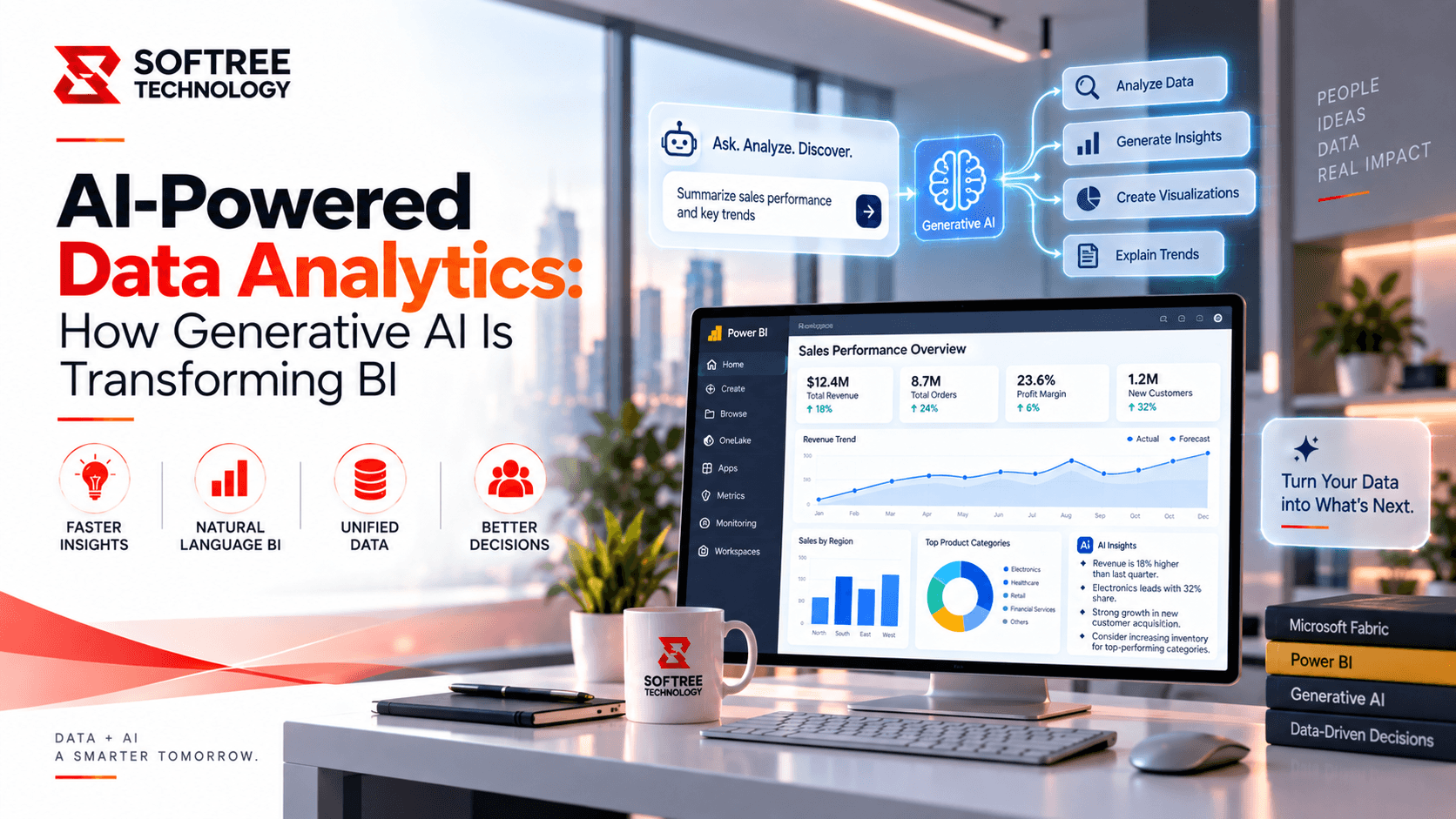
AI-powered data analytics uses artificial intelligence and machine learning to automate, accelerate, or improve how organizations collect, prepare, analyze, interpret, and communicate data. Generative AI extends this capability by allowing users to interact with analytical systems using natural language and receive summaries, explanations, queries, recommendations, and other analytical outputs.
For enterprises, the goal is to reduce the time between asking a business question and receiving a trustworthy, actionable answer while maintaining data security, governance, accuracy, and human accountability.
What Is AI-Powered Data Analytics?
AI-powered data analytics combines traditional analytics capabilities with artificial intelligence to make data analysis faster, more accessible, and more useful. Instead of relying entirely on predefined reports or technical query languages, users can interact with data using natural-language questions.
Generative AI can help explain changes in business performance, summarize dashboards, investigate patterns, generate analytical queries, and surface relevant insights. However, generative AI does not replace the underlying analytics foundation. It works best when connected to reliable enterprise data, well-defined metrics, appropriate access controls, and a trusted semantic layer.
Why Traditional BI Is Not Enough
Many organizations have invested heavily in business intelligence but still face challenges when turning data into timely decisions. Enterprises may have hundreds of dashboards, thousands of metrics, and multiple reporting environments spread across departments.
Business users frequently depend on analysts for ad hoc questions and recurring reporting requests. At the same time, large numbers of dashboards can make it difficult to identify which information actually matters. Different teams may also use inconsistent KPI definitions, while emerging patterns and anomalies can be difficult to detect quickly.
The challenge is therefore not a shortage of data. The bigger challenge is transforming trusted data into understandable, relevant, and actionable insight at the speed the business requires.
How Generative AI Is Transforming Business Intelligence
Generative AI introduces a more natural way for business users to interact with analytical information. Instead of navigating multiple dashboards to answer a question, users can ask questions in everyday language and progressively explore the results.
For example, an executive could ask which region experienced the largest margin decline and then follow up by asking what contributed to that change. The analytics system can translate the questions into analytical operations, summarize relevant information, and help users explore the underlying data.
This can make BI more accessible to users who may not be comfortable with complex analytical interfaces or technical query languages.
Generative AI can also combine trends, anomalies, forecasts, and contextual information. This allows BI to move beyond simply describing historical performance toward helping users understand drivers, identify emerging issues, and evaluate what may happen next.
Building a Strong AI-Powered Analytics Foundation
Successful AI-powered analytics begins with the data foundation. AI-generated answers are only as reliable as the data and business definitions behind them. Organizations should consolidate critical data sources, establish data quality rules, document lineage, and define ownership for important datasets and metrics.
A trusted semantic layer is equally important. Business terms such as revenue, margin, customer, region, period, and growth need consistent definitions across reports and analytical experiences. Without this layer, an AI system may generate an answer that appears reasonable but is based on an incorrect interpretation of the business metric.
Once the data foundation is established, generative AI can be introduced as an interaction and reasoning layer on top of existing BI capabilities. This approach preserves governance, security, semantic models, visual reporting, and repeatable metrics while adding natural-language interaction and intelligent assistance.
Combining Descriptive, Diagnostic, and Predictive Analytics
AI-powered analytics becomes more valuable when different analytical capabilities work together.
Descriptive analytics helps organizations understand what happened. It provides historical reporting, KPIs, and performance summaries.
Diagnostic analytics helps determine why something happened by examining relationships, changes, anomalies, and potential drivers.
Predictive analytics estimates what may happen next using historical patterns and available signals.
Prescriptive approaches can go further by helping organizations evaluate potential actions based on analytical findings.
Combining these capabilities allows an enterprise analytics experience to move from simply showing a KPI to helping users understand the drivers behind it and determine what deserves attention next.
Benefits of AI-Powered Business Intelligence
Faster Time to Insight
Natural-language interaction can reduce the number of steps required to find an answer. Business users can begin with a question and refine it conversationally instead of waiting for a new report for every variation of the question.
Higher Analyst Productivity
AI can assist with repetitive analytical activities such as summarization, query drafting, documentation, and initial investigation. This allows analysts to spend more time validating complex findings and addressing higher-value business problems.
Better Decision Support
AI can bring together trends, comparisons, anomalies, and forecasts within a single analytical experience. Instead of focusing only on the current value of a KPI, decision-makers can explore the factors influencing that KPI and identify areas that require attention.
Improved Data Accessibility
Conversational analytics can make business intelligence easier to use for employees who are less familiar with technical query languages or complex BI interfaces. This can encourage broader adoption of enterprise data and support a stronger self-service analytics culture.
Measurable Business Value
Enterprises should evaluate AI-powered BI based on business outcomes rather than AI adoption alone. Useful measurements include analyst hours saved, time-to-answer, report development cycles, self-service question resolution, adoption, decision-cycle time, and operational outcomes resulting from faster intervention.
Enterprise Use Cases
Executive Performance Analytics
Executives can use conversational analytics to explore revenue, margins, customer growth, operational KPIs, and regional performance while receiving concise contextual explanations.
Sales and Revenue Analytics
AI can help sales teams identify pipeline changes, unusual sales patterns, product performance, and customer segments that require attention. This can support faster investigation of revenue opportunities and emerging risks.
Supply Chain and Logistics
Organizations can combine operational data with AI-assisted anomaly detection, demand signals, cost analysis, and exception summaries. This can help teams identify supply chain risks earlier and prioritize areas requiring intervention.
Financial Planning and Analysis
Finance teams can use AI-assisted analytics to accelerate variance analysis, scenario exploration, management reporting, and narrative generation while maintaining controlled financial definitions.
Customer Analytics
AI-powered analytics can summarize customer behavior, identify segment changes, and support analysis of churn, retention, and service patterns.
Healthcare Analytics
Healthcare organizations can use governed analytics environments to support operational reporting, resource utilization, claims analysis, and trend discovery. Because healthcare data can be highly sensitive, these applications require appropriate privacy, security, and governance controls.
Operations and Manufacturing
AI-assisted BI can help organizations explain production deviations, monitor operational KPIs, and identify patterns across equipment, quality, and throughput data.
Responsible AI in Enterprise Analytics
Enterprise AI analytics should not treat generated answers as automatically authoritative. AI responses need to be grounded in trusted enterprise data and supported by appropriate context or evidence.
Organizations should implement identity-based access, data permissions, prompt and output controls, logging, monitoring, evaluation, and human review for high-impact decisions. Sensitive information should only be exposed to AI systems when appropriate permissions, business requirements, and security controls are in place.
Accuracy and transparency are also important. When the system does not have enough information or confidence to provide a reliable answer, it should communicate that limitation rather than generate an unsupported response.
Microsoft Fabric, Power BI, and Enterprise AI
In a Microsoft-centric environment, Microsoft Fabric can provide an integrated data and analytics foundation, while Power BI provides governed business intelligence and visualization. Azure AI services can provide generative AI capabilities that sit alongside these analytics technologies.
This combination can create an architecture where enterprise data flows through governed data platforms and semantic models before being made available to dashboards, analytical applications, or AI-assisted experiences.
The exact architecture should be determined by existing systems, security requirements, workloads, data maturity, and organizational needs rather than applying the same design to every enterprise.
Best Practices for AI-Powered Analytics
Organizations should begin with business decisions and measurable outcomes, not with the AI model itself. The first question should be what decision needs to improve and how faster or better insight will contribute to that outcome.
A strong data foundation should come next. High-quality, governed data and consistent semantic definitions provide the foundation for trustworthy analytical experiences.
AI responses should be grounded in enterprise data, with appropriate context and evidence available for important conclusions. Existing security boundaries should remain in place through least-privilege access and appropriate authorization.
Organizations should also evaluate accuracy, relevance, latency, cost, and failure modes before moving AI-powered analytics into production. Financial, regulatory, clinical, safety, and other high-impact decisions should retain appropriate human review.
How to Implement AI-Powered Data Analytics
A phased approach can reduce implementation risk and make business value easier to measure.
Assess
Identify high-value business decisions, existing BI assets, critical datasets, user groups, security requirements, and current analytics bottlenecks.
Prepare the Data
Improve data quality, lineage, governance, and semantic definitions for the selected business domain.
Pilot
Start with one or two focused use cases. Introduce natural-language analytics and AI-assisted insight generation while establishing clear evaluation criteria.
Govern
Implement access controls, monitoring, auditability, responsible AI policies, prompt and output evaluation, and human-review procedures.
Scale
Once successful patterns have been validated, expand them across additional departments and data domains using reusable architecture, components, and governance practices.
Measuring the Success of AI-Powered Analytics
Measuring success requires more than tracking how often employees interact with an AI analytics tool. Organizations should measure whether the technology is actually improving the way decisions are made.
Key measures can include time to insight, self-service analytics rate, analyst productivity, answer quality, and business outcomes. Time to insight measures how quickly users move from a business question to a validated answer, while self-service rates indicate how many questions can be resolved without analyst intervention.
Answer quality should consider accuracy, relevance, grounding, and user feedback. Ultimately, organizations should connect analytics improvements to measurable revenue, cost, risk, service, or operational outcomes.
Conclusion
AI-powered data analytics is helping enterprises move beyond static dashboards toward more conversational, contextual, and proactive business intelligence. Generative AI can make analytical information easier to explore, accelerate insight discovery, and help business users understand trends, anomalies, and potential actions.
The foundation remains just as important as the AI layer. Trusted data, consistent semantic models, strong governance, security, evaluation, and human accountability are essential for building analytics systems that organizations can rely on.
Softree Technology helps organizations modernize enterprise data and analytics environments, integrate Microsoft data and AI technologies, and build scalable BI solutions around measurable business outcomes. Whether the goal is modernizing Power BI, adopting Microsoft Fabric, introducing AI-powered analytics, or strengthening data engineering and governance, the focus remains on turning enterprise data into useful, actionable intelligence.