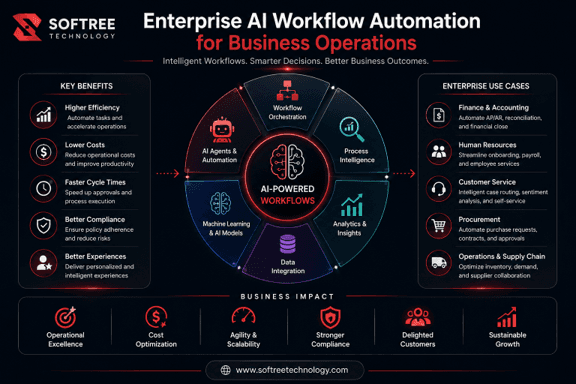
Enterprise AI Workflow Automation for Business Operations
Executive Summary
Enterprise AI Workflow Automation is emerging as one of the most significant operational transformation initiatives for modern organizations. As businesses continue to expand across geographies, systems, and customer channels, managing workflows through manual processes and traditional automation approaches is becoming increasingly unsustainable.
For many organizations, business operations still rely on a combination of emails, spreadsheets, disconnected applications, manual approvals, and fragmented processes. While traditional workflow automation has helped reduce repetitive work, it often struggles to adapt to changing business conditions, handle unstructured data, or support complex decision-making.
Enterprise AI Workflow Automation introduces a new approach by combining workflow orchestration, artificial intelligence, machine learning, process intelligence, and AI agents into a unified operational framework. Instead of simply automating predefined tasks, AI-powered workflows can understand context, analyze information, make recommendations, predict outcomes, and continuously optimize performance.
The growing adoption of AI workflow automation is being driven by several business priorities:
- Improving operational efficiency
- Reducing costs
- Accelerating decision-making
- Enhancing customer experiences
- Improving compliance and governance
- Enabling business scalability
- Supporting digital transformation initiatives
Organizations across industries are increasingly leveraging AI-powered workflows to automate finance operations, customer service processes, HR activities, procurement workflows, supply chain coordination, and enterprise-wide operational activities.
The future of workflow automation is no longer about creating more rules.
It is about creating intelligent operational systems capable of adapting, learning, and driving measurable business outcomes.
This article explores the challenges associated with traditional workflows, the role of AI in workflow modernization, implementation strategies, business benefits, enterprise use cases, best practices, and future opportunities for organizations pursuing operational excellence through Enterprise AI Workflow Automation.
Business Problem
The Growing Complexity of Enterprise Operations
Over the last decade, organizations have invested heavily in digital technologies.
Enterprise Resource Planning (ERP) systems manage financial and operational data.
Customer Relationship Management (CRM) platforms support sales and customer interactions.
Human Resource Management Systems (HRMS) manage employee information.
Collaboration platforms facilitate communication.
Analytics solutions provide business intelligence.
Despite these investments, many organizations continue to experience significant operational inefficiencies.
The problem is not necessarily a lack of technology.
The problem is how business processes flow across these systems.
In many enterprises, workflows remain fragmented, manual, and heavily dependent on human intervention.
As organizations scale, workflow complexity increases exponentially.
Processes that once involved a few employees may eventually span multiple departments, business units, geographic regions, and technology platforms.
Without intelligent workflow management, operational bottlenecks begin to emerge.
Common Workflow Challenges
Manual Approval Processes
Many organizations continue to rely on email-based approvals for critical business activities.
Examples include:
- Purchase requests
- Expense approvals
- Contract reviews
- Vendor onboarding
- Recruitment approvals
Manual approvals introduce delays, increase the risk of errors, and create visibility challenges.
Decision-makers often lack real-time information regarding workflow status, resulting in slower execution and reduced operational efficiency.
Disconnected Systems
Modern enterprises often operate dozens or even hundreds of business applications.
Examples include:
- ERP platforms
- CRM systems
- HR solutions
- Service management tools
- Financial systems
- Supply chain platforms
These systems frequently operate independently.
Employees must manually transfer information between applications, resulting in duplication, inefficiencies, and data inconsistencies.
Disconnected systems also make it difficult to achieve a unified view of operations.
Lack of Process Visibility
Organizations often struggle to answer critical operational questions:
- Where are workflow bottlenecks occurring?
- Which approvals cause delays?
- Which teams are overloaded?
- What processes generate the highest costs?
- Which workflows create compliance risks?
Without visibility, organizations cannot effectively optimize operations.
Compliance and Governance Risks
Regulatory requirements continue to increase across industries.
Organizations must demonstrate:
- Process consistency
- Auditability
- Data security
- Policy compliance
Manual workflows increase the likelihood of compliance failures and audit findings.
Employee Productivity Challenges
Employees frequently spend significant amounts of time performing repetitive administrative activities.
Examples include:
- Data entry
- Status tracking
- Document routing
- Information gathering
- Follow-up communications
These activities consume valuable resources that could otherwise be focused on strategic and customer-facing work.
Why Traditional Workflow Automation Is No Longer Enough
Traditional workflow automation solutions were designed to execute predefined rules.
For example:
"If invoice amount exceeds $10,000, route to finance manager."
While effective for simple scenarios, traditional automation has limitations.
It cannot easily:
- Interpret unstructured documents
- Understand business context
- Adapt to changing conditions
- Predict outcomes
- Make recommendations
- Learn from historical patterns
Modern business environments require greater intelligence and adaptability.
This is driving organizations toward Enterprise AI Workflow Automation.
Solution / Strategy
What Is Enterprise AI Workflow Automation?
Enterprise AI Workflow Automation combines workflow orchestration technologies with artificial intelligence capabilities to create intelligent business processes.
Rather than simply executing predefined instructions, AI-powered workflows can:
- Analyze information
- Understand context
- Recommend actions
- Predict outcomes
- Learn from historical data
- Optimize performance
The result is a more intelligent and adaptive operational environment.
Core Components of Enterprise AI Workflow Automation Workflow Orchestration
Workflow orchestration coordinates activities across systems, teams, and processes.
It ensures that tasks move through business processes efficiently while maintaining visibility and control.
Workflow orchestration serves as the foundation upon which AI capabilities are built.
Artificial Intelligence
AI enhances workflows by enabling:
- Predictive analytics
- Pattern recognition
- Decision support
- Natural language processing
- Intelligent recommendations
AI allows workflows to become more proactive and outcome-focused.
AI Agents
AI agents represent one of the most significant developments in workflow automation.
Unlike traditional automation, AI agents can:
- Gather information
- Evaluate options
- Execute actions
- Coordinate across systems
- Escalate issues when necessary
AI agents help organizations move from workflow automation to intelligent operational orchestration.
Process Intelligence
Process intelligence provides visibility into workflow performance.
Capabilities include:
- Process mining
- Bottleneck analysis
- Workflow monitoring
- Operational analytics
Organizations gain actionable insights into how processes actually operate.
Data Integration
AI workflows depend on access to reliable information.
Successful implementations integrate data from:
- ERP systems
- CRM platforms
- HR applications
- Financial systems
- Operational databases
- External data sources
Integrated data creates the foundation for intelligent decision-making.
Benefits & ROI
Why Organizations Are Investing in AI Workflow Automation
For many enterprises, workflow automation initiatives begin as operational improvement projects.
However, as organizations mature, they increasingly recognize that AI Workflow Automation delivers far more than efficiency gains.
It becomes a strategic capability that impacts productivity, customer experience, compliance, scalability, innovation, and competitive advantage.
Unlike traditional automation, AI-powered workflows continuously improve and generate value across multiple business functions.
Operational Benefits
Faster Process Execution
One of the most immediate benefits of Enterprise AI Workflow Automation is faster workflow execution.
Traditional workflows often experience delays caused by:
- Manual reviews
- Approval bottlenecks
- Information gathering
- Cross-department coordination
- Status tracking
AI-powered workflows significantly reduce these delays.
For example:
An AI-driven procurement workflow can automatically validate requests, assess budget availability, identify policy exceptions, and route approvals to appropriate stakeholders without manual intervention.
As a result:
- Cycle times decrease
- Processing speeds increase
- Business operations accelerate
Organizations often report workflow completion times reduced by 30%–70%.
Increased Employee Productivity
Knowledge workers spend substantial time performing repetitive administrative activities.
Examples include:
- Reviewing documents
- Updating systems
- Managing approvals
- Routing information
- Following up on requests
AI automation eliminates many of these low-value activities.
Employees can instead focus on:
- Strategic planning
- Customer engagement
- Innovation
- Revenue generation
- Problem-solving
This creates significant productivity gains across the organization.
Reduced Human Error
Manual workflows are prone to:
- Data entry mistakes
- Incorrect approvals
- Missed deadlines
- Inconsistent processes
AI automation helps standardize execution and reduce variability.
Benefits include:
- Improved accuracy
- Better compliance
- Reduced rework
- Higher process quality
Improved Operational Visibility
Many organizations lack visibility into workflow performance.
AI-powered workflow platforms provide:
- Real-time monitoring
- Bottleneck analysis
- Workflow analytics
- Performance dashboards
Leadership gains deeper insights into operational efficiency and process effectiveness.
Financial Benefits
Lower Operating Costs
Automation reduces the amount of manual effort required to execute business processes.
Cost savings typically result from:
- Reduced labor requirements
- Lower administrative overhead
- Improved process efficiency
- Reduced error correction
Organizations can often redirect resources toward growth initiatives instead of routine operations.
Faster Revenue Recognition
Many revenue-generating activities depend on workflow efficiency.
Examples include:
- Sales approvals
- Contract processing
- Customer onboarding
- Order fulfillment
AI automation accelerates these processes.
The result is:
- Faster deal closures
- Improved cash flow
- Reduced revenue leakage
Better Resource Utilization
AI-powered workflows help organizations optimize workforce allocation.
Instead of assigning employees to repetitive activities, organizations can focus talent on:
- Customer success
- Innovation
- Business development
- Strategic projects
This improves overall resource efficiency.
Strategic Benefits
Improved Business Agility
Market conditions continue to evolve rapidly.
Organizations must respond quickly to:
- Customer expectations
- Competitive pressures
- Regulatory changes
- Economic shifts
AI workflows provide the flexibility required to adapt processes without extensive manual intervention.
Better Decision-Making
AI-powered workflows provide:
- Predictive insights
- Risk assessments
- Intelligent recommendations
- Data-driven guidance
Decision-makers gain access to higher-quality information faster.
This improves business outcomes and reduces uncertainty.
Enhanced Customer Experience
Customers increasingly expect:
- Faster responses
- Personalized interactions
- Consistent service
AI Workflow Automation helps organizations:
- Resolve requests faster
- Improve service quality
- Reduce response times
- Deliver better experiences
Customer satisfaction often improves significantly following workflow modernization.
Enterprise Scalability
As organizations grow, process complexity increases.
Traditional workflows often struggle to scale.
AI-powered workflows provide:
- Consistency
- Standardization
- Automation
- Adaptability
This enables organizations to support growth without proportional increases in operational costs.
Enterprise Use Cases
Finance & Accounting
Finance teams manage some of the most workflow-intensive processes in the organization.
AI Workflow Automation supports:
Invoice Processing
AI can:
- Extract invoice information
- Validate data
- Detect anomalies
- Route approvals
This reduces manual effort and improves accuracy.
Expense Management
Automated workflows can:
- Review expense submissions
- Verify policy compliance
- Flag exceptions
- Approve eligible requests
Financial Close Processes
Organizations can automate:
- Reconciliations
- Reporting preparation
- Data validation
- Approval workflows
This shortens financial close cycles and improves reporting quality.
Human Resources
HR departments manage numerous employee-centric workflows.
Employee Onboarding
AI-powered workflows can automate:
- Document collection
- System provisioning
- Training assignments
- Equipment requests
This improves onboarding experiences while reducing administrative effort.
Recruitment
AI can assist with:
- Candidate screening
- Interview scheduling
- Resume analysis
- Recruitment coordination
This accelerates hiring processes.
Employee Support
AI agents can answer common HR questions regarding:
- Benefits
- Leave policies
- Payroll information
- Company procedures
This improves employee experience and reduces HR workload.
Customer Service
Customer experience is increasingly dependent on operational efficiency.
Intelligent Case Routing
AI can automatically route customer requests based on:
- Issue type
- Priority
- Customer value
- Agent expertise
This improves response times.
Service Escalation
AI workflows identify situations requiring escalation and ensure appropriate actions occur quickly.
Customer Sentiment Analysis
AI can evaluate customer communications and identify:
- Frustration
- Urgency
- Escalation risk
This enables proactive intervention.
Operations & Procurement
Operations teams often manage complex, cross-functional workflows.
Procurement Automation
AI can streamline:
- Purchase requests
- Vendor approvals
- Contract reviews
- Procurement compliance
Asset Management
Workflows can automate:
- Asset requests
- Maintenance scheduling
- Inventory tracking
- Lifecycle management
Compliance Monitoring
Organizations can automate policy enforcement and audit preparation activities.
Supply Chain Management
Supply chains generate significant workflow complexity.
Demand Forecasting
AI helps predict future demand and trigger workflow actions accordingly.
Inventory Optimization
Automated workflows support:
- Replenishment planning
- Stock monitoring
- Exception management
Supplier Collaboration
AI-powered workflows improve coordination with vendors and suppliers.
Sales & Revenue Operations
Sales teams rely on efficient workflows to maximize revenue generation.
Lead Qualification
AI evaluates leads based on:
- Engagement history
- Demographics
- Buying signals
Qualified leads receive higher priority.
Opportunity Management
Workflows automate:
- Deal reviews
- Forecast updates
- Approval processes
Proposal Management
AI helps generate and route proposals while ensuring compliance and consistency.
Best Practices
Start with Business Outcomes, Not Technology
One of the most common mistakes organizations make is starting their automation journey by selecting technology platforms before defining business objectives.
Successful AI Workflow Automation initiatives begin with a clear understanding of the outcomes the organization wants to achieve.
Examples include:
- Reducing process cycle times
- Improving customer response times
- Increasing employee productivity
- Reducing operational costs
- Enhancing compliance performance
- Improving customer satisfaction
When business objectives are clearly defined, organizations can prioritize workflows that deliver measurable value and align automation investments with strategic goals.
Focus on High-Impact Workflows First
Organizations should avoid attempting to automate every workflow simultaneously.
Instead, they should focus on processes that:
- Have high transaction volumes
- Involve repetitive activities
- Create operational bottlenecks
- Generate measurable business impact
- Require significant manual effort
Examples include:
- Invoice approvals
- Employee onboarding
- Customer service ticket routing
- Procurement approvals
- Contract management
Early success builds organizational confidence and creates momentum for broader automation initiatives.
Establish Strong Governance Frameworks
Governance becomes increasingly important as AI capabilities expand.
Organizations should define:
- Ownership responsibilities
- Approval authorities
- Data governance standards
- Compliance requirements
- Risk management processes
- Security controls
A strong governance framework ensures AI-powered workflows remain transparent, accountable, and compliant with regulatory requirements.
Prioritize Data Quality
AI is only as effective as the data it uses.
Poor data quality can result in:
- Incorrect recommendations
- Workflow failures
- Inaccurate forecasts
- Compliance issues
- Reduced user trust
Organizations should establish data quality standards covering:
- Accuracy
- Completeness
- Consistency
- Timeliness
- Accessibility
Investing in data governance significantly improves automation outcomes.
Design for Scalability
Many automation initiatives begin as departmental projects but eventually expand across the enterprise.
Workflows should be designed to support:
- Additional users
- Increased transaction volumes
- New business units
- Future AI capabilities
- Additional integrations
Scalable architectures reduce future rework and support long-term growth.
Maintain Human Oversight
Despite advances in AI, human judgment remains essential.
Organizations should identify scenarios where:
- Human review is required
- Escalations should occur
- Final approvals remain manual
- Exceptions require intervention
The goal is not to eliminate human involvement but to enable employees to focus on higher-value decisions.
Implementation Approach
Phase 1: Assessment and Discovery
The first phase focuses on understanding the current operational environment.
Key activities include:
- Workflow inventory
- Process mapping
- Stakeholder interviews
- Technology assessments
- Data evaluations
- Pain-point analysis
Organizations should identify:
- High-value automation opportunities
- Existing bottlenecks
- Compliance requirements
- Business priorities
The outcome is a clear understanding of current-state operations and potential improvement opportunities.
Phase 2: Strategy Development
Once opportunities are identified, organizations should develop a structured automation strategy.
The strategy should define:
Business Objectives
Examples:
- Reduce processing times by 50%
- Improve customer response times
- Increase productivity
- Reduce operational costs
Governance Model
Define:
- Roles and responsibilities
- Risk management procedures
- Compliance controls
- Approval structures
Technology Roadmap
Identify:
- Workflow platforms
- AI technologies
- Integration requirements
- Data architecture needs
A documented roadmap ensures alignment across stakeholders.
Phase 3: Pilot Implementation
Organizations should begin with a pilot deployment rather than a full-scale rollout.
Pilot projects provide opportunities to:
- Validate assumptions
- Measure outcomes
- Gather feedback
- Refine workflows
Pilot selection criteria should include:
- Business impact
- Process complexity
- Stakeholder support
- Data availability
Successful pilots create confidence and support future investment decisions.
Phase 4: Enterprise Scaling
Following successful pilots, organizations can expand automation initiatives across departments.
Scaling activities include:
- Standardizing workflows
- Expanding integrations
- Deploying AI capabilities
- Training employees
- Enhancing governance
The objective is to create a connected automation ecosystem that supports enterprise-wide operations.
Phase 5: Continuous Optimization
The final phase focuses on long-term improvement.
Organizations should:
- Track performance metrics
- Monitor workflow effectiveness
- Evaluate AI accuracy
- Identify optimization opportunities
- Expand automation coverage
Continuous optimization ensures automation programs continue delivering value as business requirements evolve.
AI Workflow Maturity Model
Organizations typically progress through five stages of workflow maturity.
Level
Maturity Stage
Description
Level 1
Manual Operations
Processes rely heavily on emails, spreadsheets, and human coordination
Level 2
Basic Workflow Automation
Rule-based workflows automate repetitive activities
Level 3
Intelligent Automation
AI assists with decisions and recommendations
Level 4
Enterprise AI Workflows
AI is integrated across departments and business functions
Level 5
Autonomous Operations
AI agents orchestrate workflows and continuously optimize outcomes
Organizations should assess current maturity levels and establish a roadmap for progression.
Comparison Table
Criteria
Traditional Workflow Automation
Enterprise AI Workflow Automation
Decision Making
Rule-Based
AI-Assisted
Adaptability
Limited
Dynamic
Data Processing
Structured Data Only
Structured + Unstructured Data
Learning Capability
None
Continuous Learning
Optimization
Manual Updates
Automated Optimization
Process Visibility
Limited
Real-Time Analytics
User Experience
Process-Centric
Outcome-Centric
Scalability
Moderate
Enterprise-Wide
Insights
Historical Reporting
Predictive & Prescriptive Insights
Business Impact
Efficiency Improvement
Business Transformation
Compliance Support
Reactive
Proactive Monitoring
Customer Experience
Standardized
Personalized & Intelligent
Ready to modernize your business operations with Enterprise AI Workflow Automation?
Enterprise automation is no longer limited to task execution.
Today's organizations require intelligent workflows capable of supporting decisions, improving efficiency, enhancing customer experiences, and driving business growth.
At Softree Technology, we help organizations transform fragmented and manual processes into intelligent, scalable, and AI-powered operational ecosystems.
Our Expertise Includes:
• Enterprise AI Workflow Strategy & Roadmap Development
• Intelligent Process Automation & Workflow Modernization
• AI Agents & Workflow Orchestration Solutions
• Microsoft Power Platform & Power Automate Implementations
• Copilot Studio & Conversational AI Solutions
• Process Intelligence & Workflow Analytics
• AI Governance & Security Frameworks
• Cloud & Data Modernization Initiatives
• Enterprise Architecture & Digital Transformation Programs
Whether you are exploring workflow automation opportunities or scaling enterprise-wide AI initiatives, our team can help you build intelligent workflows that deliver measurable business outcomes.
Conclusion
Enterprise AI Workflow Automation represents the next evolution of business operations.
Traditional workflow automation helped organizations eliminate repetitive tasks and improve efficiency through predefined rules. While these capabilities remain valuable, modern enterprises require far more than rule-based execution.
Today's organizations operate in dynamic environments characterized by rapidly changing customer expectations, increasing regulatory requirements, growing operational complexity, and intense competitive pressures.
To succeed, businesses need workflows that can:
- Understand context
- Analyse information
- Recommend actions
- Predict outcomes
- Adapt to changing conditions
- Continuously improve performance
Enterprise AI Workflow Automation addresses these requirements by combining artificial intelligence, workflow orchestration, process intelligence, machine learning, and AI agents into a unified operational framework. Organizations that successfully implement AI-powered workflows achieve significant benefits including:
✅ Improved productivity
✅ Reduced operational costs
✅ Faster decision-making
✅ Enhanced compliance
✅ Better customer experiences
✅ Greater scalability
✅ Stronger competitive advantage
The future of workflow automation is not simply about automating more tasks.
It is about creating intelligent business operations capable of delivering better outcomes with greater speed, accuracy, and agility.
As AI technologies continue to mature, organizations that invest in workflow modernization today will be better positioned to compete, innovate, and grow in an increasingly digital economy.
Enterprise AI Workflow Automation is no longer a future concept.
It is becoming a foundational capability for operational excellence and sustainable business transformation.