Introduction
Artificial Intelligence has moved beyond experimentation. Organizations across industries are now using AI to improve customer experiences, automate repetitive work, support employees, strengthen decision-making, and improve operational efficiency.
The focus is also changing. Instead of asking whether AI can be used in a business, leaders are increasingly asking where AI can create meaningful business value.
The answer depends on the organization. One enterprise may benefit most from automating document-heavy operations, while another may prioritize customer service, financial analysis, supply chain optimization, or enterprise knowledge management.
The strongest AI implementations address a clear business challenge, integrate with existing processes, and produce measurable improvements.
Quick Answer
Enterprise AI use cases are practical applications of Artificial Intelligence that improve business processes, decision-making, customer experiences, and operational performance.
Common use cases include:
- Process and workflow automation
- Intelligent document processing
- AI-powered enterprise search
- AI decision intelligence
- Customer service automation
- Supply chain optimization
- Employee self-service
- Predictive analytics
- AI agents
- Intelligent knowledge management
The key takeaway is that enterprises should prioritize AI based on business impact and feasibility rather than adopting AI simply because the technology is available.
Table of Contents
- What Are Enterprise AI Use Cases?
- Why Enterprises Are Moving From AI Experiments to Business Use Cases
- Enterprise AI Across Key Business Functions
- Why Enterprise AI Needs to Be Connected
- Technologies Enabling Enterprise AI
- High-Value Enterprise AI Use Cases
- Business Benefits of Enterprise AI
- Best Practices for Enterprise AI Adoption
- Frequently Asked Questions
- Key Takeaways
- Conclusion
What Are Enterprise AI Use Cases?
Enterprise AI use cases are practical applications of Artificial Intelligence within business functions to improve processes, decision-making, customer experiences, or operational performance.
These applications can use different AI capabilities, including:
- Generative AI
- AI Agents
- Machine Learning
- Predictive Analytics
- Natural Language Processing
- Intelligent Document Processing
- Conversational AI
- Intelligent Workflow Automation
- Enterprise Knowledge Search
The strongest implementations often combine several capabilities. For example, AI can understand an incoming customer request, retrieve relevant information, determine the next action, and trigger an automated workflow. This creates a connected business process rather than simply adding an AI chatbot.
Why Enterprises Are Moving From AI Experiments to Business Use Cases
Many organizations have experimented with generative AI assistants, chatbots, automation tools, and predictive analytics. However, experimentation alone does not create transformation.
Enterprises often encounter challenges such as:
- AI initiatives remaining isolated within individual departments
- Business data being distributed across disconnected systems
- Employees continuing to perform repetitive manual processes
- AI pilots lacking measurable business outcomes
- Security and governance requirements slowing adoption
- Existing applications not easily supporting intelligent capabilities
- Difficulty identifying which AI opportunities should be prioritized
A successful enterprise AI strategy therefore starts with the business process rather than the technology. Organizations should identify where intelligence, automation, and decision support can solve measurable business problems.
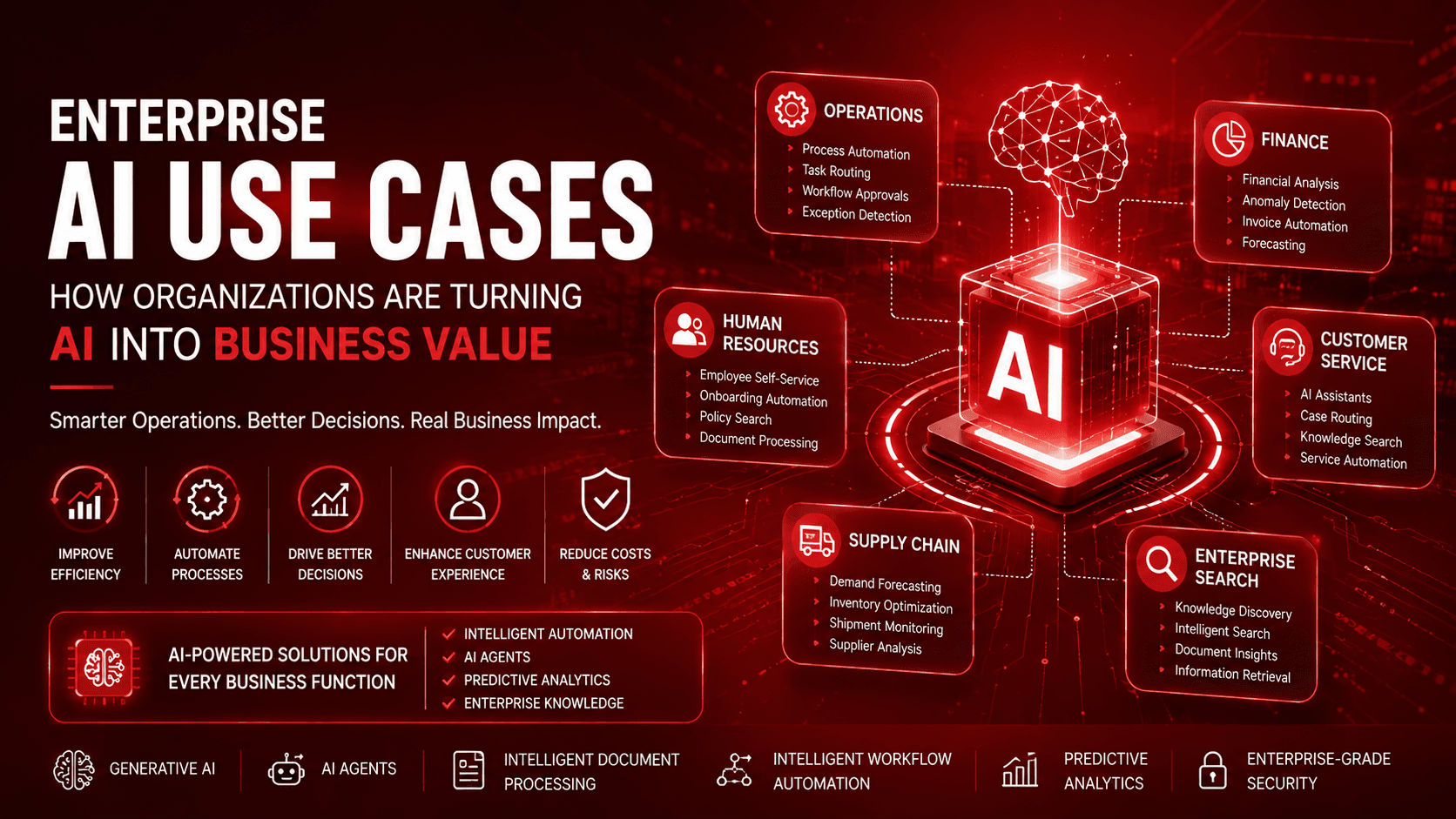
Enterprise AI Across Key Business Functions
Operations and Process Automation
AI can help operations teams identify bottlenecks, classify requests, automate routine decisions, and trigger workflows based on business events.
Common examples include:
- Automated request processing
- Exception detection
- Intelligent task routing
- Workflow approvals
- Operational notifications
- Process monitoring
The objective is to reduce unnecessary manual coordination while allowing employees to focus on activities that require judgment and expertise.
Finance and Business Intelligence
Finance teams manage large volumes of structured and unstructured information. AI can support financial analysis, forecasting, document processing, reconciliation, anomaly detection, and management reporting.
Common applications include:
- Financial trend analysis
- Unusual transaction detection
- Automated invoice processing
- Financial forecasting
- Financial document information extraction
- Management insight generation
Human Resources
AI can help HR teams automate routine requests, support employee onboarding, summarize employee information, answer policy questions, and route requests to the appropriate teams.
Common use cases include:
- Employee self-service assistants
- Automated onboarding workflows
- Leave and benefits inquiries
- HR document processing
- Policy search
- Employee knowledge management
These capabilities can improve employee experiences while reducing repetitive administrative work for HR teams.
Customer Service
AI can understand service requests, classify cases, recommend responses, retrieve relevant knowledge, and route complex issues to the appropriate support team.
AI-powered customer service can support:
- Conversational customer assistance
- Intelligent case routing
- Knowledge recommendations
- Automated service workflows
- Agent assistance
- Customer communication
The objective is not simply to automate conversations but to create a connected service process that provides faster and more consistent support.
Supply Chain and Logistics
Supply chain operations generate large volumes of data across warehouses, transportation networks, inventory systems, suppliers, and customer orders.
AI can support:
- Demand forecasting
- Inventory optimization
- Shipment monitoring
- Exception management
- Supplier analysis
- Warehouse process optimization
- Automated operational workflows
Connecting AI insights with workflows allows organizations to respond to supply chain issues more proactively.
Enterprise Knowledge Management
Enterprise knowledge is often distributed across documents, policies, emails, applications, intranets, and departmental repositories.
AI-powered knowledge solutions allow employees to discover relevant information using natural language instead of manually searching across multiple systems.
This can improve:
- Information discovery
- Employee productivity
- Knowledge sharing
- Internal support
- Decision-making
- Organizational knowledge reuse
Why Enterprise AI Needs to Be Connected
The greatest value often appears when individual AI capabilities are connected rather than implemented as isolated tools.
For example, a customer request could be understood by an AI assistant, matched against enterprise knowledge, routed through an automated workflow, recorded in a business application, and escalated to a human employee when necessary.
This creates a connected chain:
Understand → Decide → Act → Monitor
Moving from isolated AI capabilities to connected intelligent workflows helps organizations progress from individual AI experiments toward broader operational transformation.
Technologies Enabling Enterprise AI
Enterprise AI typically combines AI models, business applications, data platforms, automation tools, and cloud services.
Generative AI
Generative AI can summarize information, generate content, analyze documents, answer questions, and assist employees with everyday business activities.
AI Agents
AI Agents can interpret business context, determine the next action within approved boundaries, use connected systems, and coordinate multi-step workflows.
Intelligent Workflow Automation
Workflow automation connects AI decisions with actual business processes so approved actions can be triggered automatically.
Predictive Analytics
Predictive models identify patterns, forecast demand, detect risks, and anticipate potential business outcomes.
Enterprise Data Platforms
Reliable business data is essential for AI. Platforms such as Microsoft Fabric, Dataverse, enterprise databases, and cloud data services can provide the foundation for connected AI solutions.
High-Value Enterprise AI Use Cases
Intelligent Document Processing
Enterprises process invoices, contracts, applications, forms, claims, and other documents every day.
AI can extract relevant information, classify documents, validate data, and route records to the appropriate workflow. This reduces manual processing and improves consistency and processing speed.
AI-Powered Enterprise Search
Employees often spend significant time searching for policies, procedures, documents, and internal knowledge.
AI-powered enterprise search allows employees to ask questions using natural language and receive relevant information from approved enterprise sources.
AI Decision Intelligence
AI can analyze business information, identify patterns, generate forecasts, detect anomalies, and highlight areas requiring attention.
This moves organizations from simply reporting what happened toward understanding what may happen next.
AI Customer Service Automation
AI can classify customer requests, recommend responses, retrieve relevant knowledge, automate repetitive interactions, and route complex cases to human teams.
AI-Powered Operations
Operational teams can use AI to monitor processes, identify exceptions, predict bottlenecks, and trigger notifications, approvals, escalations, or follow-up workflows.
Business Benefits of Enterprise AI
Higher Productivity
Employees spend less time on repetitive administrative work and more time on strategic and customer-focused activities.
Faster Decision-Making
AI provides relevant information and insights faster, allowing business leaders to respond more quickly to changing conditions.
Improved Customer Experience
Intelligent assistants and automated workflows can provide faster and more consistent customer interactions.
Reduced Operational Costs
Automating repetitive processes can reduce manual effort and improve resource utilization.
Better Business Visibility
Connected AI solutions can bring information from different systems together, providing leaders with a clearer view of business performance.
Greater Scalability
Organizations can handle increasing workloads without increasing manual effort at the same rate.
Best Practices for Enterprise AI Adoption
Start With the Business Problem
The strongest AI initiatives begin with a clearly defined business challenge. Identify areas where delays, repetitive work, fragmented information, or poor visibility are affecting performance.
Prioritize High-Value Use Cases
Not every process requires AI. Prioritize opportunities based on:
- Business impact
- Process volume
- Feasibility
- Data availability
- Implementation complexity
Build on Existing Enterprise Systems
AI should complement existing business applications rather than create unnecessary technology silos. Integrating AI with CRM, ERP, HR, document management, and workflow systems creates more useful business solutions.
Establish Governance From the Beginning
Enterprise AI requires controls around data access, security, privacy, model usage, and human oversight. Governance should be part of solution design from the beginning.
Keep Humans in the Loop
AI should support employees and decision-makers, particularly when processes involve sensitive information, complex decisions, or significant business consequences.
Measure Business Outcomes
Track measurable improvements such as:
- Processing time
- Productivity
- Cost reduction
- Response time
- Accuracy
- Customer satisfaction
- Operational capacity
Frequently Asked Questions
What are enterprise AI use cases?
Enterprise AI use cases are practical applications of AI that solve specific business problems across functions such as operations, finance, HR, customer service, supply chain, and knowledge management.
Which enterprise functions benefit most from AI?
Almost every business function can benefit, but high-volume, repetitive, data-intensive, or decision-heavy processes are often strong candidates.
What is the difference between AI automation and AI agents?
AI automation typically follows defined workflows and rules, while AI Agents can interpret context, make decisions within approved boundaries, and coordinate multiple actions or systems.
How should organizations choose their first AI use case?
Start with a high-value business problem where the process is measurable, the required data is available, and the expected outcome can be clearly defined.
Is enterprise AI only useful for large organizations?
No. Cloud-based AI, automation, and business platforms allow organizations of different sizes to adopt AI incrementally and scale successful use cases over time.
Key Takeaways
- Start AI adoption with a measurable business problem.
- Prioritize high-volume, repetitive, data-intensive, or decision-heavy processes.
- Connect AI with existing enterprise applications and workflows.
- Use enterprise data platforms as the foundation for reliable AI solutions.
- Establish security, governance, and human oversight from the beginning.
- Measure AI success through business outcomes rather than technology adoption alone.
- Connected intelligent workflows can create greater value than isolated AI tools.
Conclusion
Enterprise AI is becoming valuable not because organizations can deploy more AI, but because they can apply it to the right business problems.
From intelligent document processing and enterprise search to customer service, decision intelligence, and operational automation, AI can improve how organizations work across virtually every business function.
The strongest implementations connect AI, enterprise data, business applications, and workflows into a coordinated operating model. Organizations that approach AI through measurable use cases can move beyond experimentation and build practical capabilities that improve productivity, decision-making, customer experience, and operational performance.
The future of enterprise AI will not be defined by how many AI tools an organization adopts. It will be defined by how effectively those capabilities are connected to the work that matters.
Build Practical Enterprise AI Solutions With Softree Technology
Softree Technology helps enterprises identify, design, and implement practical AI solutions using AI Automation, AI Agents, Microsoft Copilot, Azure AI Services, Microsoft Power Platform, Power Automate, Power Apps, Dataverse, and intelligent workflows.
The focus is on connecting AI capabilities with real business processes to automate work, improve decision-making, enhance customer experiences, and create measurable operational value.
Visit Softree Technology at https://www.softreetechnology.com/ to explore enterprise AI solutions.