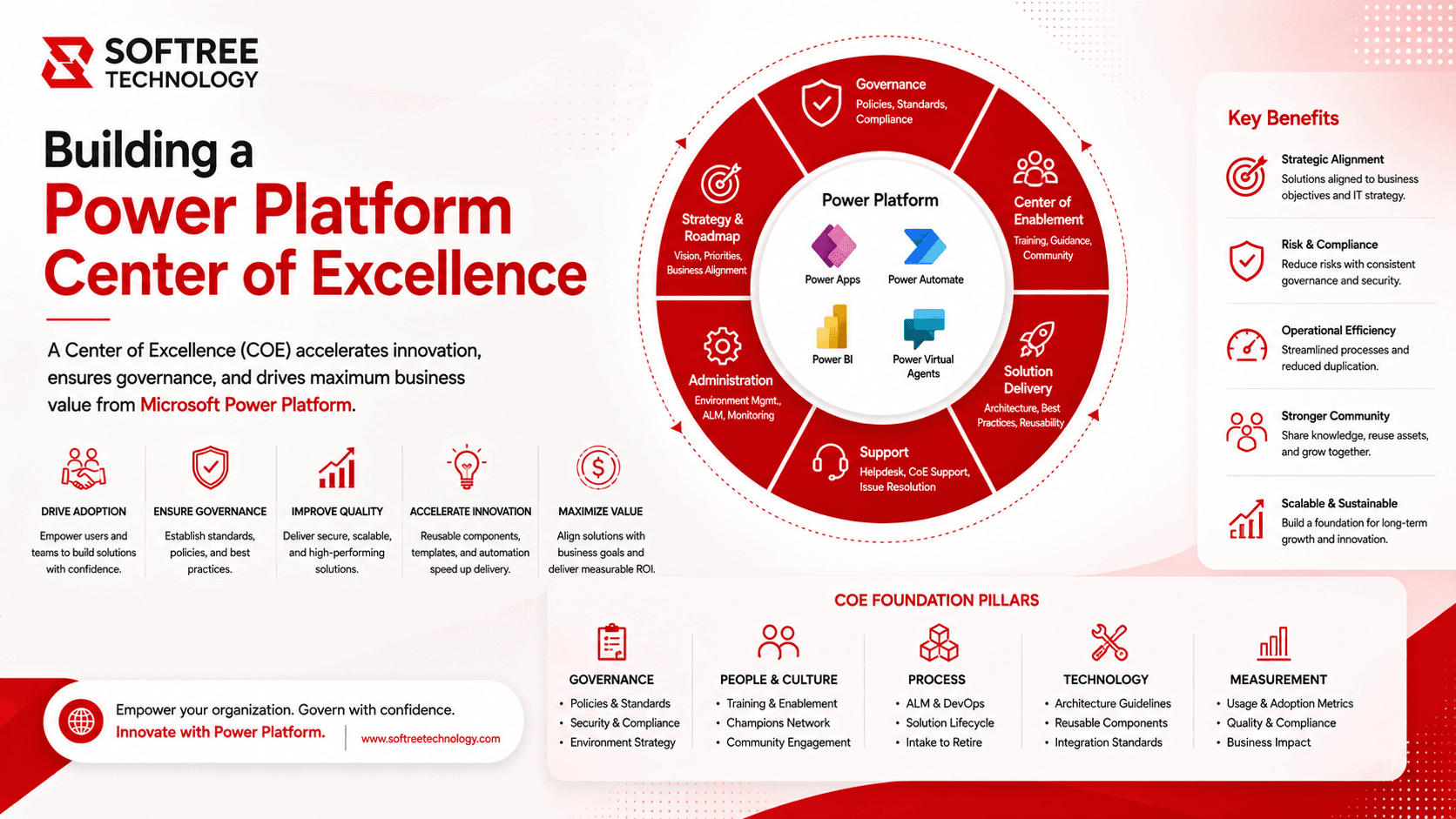
1. Introduction
├── Hook
Microsoft Power Platform enables organizations to build applications, automate workflows, analyze data, and create AI-powered solutions with low-code and no-code technologies.
├── Problem Statement
As Power Platform adoption grows, different departments may independently create applications and automations, leading to challenges around security, governance, compliance, application ownership, and data management.
└── What the Reader Will Learn
Learn what a Power Platform Center of Excellence is, why enterprises need one, how it works, its key components and benefits, common use cases, best practices, and mistakes to avoid.
──────────────────────────────────────────────────────────────
2. Quick Answer
├── Brief Summary
A Power Platform Center of Excellence (CoE) is an organizational framework for governing, supporting, and scaling Microsoft Power Platform adoption.
└── Key Takeaway
A successful CoE balances innovation with governance by providing standards, security, training, monitoring, and support while enabling employees to build solutions responsibly.
──────────────────────────────────────────────────────────────
3. Table of Contents
├── What Is a Power Platform Center of Excellence?
├── Why Is a Power Platform CoE Important?
├── How Does a Power Platform CoE Work?
├── Key Features / Components
├── Benefits of a Power Platform CoE
├── Common Use Cases
├── Best Practices
├── Common Mistakes to Avoid
├── Comparison: Without a CoE vs. With a CoE
├── Frequently Asked Questions
├── Key Takeaways
└── Conclusion
──────────────────────────────────────────────────────────────
4. What Is a Power Platform Center of Excellence?
├── Definition
A Power Platform CoE is a centralized governance and enablement framework that helps organizations successfully adopt and scale Microsoft Power Platform.
├── Overview
It brings together business leaders, IT teams, developers, administrators, security teams, and citizen developers to establish common standards for creating, managing, securing, and maintaining Power Platform solutions.
└── Industry Context
A CoE typically covers platform governance, environment management, security, compliance, application lifecycle management, citizen development, training, monitoring, adoption, and enterprise architecture.
──────────────────────────────────────────────────────────────
5. Why Is a Power Platform CoE Important?
├── Business Impact
│ ├── Accelerates low-code adoption
│ ├── Reduces development duplication
│ ├── Improves application quality
│ ├── Strengthens security
│ ├── Increases platform visibility
│ └── Improves compliance
├── Challenges It Solves
│ ├── Duplicate applications
│ ├── Unmanaged environments
│ ├── Security risks
│ ├── Inconsistent development practices
│ ├── Unclear application ownership
│ ├── Abandoned solutions
│ └── Compliance challenges
└── Key Benefits
A CoE creates a structured environment where business teams can continue innovating while IT and leadership maintain appropriate visibility, security, and control.
──────────────────────────────────────────────────────────────
6. How Does a Power Platform CoE Work?
├── Step 1: Establish Governance
Define policies for environments, security, data, connectors, ownership, naming conventions, deployment, and lifecycle management.
├── Step 2: Enable Citizen Developers
Provide training, guidelines, templates, documentation, community sessions, office hours, reusable components, and support channels.
├── Step 3: Monitor and Manage the Platform
Track applications, flows, environments, makers, connectors, usage patterns, and business-critical solutions.
└── Diagram / Process Flow / Visual
Business Strategy → Governance → Environment & Security Management → Citizen Developer Enablement → Application & Workflow Development → Monitoring & Compliance → Adoption & Business Value → Continuous Improvement
──────────────────────────────────────────────────────────────
7. Key Features / Components
├── Governance Framework
Policies for application development, environments, data access, security, compliance, deployment, and ownership.
├── Center of Excellence Team
Cross-functional team including Power Platform administrators, enterprise architects, security professionals, business stakeholders, solution architects, developers, citizen developer champions, and compliance teams.
├── Environment Strategy
Clear separation and management of development, testing, and production environments.
├── Citizen Development Program
Training, certification guidance, development standards, templates, documentation, community support, and application review.
├── Monitoring and Analytics
Visibility into applications, flows, environments, makers, connectors, usage, risks, and opportunities.
└── Security and Compliance
Identity and access management, data protection, permissions, connector governance, DLP policies, ownership, and audit requirements.
──────────────────────────────────────────────────────────────
8. Benefits of a Power Platform CoE
├── Benefit 1: Improved Governance
Establish consistent standards and centralized visibility across Power Apps, Power Automate, Dataverse, and other Power Platform services.
├── Benefit 2: Stronger Security and Compliance
Establish controls around data, access, applications, and connectors.
├── Benefit 3: Faster Citizen Development
Provide employees with training, templates, standards, reusable components, and support.
├── Benefit 4: Reduced Application Duplication
Improve visibility into existing applications and workflows so teams can reuse solutions instead of rebuilding them.
└── Benefit 5: Better Business Value
Help leadership identify high-impact applications, automation opportunities, modernization initiatives, and enterprise solutions.
──────────────────────────────────────────────────────────────
9. Common Use Cases
├── Use Case 1: Citizen Development Governance
Establish structured programs for business users to create Power Apps and Power Automate workflows while following enterprise standards.
├── Use Case 2: Power Apps Governance
Manage application ownership, environments, security, data access, deployment, and lifecycle management.
├── Use Case 3: Power Automate Governance
Govern flow ownership, connectors, business-critical workflows, error monitoring, approvals, and lifecycle management.
├── Use Case 4: Environment Management
Separate development, testing, and production workloads while controlling access and data policies.
└── Use Case 5: Compliance and Risk Management
Identify sensitive data usage, high-risk applications, unmanaged solutions, business-critical workflows, and inactive resources.
──────────────────────────────────────────────────────────────
10. Best Practices
├── Best Practice 1: Establish Clear Governance Policies
Define practical policies for environments, applications, workflows, data, connectors, security, and deployment.
├── Best Practice 2: Create a Dedicated CoE Team
Assign clear ownership for administration, governance, architecture, security, enablement, and business adoption.
├── Best Practice 3: Support Citizen Developers
Provide training, documentation, templates, communities, and expert support.
├── Best Practice 4: Use an Environment Strategy
Separate development, testing, and production workloads where appropriate.
├── Best Practice 5: Monitor Platform Adoption
Regularly review applications, flows, environments, makers, connectors, and usage patterns.
├── Best Practice 6: Standardize Application Lifecycle Management
Define processes for planning, development, testing, deployment, maintenance, and retirement.
└── Best Practice 7: Review Governance Regularly
Update governance policies as business requirements and Power Platform capabilities evolve.
──────────────────────────────────────────────────────────────
11. Common Mistakes to Avoid
├── Mistake 1: Treating Governance as Restriction
Overly restrictive policies can discourage citizen developers and reduce adoption.
├── Mistake 2: Building a CoE Without Executive Support
A CoE requires organizational sponsorship, resources, and leadership support.
├── Mistake 3: Ignoring Citizen Developers
Lack of training, communication, and support can result in inconsistent development and low adoption.
├── Mistake 4: Creating Too Many Rules
Governance should be clear, practical, risk-based, and aligned with business requirements.
├── Mistake 5: Failing to Monitor the Environment
Continuous monitoring is necessary to maintain visibility into applications, workflows, connectors, and platform usage.
└── Mistake 6: Not Defining Ownership
Business-critical applications and workflows need clearly defined ownership to remain maintainable and secure.
──────────────────────────────────────────────────────────────
12. Key Takeaways
✓ A Power Platform CoE provides governance, enablement, and strategic direction for enterprise low-code adoption.
✓ Effective CoEs balance innovation with security, compliance, and operational control.
✓ Citizen developers need training, support, standards, and reusable resources.
✓ Environment management, ownership, lifecycle management, and continuous monitoring are essential for scalable adoption.
✓ Governance should be practical and risk-based rather than unnecessarily restrictive.
✓ Executive sponsorship and cross-functional collaboration are important for long-term success.
──────────────────────────────────────────────────────────────
13. Conclusion
├── Summary
A Power Platform Center of Excellence provides the structure organizations need to scale low-code development responsibly, with consistent governance, security, application management, citizen development, and compliance.
├── Final Insight
The most effective CoE strategies do not simply restrict employees. They create a framework where business users can innovate while following clear enterprise standards through training, reusable resources, monitoring, lifecycle management, and continuous governance.
└── Call-to-Action
Ready to establish a scalable Power Platform Center of Excellence? Partner with Softree Technology to build a governance framework that enables innovation while protecting your enterprise.
Softree Technology: https://www.softreetechnology.com/