Introduction
AI agents are moving beyond simple question answering. They can now reason through tasks, use tools, retrieve business information, interact with APIs, and trigger actions across connected systems. As these capabilities move into production, the biggest challenge is no longer only how well an agent can reason—it is how safely that agent can access data, use tools, and perform business actions.
Quick Answer:
AI agents become powerful when they can access APIs, retrieve business data, call tools, and take actions in real systems. That capability also creates security and governance requirements. Amazon Bedrock AgentCore provides capabilities for deploying and operating production-ready AI agents, including secure runtime environments, identity, tool access, memory, observability, and integrations with business systems.
Why AI Agent Security Becomes a Problem
A chatbot that only generates text has limited access to your business environment. An AI agent is different. Once an agent can check an order, retrieve a customer record, call an API, update a system, or initiate a business workflow, every action needs to be controlled.
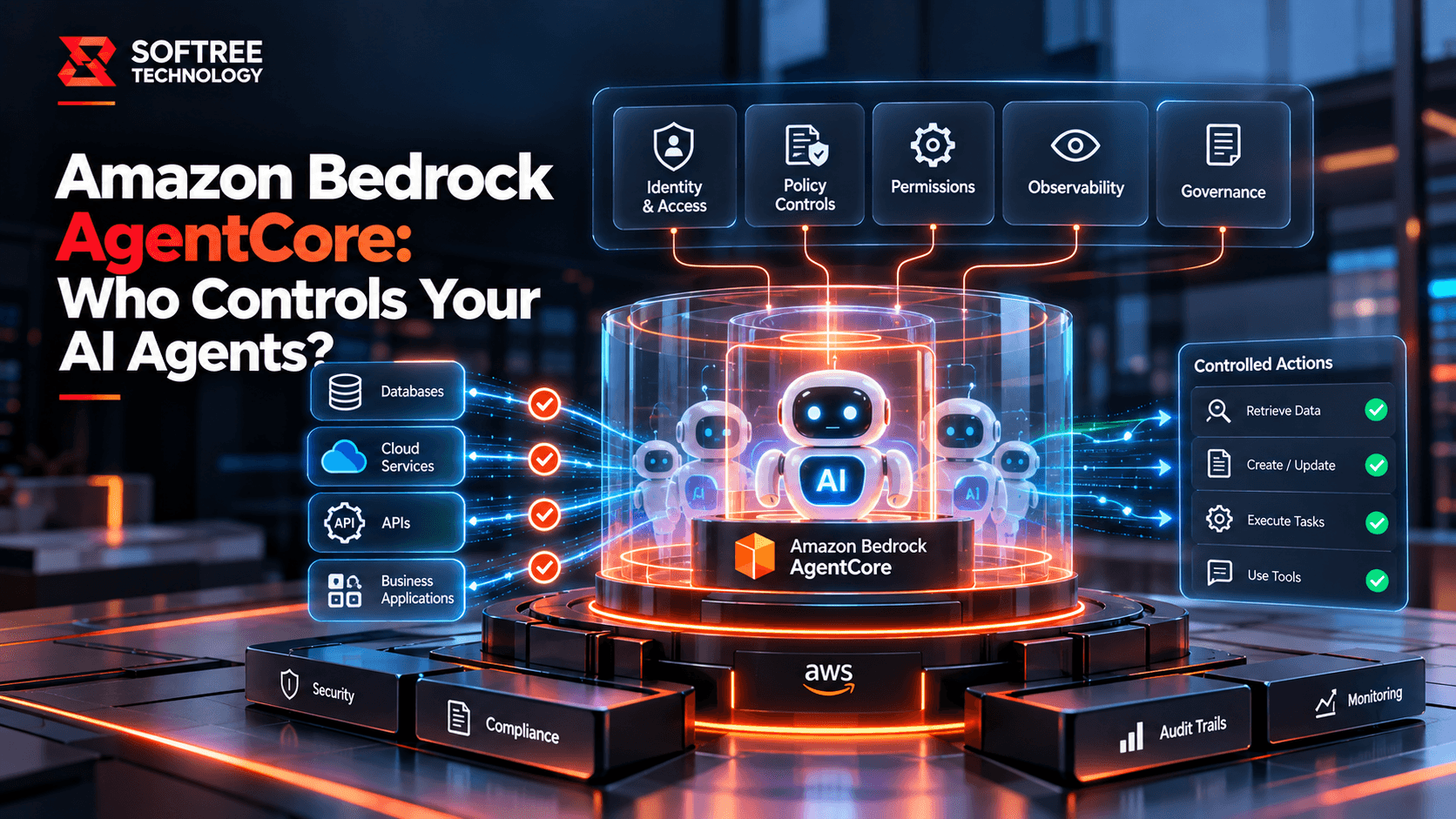
The important question is therefore not only “What can the AI agent do?” but also “Which identity is it using, which tools can it access, what data can it reach, and which actions is it allowed to perform?” Amazon Bedrock AgentCore addresses these requirements through capabilities designed around agent execution, identity, controlled integrations, and production operations.
AgentCore Runtime provides the environment where agents can run, while Gateway can connect agents with APIs, tools, applications, and business systems. Identity and permissions help control access, while observability and evaluations support monitoring and continuous improvement. Softree's AgentCore architecture similarly focuses on moving agents from reasoning and tool use toward secure, observable production execution.
Identity: Who Is the Agent?
An AI agent needs an identity when it interacts with protected resources. Instead of giving an agent unrestricted credentials, its identity should be associated with the permissions required for its specific responsibilities.
For example, a customer-support agent may need permission to read order information and create a support request. It may not need permission to modify financial records or access unrelated customer data. Separating these permissions helps apply a least-privilege approach to agent workflows.
Runtime: Where Does the Agent Execute?
AgentCore Runtime provides a secure and scalable environment for deploying AI agents. This becomes important when moving an agent from a development prototype into production, where workloads, sessions, integrations, and access controls need to be managed consistently. Softree's implementation approach includes secure agent runtimes and production deployment as part of its AgentCore development process.
Gateway: What Can the Agent Use?
An agent becomes useful when it can interact with external tools. Those tools could include REST APIs, databases, MCP servers, Lambda functions, enterprise applications, or other business services.
A controlled gateway provides a structured integration layer between the agent and these systems. Instead of allowing an agent to freely call every available service, organizations can define which tools are exposed and how they can be used.
Observability: What Did the Agent Do?
Production agents need more than successful responses. Teams need visibility into how an agent behaves, which tools it uses, where workflows fail, and how the system performs over time.
AgentCore includes observability and evaluation capabilities for monitoring, tracing, debugging, and evaluating agents in production.
A Real-World Technical Example: Customer Support Agent
Consider a customer-support AI agent that receives a request such as: “Where is my order, and can you raise a service request if it is delayed?”
The agent first understands the request. It then accesses the appropriate order-management API, retrieves the customer's order information, evaluates the status, and creates a service request if the required conditions are met.
A production architecture could look like this:
Customer Request
↓
AI Support Agent
↓
AgentCore Runtime
↓
Identity + Access Controls
↓
AgentCore Gateway
↓
Orders
↓
CRM
↓
Ticketing
↓
Business Action
The important part is that the agent does not receive unrestricted access to every system. Its identity, available tools, permissions, and actions can be designed around the actual workflow.
When Should You Use Amazon Bedrock AgentCore?
AgentCore becomes particularly relevant when an AI application needs to move beyond simple question answering into production agent workflows. This includes scenarios where agents need to use enterprise APIs, interact with business applications, access knowledge, maintain context, execute multi-step workflows, or operate at production scale.
For a basic chatbot with no external system access, a simpler architecture may be sufficient. As soon as an agent starts taking business actions, security, identity, integration, monitoring, and governance become much more important.
How to Build an AgentCore Application for Production?
A practical production approach starts with defining the agent's responsibilities and identifying every tool, API, data source, and business system it needs. The architecture can then establish the runtime environment, identity model, permissions, integration layer, and monitoring strategy.
Softree describes its AgentCore development approach as Reason → Remember → Use Tools → Act → Be Secure → Be Observed, covering discovery, AI agent architecture, AgentCore integration, optimization, and production deployment. Its technology stack includes Amazon Bedrock, AgentCore Runtime, Memory, Gateway, Identity, Evaluations, Python, FastAPI, REST APIs, MCP, AWS, CloudWatch, VPC, and API security.
Build Production-Ready AI Agents with Softree
AI agents can reason, use tools, access business data, and execute real actions. Moving these agents into production requires secure architecture, controlled access, reliable integrations, and continuous observability. Amazon Bedrock AgentCore provides the capabilities needed to support secure agent execution, identity, memory, tool integration, and production operations.
Explore Softree’s Amazon Bedrock AgentCore Development Services to design, integrate, secure, and deploy production-ready AI agents.
https://www.softreetechnology.com/services/amazon-bedrock-agentcore-development