1. Introduction
├── Hook
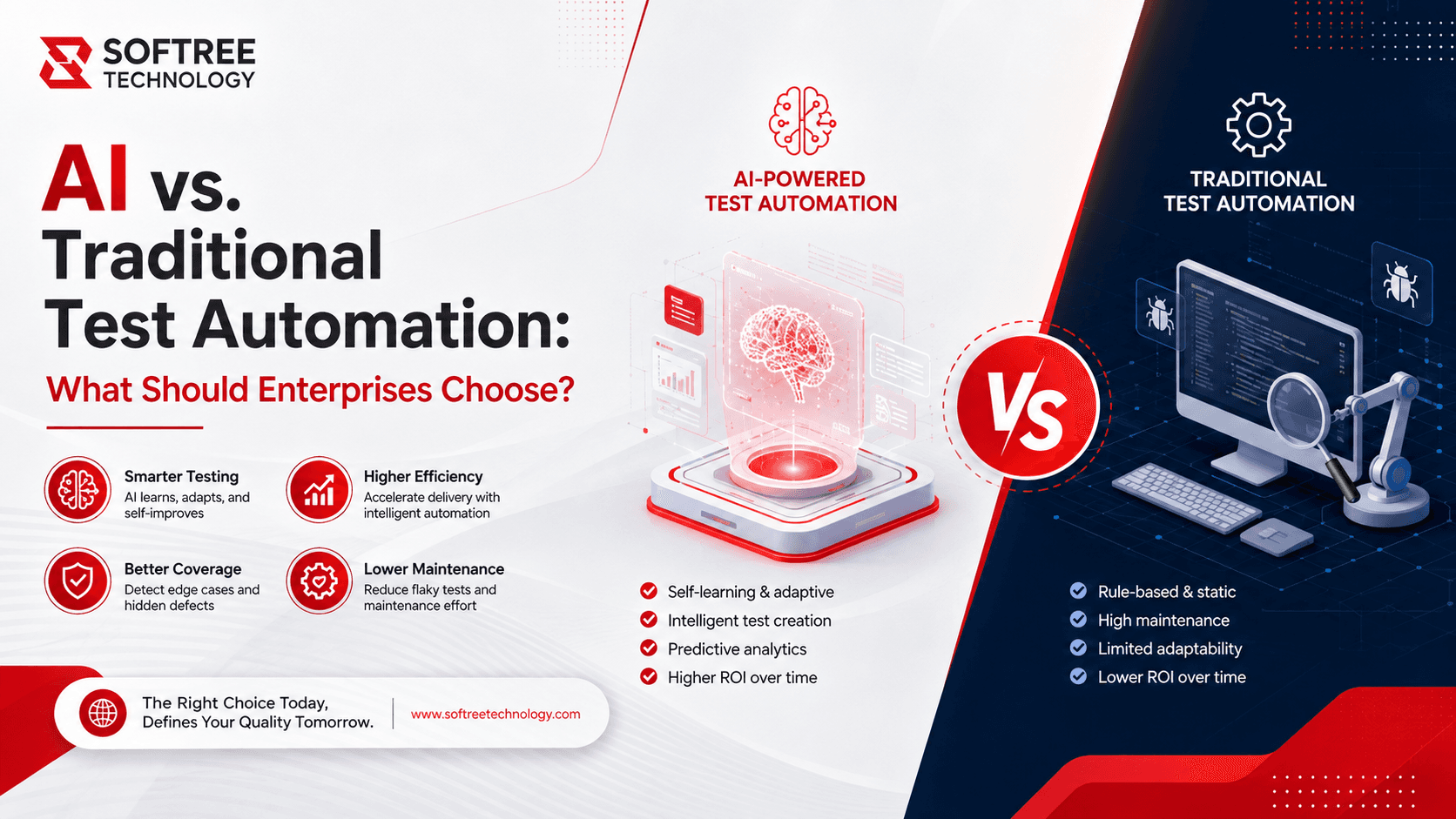
Enterprises have traditionally relied on automated testing to improve regression testing, consistency, and release speed. With AI now transforming software development and QA, a new question is emerging: should enterprises continue with traditional test automation or adopt AI-powered testing?
├── Problem Statement
Modern applications are changing rapidly, with shorter release cycles, complex integrations, APIs, cloud services, mobile interfaces, and increasingly sophisticated user journeys. Traditional automation can become expensive to maintain as applications and test suites grow.
└── What the Reader Will Learn
Compare AI-powered and traditional test automation, understand where each approach works best, and learn why a hybrid testing strategy is often the most practical choice for enterprises.
──────────────────────────────────────────────────────────────
2. Quick Answer
├── Brief Summary
Traditional test automation is best for stable, predictable, and business-critical workflows, while AI-powered automation adds intelligence to areas such as test generation, prioritization, maintenance, failure analysis, and coverage analysis.
└── Key Takeaway
Most enterprises do not need to choose between AI and traditional automation. The strongest approach is usually AI + traditional automation, using deterministic automation where predictability matters and AI where scale, complexity, change, and analysis create opportunities for improvement.
──────────────────────────────────────────────────────────────
3. Table of Contents
├── What Is AI vs. Traditional Test Automation?
├── Why Is AI-Powered Test Automation Important?
├── How Does AI-Powered Test Automation Work?
├── Key Features / Components
├── Benefits of AI and Traditional Test Automation
├── Common Enterprise Use Cases
├── Best Practices
├── Common Mistakes to Avoid
├── Key Takeaways
└── Conclusion
──────────────────────────────────────────────────────────────
4. What Is AI vs. Traditional Test Automation?
├── Definition
│ ├── Traditional test automation uses predefined scripts, rules, assertions, and workflows to execute tests automatically.
│ └── AI-powered test automation applies artificial intelligence across different parts of the testing lifecycle.
├── Overview
│ ├── Traditional automation focuses on deterministic and repeatable execution.
│ └── AI-powered automation adds intelligence and adaptability around the existing automation process.
└── Industry Context
├── Enterprise applications are becoming more complex.
├── Release cycles are becoming shorter.
├── Regression suites are becoming larger.
└── AI is increasingly being applied to test generation, regression optimization, UI testing, defect prediction, and failure analysis.
──────────────────────────────────────────────────────────────
5. Why Is AI vs. Traditional Test Automation Important?
├── Business Impact
│ ├── Faster regression feedback
│ ├── Reduced repetitive QA effort
│ ├── Improved test coverage
│ └── More efficient quality engineering
├── Challenges It Solves
│ ├── Large and slow regression suites
│ ├── High automation maintenance effort
│ ├── Frequently changing interfaces
│ ├── Repetitive failure investigation
│ └── Testing gaps in complex applications
└── Key Benefits
├── Faster test creation
├── Intelligent test prioritization
├── Reduced maintenance effort
├── Faster failure analysis
└── Better test coverage
──────────────────────────────────────────────────────────────
6. How Does AI-Powered Test Automation Work?
├── Step 1: Analyze Requirements and Application Changes
│ └── Identify business requirements, application changes, existing tests, and potential testing gaps.
├── Step 2: Generate and Prioritize Tests
│ └── AI can suggest test scenarios, generate test data, and prioritize tests based on changes, historical failures, and risk.
├── Step 3: Execute and Analyze
│ └── Automated tests execute while AI assists with failure classification, anomaly detection, and result analysis.
├── Step 4: Human Validation
│ └── QA engineers validate test intent, expected results, business relevance, coverage, security implications, and false positives/negatives.
└── Diagram / Process Flow / Visual
Requirements → AI Test Generation → Test Prioritization → Automated Execution → AI Failure Analysis → Human Validation → CI/CD → Continuous Improvement
──────────────────────────────────────────────────────────────
7. Key Features / Components
├── AI Test-Case Generation
│ └── Generates or suggests positive, negative, boundary, and edge-case scenarios.
├── Intelligent Test Prioritization
│ └── Prioritizes tests using application changes, historical failures, and test results.
├── Automation Maintenance / Self-Healing
│ └── Assists with identifying changed UI elements and updating automation.
├── Failure Analysis
│ └── Analyzes logs, screenshots, traces, and historical failures.
├── Test Data Generation
│ └── Assists teams in creating relevant test data.
├── Coverage Analysis
│ └── Identifies potential gaps in existing test coverage.
└── Natural-Language Testing
└── Allows testers to describe scenarios using natural language and potentially transform them into test cases or automation.
──────────────────────────────────────────────────────────────
8. Benefits of AI vs. Traditional Test Automation
├── Benefit 1: Predictable and Repeatable Testing
│ └── Traditional automation provides deterministic execution for stable business workflows.
├── Benefit 2: Faster Test Creation
│ └── AI can accelerate the creation of test scenarios and automation.
├── Benefit 3: Reduced Maintenance Effort
│ └── AI-assisted maintenance can reduce repetitive work caused by application and UI changes.
├── Benefit 4: Faster Feedback and Failure Analysis
│ └── AI can help prioritize tests and analyze failures across large testing environments.
└── Benefit 5: Improved Coverage
└── AI can identify additional scenarios and potential coverage gaps.
──────────────────────────────────────────────────────────────
9. Common Use Cases
├── Use Case 1: Stable Regression Testing
│ └── Traditional automation for predictable workflows such as login, checkout, invoicing, and standard data validation.
├── Use Case 2: Large Regression Suites
│ └── AI-assisted prioritization helps teams identify important tests and obtain feedback sooner.
├── Use Case 3: Frequently Changing UIs
│ └── AI-assisted element recognition and maintenance can reduce automation maintenance effort.
├── Use Case 4: Complex Enterprise Applications
│ └── AI can assist with analyzing large volumes of testing information across APIs, integrations, and workflows.
└── Use Case 5: Failure-Heavy Testing Environments
└── AI can categorize and summarize repetitive failures.
──────────────────────────────────────────────────────────────
10. Best Practices
├── Best Practice 1: Start With a Specific Business Problem
│ └── Identify high-value opportunities such as test generation, prioritization, failure analysis, or maintenance.
├── Best Practice 2: Run a Controlled Pilot
│ └── Establish a baseline and measure results after introducing AI.
├── Best Practice 3: Keep Human Review
│ └── AI-generated tests and automated changes should be reviewed and validated by QA professionals.
├── Best Practice 4: Integrate With Existing CI/CD
│ └── Enhance the existing testing ecosystem rather than creating an isolated AI process.
└── Best Practice 5: Scale Based on Measurable Results
└── Expand AI capabilities only when measurable improvements are demonstrated.
──────────────────────────────────────────────────────────────
11. Common Mistakes to Avoid
├── Mistake 1: Replacing Traditional Automation Completely
│ └── Enterprises should not migrate every existing test to AI simply because AI is available.
├── Mistake 2: Trusting AI-Generated Tests Without Validation
│ └── AI-generated tests require QA review for intent, expected results, business relevance, security, and accuracy.
├── Mistake 3: Adopting AI Without Measuring Results
│ └── AI adoption should be evaluated using metrics such as coverage, regression cycle time, maintenance effort, defect detection, false-positive rate, escaped defects, and cost per release.
├── Mistake 4: Choosing a Tool Before Identifying the Problem
│ └── Enterprises should first identify where AI can provide measurable value.
└── Mistake 5: Removing Human Expertise
└── AI should enhance QA engineers rather than eliminate human validation and decision-making.
──────────────────────────────────────────────────────────────
12. Key Takeaways
✓ Traditional automation remains valuable for stable, predictable, and business-critical workflows.
✓ AI adds intelligence to test generation, prioritization, maintenance, failure analysis, and coverage.
✓ Enterprises should generally adopt a hybrid testing strategy instead of replacing traditional automation completely.
✓ AI adoption should be driven by measurable improvements in quality, testing speed, coverage, and overall delivery efficiency.
──────────────────────────────────────────────────────────────
13. Conclusion
├── Summary
Traditional automation provides the foundation for predictable and repeatable testing, while AI-powered automation adds intelligence for complex, changing, and high-volume testing environments.
├── Final Insight
The future of enterprise testing is not about choosing between AI and traditional automation. It is about combining automation efficiency, AI intelligence, and human expertise to create a scalable quality engineering strategy.
└── Call-to-Action
Ready to modernize enterprise testing? Talk to Softree Technology about building an AI-assisted testing strategy that improves coverage, accelerates feedback, reduces repetitive QA effort, and works with your existing technology ecosystem.
Explore Softree Technology:www.softreetechnology.com