Introduction
Today's customers expect instant responses, personalized interactions, seamless communication across channels, and quick resolution to their issues. Yet many organizations still depend on manual customer service processes that struggle to keep pace with growing demand.
Support teams spend significant time routing tickets, answering repetitive questions, searching for information, escalating cases, and manually updating customers. As request volumes increase, response times become longer, service quality becomes inconsistent, and operational costs rise.
AI-powered customer service automation addresses these challenges by connecting repetitive support activities, intelligent assistance, workflow automation, and enterprise knowledge. The goal is not to replace human agents, but to help them resolve complex issues while AI handles repetitive and administrative work.
Quick Answer: What Is AI-Powered Customer Service Automation?
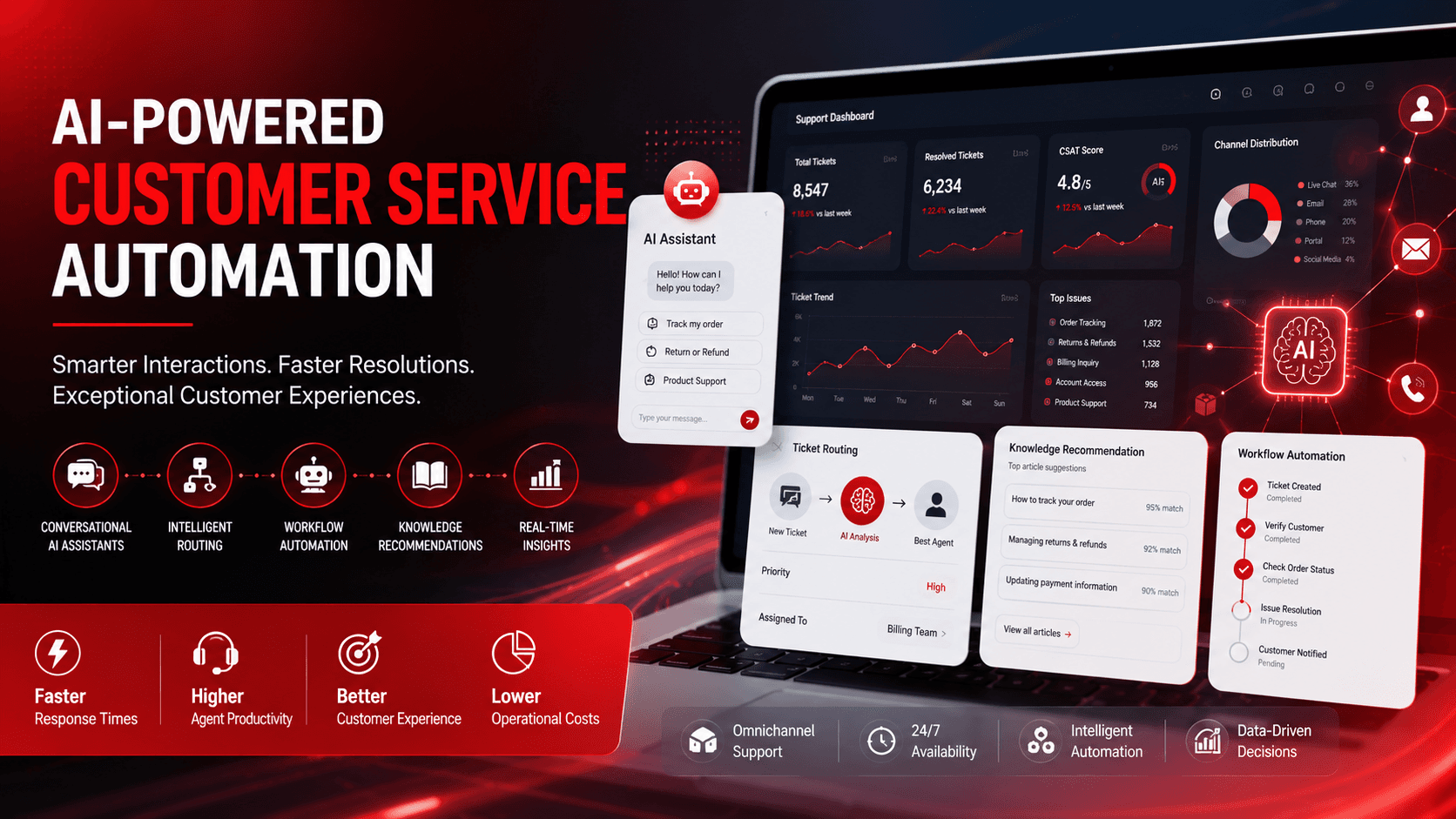
AI-powered customer service automation combines artificial intelligence, conversational AI, workflow automation, enterprise knowledge management, and intelligent case routing to improve customer support operations.
It can automatically classify requests, route cases, recommend knowledge articles, assist agents with real-time information, monitor SLAs, trigger workflows, and keep customers informed throughout the resolution process.
Key takeaway: AI connects the customer service journey from the initial request through resolution, helping organizations deliver faster and more consistent support while allowing human agents to focus on complex customer needs.
Table of Contents
- What Is AI-Powered Customer Service Automation?
- Why Is AI-Powered Customer Service Automation Important?
- How Does AI-Powered Customer Service Automation Work?
- Key Features and Components
- Benefits of AI-Powered Customer Service Automation
- Common Enterprise Use Cases
- Best Practices for Implementation
- Common Mistakes to Avoid
- Key Takeaways
- Conclusion
What Is AI-Powered Customer Service Automation?
AI-powered customer service automation brings together AI, conversational assistants, workflow automation, enterprise knowledge, and intelligent case routing into a connected support environment.
Traditional customer service often involves separate channels and disconnected applications. Requests may arrive through email, phone, live chat, customer portals, social media, or mobile applications. When these channels operate independently, customer information becomes fragmented and agents spend valuable time collecting context.
An AI-powered approach connects these interactions and automates appropriate steps throughout the customer service journey.
Industry Context
Modern enterprises need customer service operations that can scale with increasing request volumes without relying entirely on additional support staff. AI automation helps organizations manage repetitive interactions while maintaining human oversight for complex cases.
Why Is AI-Powered Customer Service Automation Important?
Customer service has become an important business differentiator because every interaction can influence customer satisfaction, loyalty, and brand reputation.
Common challenges include:
- Long response times
- Manual ticket assignment
- Repetitive customer inquiries
- Inconsistent service experiences
- Knowledge distributed across multiple systems
- Limited support-performance visibility
- High operational costs
- Difficulty scaling support teams
AI-powered automation helps address these challenges by connecting customer interactions with intelligent routing, knowledge recommendations, workflow automation, and service-performance monitoring.
How Does AI-Powered Customer Service Automation Work?
A connected AI customer service workflow can be structured around several stages:
Step 1: Capture the Customer Request
Customer requests enter through channels such as email, phone, live chat, customer portals, social media, or mobile applications.
Step 2: Understand and Classify the Request
AI analyzes the incoming request to understand customer intent, determine priority, and classify the case.
Step 3: Route the Case
The case is automatically routed to the appropriate team or specialist, reducing unnecessary transfers and improving first-response times.
Step 4: Assist the Service Agent
AI recommends relevant knowledge articles, troubleshooting guides, and standard operating procedures while providing agents with contextual information.
Step 5: Automate the Required Workflow
Approvals, document verification, refunds, order updates, technical investigations, and account changes can move through predefined workflows automatically.
Step 6: Monitor and Improve
AI monitors response times, resolution rates, customer satisfaction, SLA compliance, and case backlogs so managers can identify bottlenecks and improve resource allocation.
Key Features and Components
Intelligent Case Routing
AI analyzes incoming requests, identifies customer intent, determines priority, and routes cases to the appropriate team or specialist. This reduces unnecessary transfers and helps customers reach the right resource sooner.
Conversational Customer Assistance
AI-powered virtual assistants can answer frequently asked questions, guide customers through common processes, and collect relevant information before escalating complex cases to human agents.
Intelligent Knowledge Recommendations
AI can analyze customer conversations and recommend relevant knowledge articles, troubleshooting guides, and standard operating procedures, giving agents useful information during customer interactions.
Workflow Automation
Customer service workflows can include approvals, refunds, account changes, document verification, and coordination between departments. Automation helps move these tasks through the appropriate operational path without relying on manual coordination.
Service Performance Monitoring
AI can monitor response times, resolution rates, customer satisfaction, SLA compliance, and case backlogs. This provides managers with proactive visibility into areas requiring attention.
Benefits of AI-Powered Customer Service Automation
Faster Response Times
Automated classification and intelligent routing help customers reach the appropriate team without unnecessary delays.
Improved Customer Experience
Customers can receive quicker responses, consistent communication, and greater transparency throughout the service journey.
Higher Agent Productivity
Automating repetitive tasks allows support agents to spend more time solving complex issues and building customer relationships.
Consistent Service Quality
AI can standardize workflows, knowledge recommendations, and service processes across customer interactions.
Lower Operational Costs
Reducing repetitive administrative work allows organizations to scale customer service without proportionally increasing support staff.
Better Operational Visibility
Real-time dashboards and intelligent insights help service managers monitor performance, identify bottlenecks, and improve resource allocation.
Common Use Cases
AI-powered customer service automation can support multiple industries and business processes.
- Healthcare: Patient inquiries, appointment scheduling, referrals, insurance verification, and follow-up communications.
- Banking & Financial Services: Account inquiries, loan updates, fraud-related requests, card services, and customer verification.
- Retail & E-Commerce: Order tracking, returns, refunds, product inquiries, delivery updates, and customer feedback.
- Manufacturing: Dealer support, warranty claims, technical service requests, spare-parts inquiries, and product documentation.
- Logistics & Supply Chain: Shipment inquiries, delivery updates, proof-of-delivery requests, freight exceptions, and customer notifications.
- IT & Enterprise Services: Employee support, password resets, software access, incident management, and approval workflows.
Best Practices for Implementation
Start With High-Volume Processes
Begin with repetitive customer interactions such as ticket routing, common inquiries, appointment requests, or order-status updates where measurable value can be demonstrated.
Build a Centralized Knowledge Base
Maintain accurate and structured knowledge articles that both AI systems and support teams can use to provide consistent answers.
Integrate Existing Business Systems
Connect CRM, ERP, ticketing systems, customer portals, communication platforms, and enterprise applications to create a unified customer experience.
Keep Human Agents in Control
AI should assist customer service teams rather than replace them. Complex cases, escalations, and sensitive customer situations should remain under human oversight.
Continuously Monitor Performance
Track response times, resolution rates, customer satisfaction, SLA compliance, and workflow performance to identify opportunities for improvement.
Common Mistakes to Avoid
Based on the implementation guidance in the source, avoid:
- Automating everything at once: Start with high-volume, repetitive processes where value can be measured.
- Using disconnected knowledge: Build a centralized and accurate knowledge base before relying heavily on AI recommendations.
- Removing human oversight: Keep complex cases, escalations, and sensitive situations with human agents.
- Ignoring existing systems: Integrate CRM, ERP, ticketing, portals, and other enterprise applications rather than creating another isolated system.
- Failing to measure performance: Continuously monitor service and workflow metrics.
Key Takeaways
- AI can automate repetitive customer service activities while supporting human agents.
- Intelligent routing helps customers reach the right support team faster.
- Knowledge recommendations and conversational assistance improve agent productivity.
- Workflow automation connects customer requests with downstream business processes.
- Human oversight remains important for complex and sensitive customer situations.
- Continuous performance monitoring helps organizations improve service operations.
Conclusion
Customer service is increasingly measured by how consistently, intelligently, and seamlessly organizations support customers throughout every interaction.
AI-powered customer service automation connects people, processes, and enterprise systems into a unified support experience. Intelligent routing, workflow automation, conversational assistance, knowledge management, and real-time insights can help organizations improve operational efficiency while delivering faster and more consistent customer experiences.
Organizations looking to modernize customer service can start with high-volume processes, establish a reliable knowledge foundation, integrate existing business systems, and keep human agents involved in complex decisions.
Transform Customer Service With Softree Technology
Softree Technology helps organizations modernize customer service using AI Automation, AI Agents, Intelligent Workflows, Microsoft Copilot, Azure AI Services, Dynamics 365, Power Automate, Power Apps, and the Microsoft Power Platform.
Visit Softree Technology at https://www.softreetechnology.com/ to explore AI-powered customer service automation solutions.