Introduction
Cyberattacks have become more sophisticated, targeting organizations through zero-day vulnerabilities, advanced persistent threats (APTs), cloud environments, and increasingly complex attack surfaces. While traditional penetration testing remains an essential part of cybersecurity, periodic manual assessments often struggle to keep pace with today's rapidly evolving digital landscape.
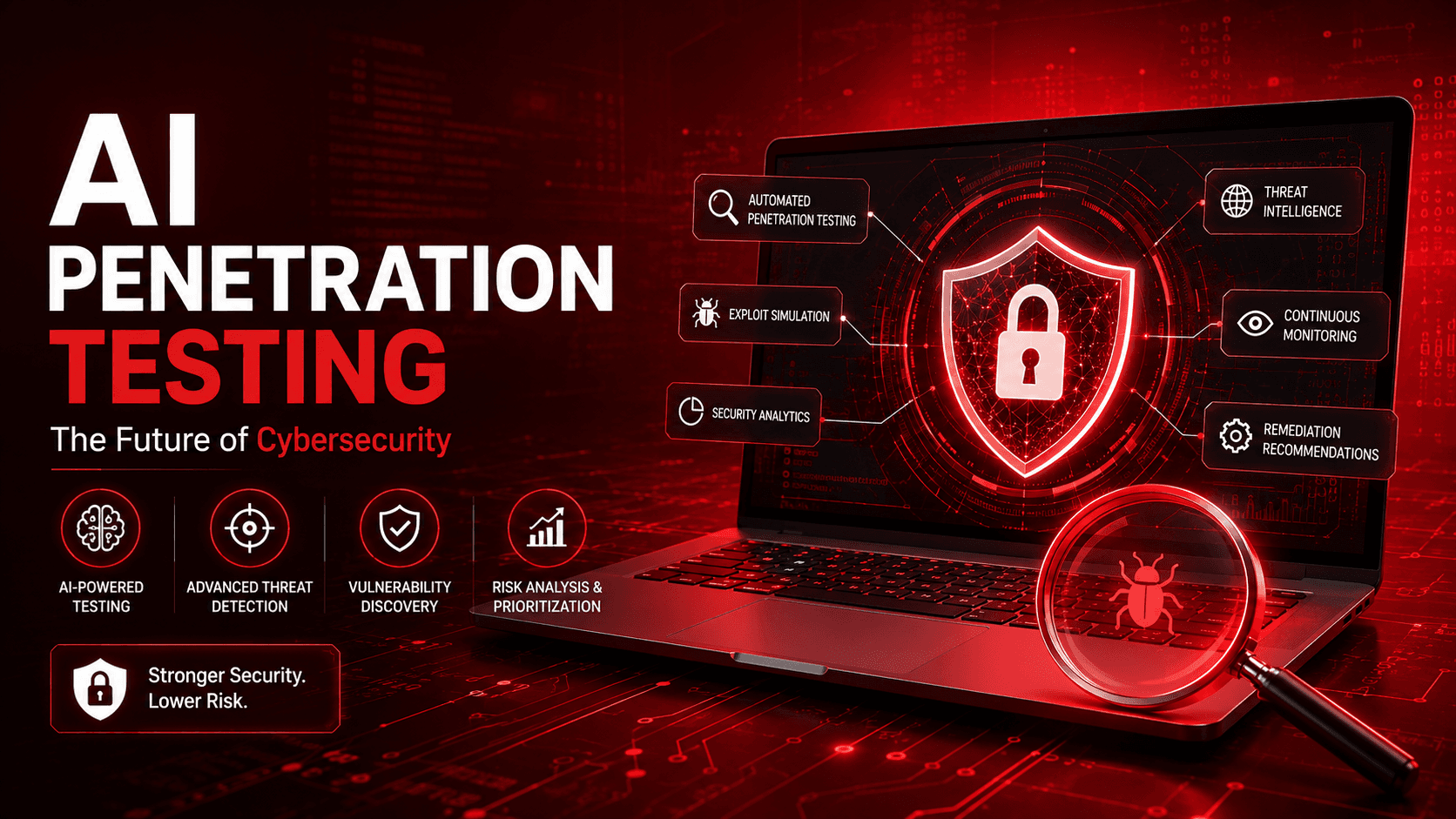
AI Penetration Testing is transforming how organizations approach offensive security. By combining artificial intelligence with ethical hacking techniques, businesses can automate vulnerability discovery, improve testing accuracy, and identify exploitable weaknesses faster than traditional methods. This enables security teams to proactively strengthen their defenses before attackers can exploit vulnerabilities.
In this guide, you'll learn what AI Penetration Testing is, how it works, its core features, enterprise use cases, business benefits, implementation best practices, and common mistakes to avoid.
Quick Answer
AI Penetration Testing uses artificial intelligence and machine learning to automate penetration testing, discover vulnerabilities faster, prioritize risks, and improve overall security posture. Rather than replacing ethical hackers, AI enhances their capabilities by automating repetitive tasks and providing intelligent recommendations.
Organizations adopting AI-powered penetration testing can perform continuous security assessments, reduce manual effort, and improve protection against modern cyber threats.
Table of Contents
- What is AI Penetration Testing?
- Why is AI Penetration Testing Important?
- How Does AI Penetration Testing Work?
- Key Features
- Benefits
- AI Penetration Testing vs Traditional Testing
- Enterprise Use Cases
- Best Practices
- Common Mistakes to Avoid
- Key Takeaways
- Conclusion
What is AI Penetration Testing?
AI Penetration Testing is the use of artificial intelligence and machine learning to improve penetration testing through automated vulnerability discovery, attack simulation, risk analysis, and remediation recommendations. Unlike traditional penetration testing, which depends heavily on manual effort, AI continuously analyzes applications, APIs, cloud environments, network traffic, and infrastructure to identify security weaknesses more efficiently.
Instead of replacing cybersecurity professionals, AI supports ethical hackers by automating repetitive activities and uncovering vulnerabilities that may otherwise remain undetected. This allows security teams to focus their expertise on validating findings and strengthening enterprise security.
Key capabilities include:
- Automated vulnerability discovery
- Intelligent attack simulation
- AI-driven risk analysis
- Remediation recommendations
- Continuous security assessment
Why is AI Penetration Testing Important?
Modern organizations release software rapidly while expanding their digital infrastructure across cloud platforms, APIs, hybrid work environments, and connected systems. Traditional penetration testing, typically performed quarterly or annually, cannot always detect newly introduced vulnerabilities before they become security risks.
AI Penetration Testing helps organizations overcome these limitations by providing continuous testing, broader security coverage, and intelligent prioritization of vulnerabilities. It enables businesses to identify critical weaknesses earlier and improve overall cybersecurity resilience.
Business benefits include:
- Continuous vulnerability discovery
- Faster security assessments
- Better attack surface visibility
- Reduced manual effort
- Improved scalability across enterprise environments
How Does AI Penetration Testing Work?
AI-powered penetration testing combines automation, machine learning, and threat intelligence to simulate attacks and identify vulnerabilities across enterprise systems. It continuously evaluates applications, cloud infrastructure, APIs, and networks while providing security teams with actionable recommendations.
The process begins by discovering assets that require testing, followed by automated penetration testing, AI-assisted ethical hacking, integration with global threat intelligence, and risk-based vulnerability management. Together, these capabilities enable organizations to detect vulnerabilities more efficiently and prioritize remediation based on business impact.
Typical workflow:
- Intelligent attack surface discovery
- Automated penetration testing
- AI-assisted ethical hacking
- Threat intelligence integration
- Risk-based vulnerability management
Visual Suggestion: AI Penetration Testing Workflow (Assets → AI Discovery → Attack Simulation → Risk Analysis → Remediation).
Key Features
AI Penetration Testing platforms combine automation and intelligence to improve testing speed, accuracy, and coverage. These capabilities allow organizations to continuously assess their security posture without slowing development.
Key features include:
- Intelligent asset discovery
- Automated penetration testing
- AI-assisted ethical hacking
- Threat intelligence integration
- Risk-based vulnerability management
- Continuous security assessments
- Automated reporting
Benefits of AI Penetration Testing
Organizations implementing AI Penetration Testing can improve both operational efficiency and cybersecurity effectiveness. AI significantly reduces testing time while expanding security coverage across cloud platforms, APIs, applications, and enterprise infrastructure.
It also enables continuous testing, improves vulnerability accuracy by reducing false positives, and lowers operational costs by automating repetitive security tasks.
Major benefits:
- Faster vulnerability discovery
- Continuous security testing
- Improved testing accuracy
- Better enterprise security coverage
- Greater cost efficiency
AI Penetration Testing vs Traditional Penetration Testing
Traditional penetration testing is typically conducted on a scheduled basis and relies heavily on manual effort. While it remains valuable, it may not provide the continuous visibility required for modern enterprise environments.
AI Penetration Testing introduces automation, continuous assessments, AI-driven risk prioritization, and real-time threat intelligence, enabling organizations to respond more quickly to evolving cyber threats.
Comparison highlights:
- Continuous vs. periodic testing
- Automated vs. manual vulnerability discovery
- Intelligent vs. limited attack simulation
- AI-driven vs. manual risk prioritization
- Automated vs. manual reporting
Common Use Cases
AI Penetration Testing supports a wide range of enterprise cybersecurity initiatives. Organizations integrate AI into their security programs to strengthen application security, cloud security, API protection, DevSecOps, and regulatory compliance.
As software ecosystems continue to grow more complex, AI enables security teams to identify vulnerabilities earlier and improve overall cyber resilience.
Common use cases:
- Web application security
- Cloud security
- API security testing
- DevSecOps integration
- Compliance audits
Best Practices
Successfully implementing AI Penetration Testing requires combining intelligent automation with experienced cybersecurity professionals. Organizations should integrate AI into their DevSecOps pipelines, prioritize high-risk vulnerabilities, continuously update AI models, and measure security performance using key metrics.
Following these best practices helps maximize the effectiveness of AI-powered security testing while ensuring accurate and actionable results.
- Combine AI with human expertise
- Integrate testing into DevSecOps
- Prioritize critical risks
- Continuously update AI models
- Monitor security metrics
Common Mistakes to Avoid
Although AI greatly improves penetration testing, organizations should avoid relying solely on automation. Human validation remains essential for complex attack scenarios and high-risk findings.
Common implementation mistakes include poor integration with existing security tools, outdated AI models, overlooking privacy considerations, and failing to prioritize vulnerabilities based on business impact.
- Relying only on AI
- Delaying AI model updates
- Poor security tool integration
- Ignoring privacy requirements
- Treating all vulnerabilities equally
Key Takeaways
- AI accelerates penetration testing and vulnerability discovery.
- Continuous testing improves enterprise security visibility.
- AI supports ethical hackers rather than replacing them.
- Threat intelligence enhances attack detection and prioritization.
- DevSecOps integration enables proactive security throughout development.
Conclusion
As cyber threats continue to evolve, organizations need security strategies that are proactive, intelligent, and scalable. AI Penetration Testing enables enterprises to automate vulnerability discovery, strengthen ethical hacking efforts, improve risk management, and identify critical security weaknesses before attackers can exploit them.
While AI significantly enhances penetration testing, the most effective cybersecurity programs combine AI-driven automation with the expertise of skilled security professionals. This balanced approach helps organizations reduce risk, improve compliance, and build a stronger security posture for the future.
If you're looking to modernize your cybersecurity strategy with AI-powered penetration testing, visit Softree Technology to explore our AI, cybersecurity, and enterprise software solutions. Our team helps organizations build secure, scalable, and future-ready digital systems designed to withstand today's evolving cyber threats.