Introduction
Business leaders have access to more data than ever, including sales reports, financial dashboards, customer analytics, operational metrics, employee performance, and market trends. Yet many organizations still struggle to turn this information into timely, actionable intelligence.
Executives often spend valuable time reviewing reports, comparing spreadsheets, validating numbers, and waiting for departmental updates before making strategic decisions. By the time information reaches leadership, opportunities may already have changed.
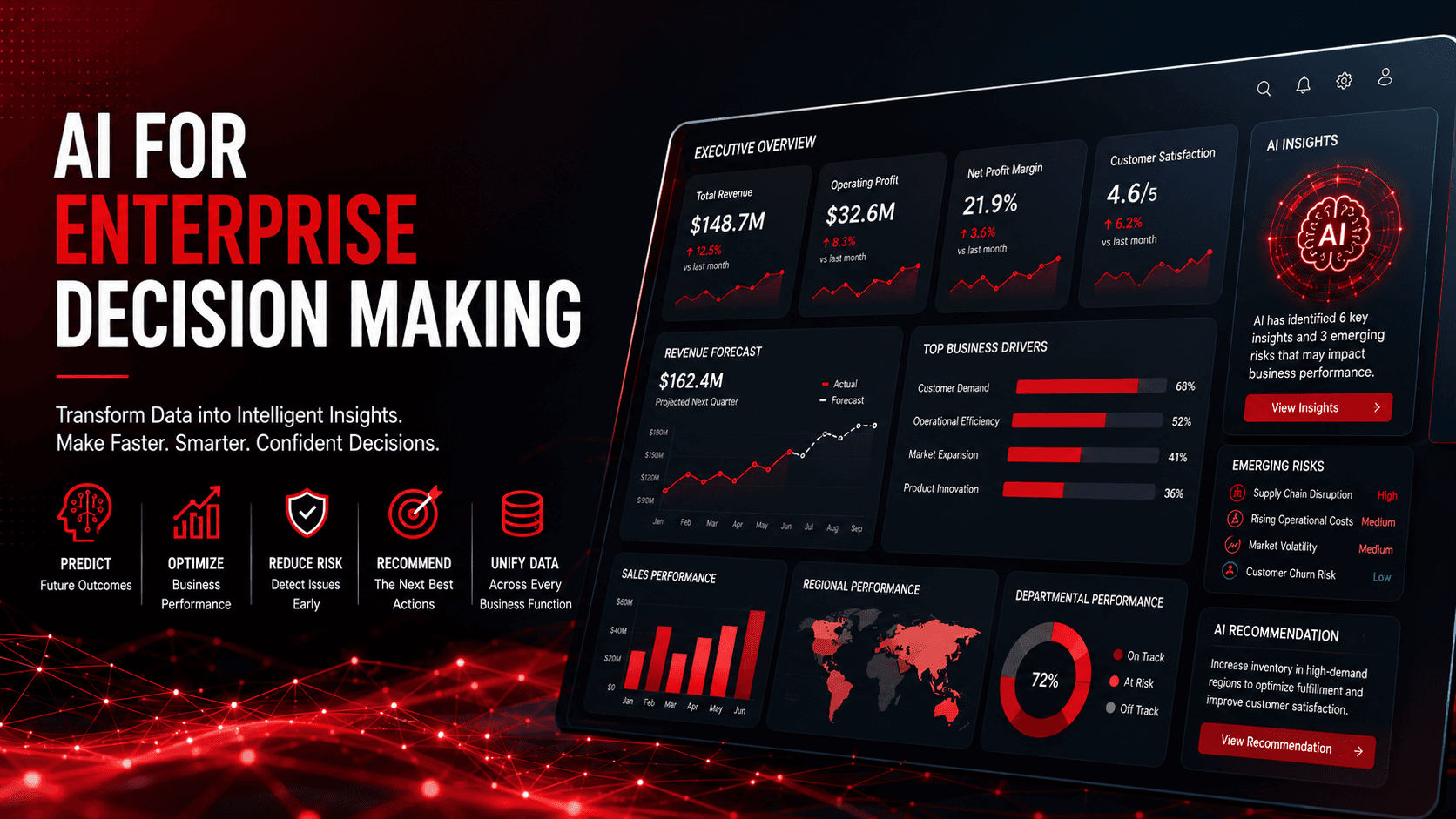
AI-powered decision intelligence changes this approach by continuously analyzing enterprise data, identifying patterns, predicting outcomes, and recommending potential actions. Instead of only asking “What happened?”, organizations can begin answering “What is likely to happen next, and what should we do about it?”
Quick Answer: What Is AI for Enterprise Decision Making?
AI for enterprise decision making combines Artificial Intelligence, Machine Learning, predictive analytics, business intelligence, and intelligent automation to help organizations make faster and more informed decisions.
AI can consolidate enterprise data, detect trends, generate forecasts, identify operational bottlenecks, recommend actions, monitor KPIs, and alert leadership about emerging risks.
Key takeaway: AI shifts enterprise decision-making from reactive reporting toward proactive decision intelligence.
Table of Contents
- What Is AI for Enterprise Decision Making?
- Why Traditional Enterprise Decision Making Falls Short
- Why AI-Powered Decision Intelligence Matters
- How AI Supports Enterprise Decision Making
- Key Business Areas Transformed by AI
- Technologies Powering AI Decision Intelligence
- Real-World Enterprise Use Cases
- Benefits of AI for Enterprise Decision Making
- Best Practices for AI Adoption
- Common Mistakes to Avoid
- Key Takeaways
- Conclusion
What Is AI for Enterprise Decision Making?
AI for enterprise decision making enables organizations to use business data more intelligently by combining predictive analytics, machine learning, business intelligence, and automation.
Instead of simply presenting historical reports, AI continuously analyzes information to identify patterns, detect anomalies, forecast outcomes, and surface recommendations.
From Data to Decision Intelligence
A modern decision intelligence environment can:
- Consolidate data from multiple enterprise systems
- Detect business trends and patterns
- Generate predictive forecasts
- Identify operational bottlenecks
- Recommend business actions
- Monitor KPIs continuously
- Alert leadership about emerging risks
- Support strategic planning with real-time insights
This allows leaders to spend less time searching for information and more time acting on business opportunities.
Why Traditional Enterprise Decision Making Falls Short
Many organizations still rely on fragmented decision-making processes involving disconnected systems and manual reporting.
Enterprise information may exist across ERP systems, CRM platforms, spreadsheets, emails, cloud applications, and departmental databases. Bringing this information together for leadership can become time-consuming and difficult.
Common challenges include:
- Data scattered across multiple business systems
- Manual report preparation
- Delayed executive visibility
- Inconsistent departmental metrics
- Reactive decision-making
- Limited forecasting capabilities
- Difficulty identifying emerging risks
- Slow response to market changes
As organizations grow, these challenges become increasingly difficult to manage.
How Does AI Support Enterprise Decision Making?
AI-powered decision intelligence follows a continuous cycle:
Step 1: Connect Enterprise Data
Data from ERP, CRM, finance, HR, operational systems, and other sources is brought together into a connected data foundation.
Step 2: Analyze Business Information
AI and machine learning identify patterns, trends, anomalies, and relationships within the data.
Step 3: Generate Predictions
Predictive models forecast potential outcomes such as revenue, demand, operational performance, workforce requirements, and supply chain risks.
Step 4: Surface Recommendations
AI provides recommendations that help business leaders determine potential next actions.
Step 5: Monitor Continuously
KPIs and business conditions are continuously monitored so emerging risks and changes can be identified earlier.
Step 6: Keep Humans in Control
AI supports decision-makers with insights and recommendations while critical business decisions remain under human oversight.
Key Business Areas Transformed by AI Decision Intelligence
Executive Performance Monitoring
AI can unify financial, operational, customer, and workforce information into connected executive insights, giving leadership a trusted view of organizational performance.
Financial Planning and Forecasting
AI can evaluate historical performance, seasonal demand, market conditions, and operational changes to support financial forecasting, budgeting, cash-flow planning, and risk identification.
Sales and Revenue Intelligence
AI can analyze customer behavior, sales performance, buying patterns, historical conversions, and market conditions to improve revenue forecasting and identify pipeline and revenue risks.
Supply Chain and Operations Planning
AI can analyze inventory, supplier performance, logistics, production schedules, demand, and fulfillment activity to identify risks and support proactive supply chain decisions.
Workforce Planning
AI can help HR teams analyze hiring trends, workforce capacity, employee engagement, training needs, and retention risks to support workforce planning.
Technologies Powering Enterprise Decision Making
Modern decision intelligence relies on an integrated ecosystem of AI, analytics, automation, and cloud technologies.
Key technologies include:
- Artificial Intelligence — Pattern identification and outcome prediction
- Machine Learning — Continuous improvement of forecasting models
- Business Intelligence — Interactive reporting and executive dashboards
- Microsoft Fabric — Enterprise data unification
- Power BI — Visualization and performance monitoring
- Microsoft Copilot — Natural-language analysis and data exploration
- Azure AI Services — Predictive analytics and recommendations
- Power Automate — Business workflow automation
Together, these technologies help organizations move from static reporting toward continuous decision intelligence.
Real-World Enterprise Use Cases
AI-powered decision intelligence can support organizations across multiple industries.
- Manufacturing: Production forecasting, inventory optimization, equipment monitoring, and production planning.
- Healthcare: Patient flow, resource utilization, staffing, and operational performance.
- Financial Services: Fraud detection, credit risk, transaction monitoring, and investment decisions.
- Retail: Inventory planning, demand forecasting, pricing, and promotional performance.
- Supply Chain & Logistics: Shipment performance, warehouse utilization, transportation efficiency, and delivery risk.
- Human Resources: Workforce planning, talent acquisition, retention, learning, and organizational performance.
Benefits of AI for Enterprise Decision Making
Faster Decision Making
Leadership teams spend less time gathering information and more time acting on reliable business insights.
Improved Forecast Accuracy
Predictive models support forecasting for revenue, demand, operations, and workforce planning.
Better Executive Visibility
Connected business data gives executives a unified view of organizational performance.
Reduced Business Risk
AI can continuously identify anomalies, emerging trends, and operational risks before they become larger business issues.
Increased Operational Efficiency
Automated reporting and intelligent recommendations reduce manual analysis and improve collaboration across departments.
Data-Driven Business Culture
Organizations can make decisions using trusted insights rather than assumptions, creating greater consistency across departments.
Best Practices for Successful AI Adoption
Start With High-Value Decisions
Focus first on areas where faster insights can produce measurable business outcomes, such as forecasting, operations, finance, or customer service.
Build a Unified Data Foundation
Integrate data from ERP, CRM, HR, finance, and operational systems so AI models can work with consistent information.
Maintain Data Quality
AI depends on reliable, well-governed business data. Establish clear data standards and ownership across departments.
Keep Humans in the Decision Loop
AI should enhance executive judgment through recommendations and insights while important business decisions remain under human oversight.
Monitor and Improve Continuously
Evaluate AI performance regularly, refine predictive models, and update decision frameworks as business conditions change.
Common Mistakes to Avoid
- Starting with low-value use cases: Prioritize decisions where AI can produce measurable business value.
- Ignoring data quality: Poor-quality or inconsistent data can reduce the reliability of AI insights.
- Creating another data silo: Connect enterprise systems instead of creating isolated AI solutions.
- Removing human oversight: Keep leadership involved in critical business decisions.
- Treating AI as a one-time implementation: Continuously monitor, evaluate, and improve AI models and decision frameworks.
These recommendations align with the source's emphasis on high-value decisions, unified data, data quality, human oversight, and continuous improvement.
Key Takeaways
- AI transforms enterprise data into actionable decision intelligence.
- Predictive analytics helps organizations anticipate future business conditions.
- Connected data improves executive visibility and forecasting.
- AI can identify risks and opportunities earlier than traditional reporting.
- Human judgment remains essential for critical business decisions.
- A strong data foundation is necessary for successful AI adoption.
Conclusion
Organizations can no longer rely solely on historical reports and manual analysis to guide strategic decisions. As enterprise data continues to grow in volume and complexity, traditional decision-making processes become increasingly difficult to sustain.
AI-powered decision intelligence helps transform disconnected data into meaningful insights, improve forecasting, reduce uncertainty, and enable organizations to respond to changing business conditions with greater speed and confidence.
Empower Smarter Business Decisions With Softree Technology
Softree Technology helps organizations transform enterprise data into actionable intelligence using AI, Microsoft Copilot, Azure AI Services, Microsoft Fabric, Power BI, Power Automate, and the Microsoft Power Platform.
Visit Softree Technology at https://www.softreetechnology.com/ to explore AI-powered enterprise decision-making solutions.