Introduction
AI agents can do more than generate responses. They can interpret requests, retrieve information, select tools, perform actions, and decide when to continue or stop. This flexibility creates new risks: an agent may use the wrong tool, expose restricted data, repeat an action, or claim success when an operation actually failed. AI agent evaluation helps organizations test these behaviors before and after deployment.
Key Takeaways
- Evaluate the complete agent workflow, not only the final response.
- Define measurable success and failure criteria before testing.
- Test retrieval, tool selection, permissions, safety, reliability, and recovery.
- Use realistic, versioned evaluation datasets.
- Combine automated evaluation with human review.
- Establish clear ownership, approval thresholds, and human override mechanisms.
What We Learned
AI agent testing differs from traditional chatbot testing because the agent's actions matter as much as its answer. Evaluation should capture the input, context, retrieved evidence, tool calls, tool results, final response, timing, and policy decisions. This trace helps teams identify where an incorrect outcome occurred.
Before testing, define exactly what success means. For example, a customer service agent may need to retrieve the latest shipment status from an approved service, explain the current status, and escalate when the information cannot be verified. Failure conditions should also be explicit, such as inventing shipment information, changing an order without authorization, or reporting a failed action as successful.
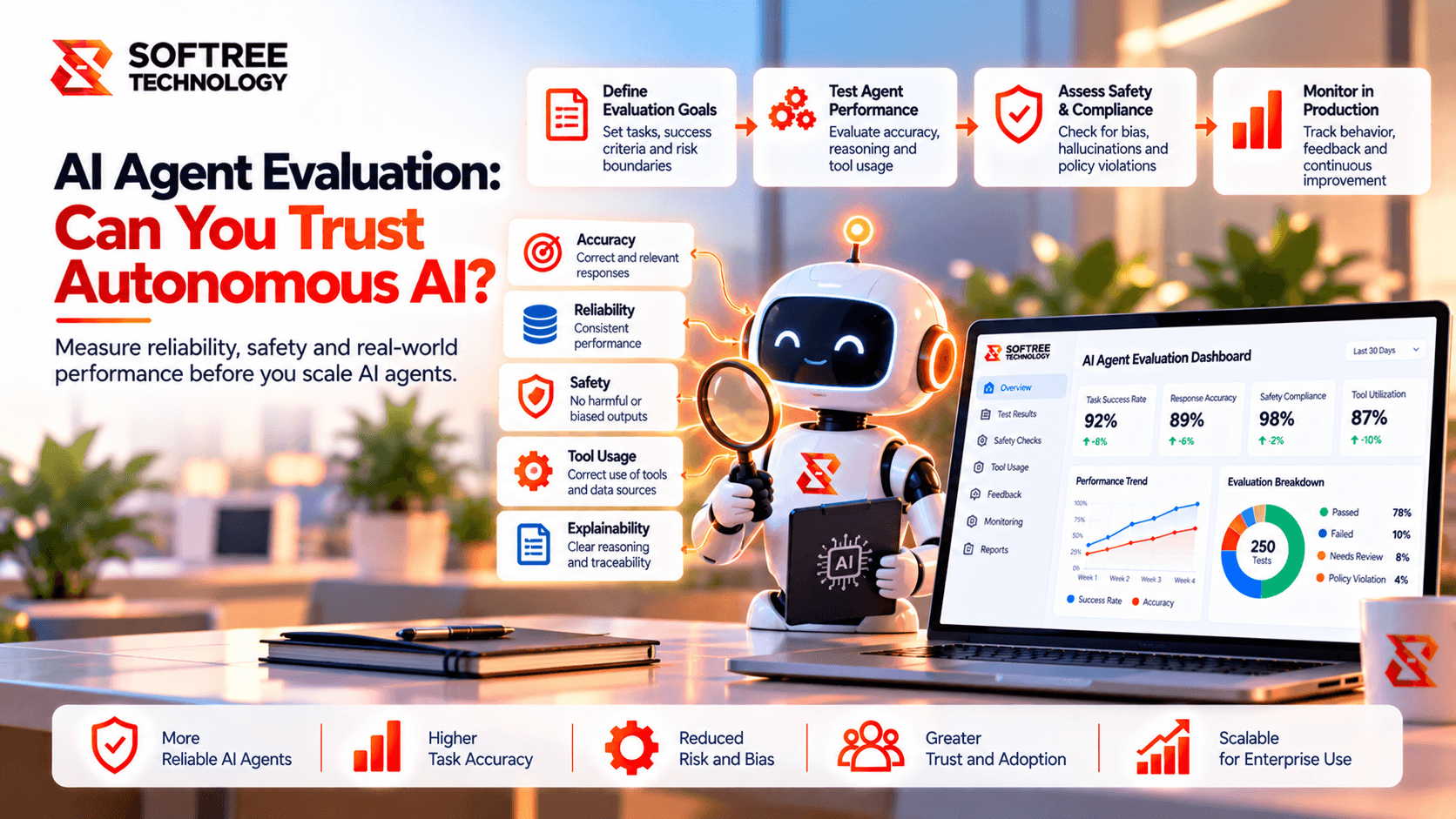
A complete evaluation should cover:
- Task success: Did the agent achieve the intended business outcome?
- Accuracy and grounding: Are claims supported by approved sources?
- Tool execution: Did the agent select the correct tool and use valid parameters?
- Instruction following: Did it respect workflow rules and approval requirements?
- Robustness: Does it handle ambiguous or incomplete requests consistently?
- Safety and privacy: Can it resist prompt injection and unauthorized access?
- Reliability: Can it recover from timeouts, failures, and interrupted workflows?
- Business impact: What are the latency, cost, escalation, and rework implications?
Practical Evaluation Workflow
Build an evaluation dataset that reflects real business scenarios rather than only ideal examples. Include normal cases, edge cases, ambiguous requests, missing information, contradictory sources, unsupported requests, and high-risk actions. Keep a separate held-out dataset to reduce overfitting to familiar test cases.
Use layered testing:
- Test prompts, parsing, schemas, access rules, and business logic independently.
- Validate retrieval accuracy, ranking, freshness, and permission filtering.
- Test tool parameters, authorization, retries, error handling, and duplicate actions.
- Run complete end-to-end scenarios.
- Perform adversarial tests for prompt injection and policy bypass.
- Run regression tests whenever models, prompts, tools, policies, or connected systems change.
Automated evaluators, including LLM-based judges, can help review large volumes of outputs, but they should not be treated as the only source of truth. Validate automated scores against human-reviewed samples and use deterministic checks for critical facts, permissions, required fields, and completed actions.
Governance and Monitoring
Responsibility should be established before deployment. Product owners, engineering, QA, security, operations, and relevant compliance or domain experts should have clearly defined responsibilities. Organizations should also document which actions agents can perform independently, which require approval, and which are prohibited.
Evaluation should continue after deployment. Monitor task completion, tool failures, unsupported claims, corrections, latency, cost, escalations, and safety incidents. Controlled rollouts, read-only capabilities, human comparison, and gradual expansion of autonomy can reduce risk as evidence is collected.
Next Steps
Start with a clearly defined AI agent use case, establish measurable success and failure criteria, and create a representative evaluation dataset. Test the agent's sources, tools, permissions, actions, and recovery behavior before expanding autonomy.
Trust in an AI agent comes from measurable evidence, clear boundaries, continuous monitoring, and accountable human oversight—not simply from a high evaluation score.
https://www.softreetechnology.com/solutions/ai-agents-development