Introduction
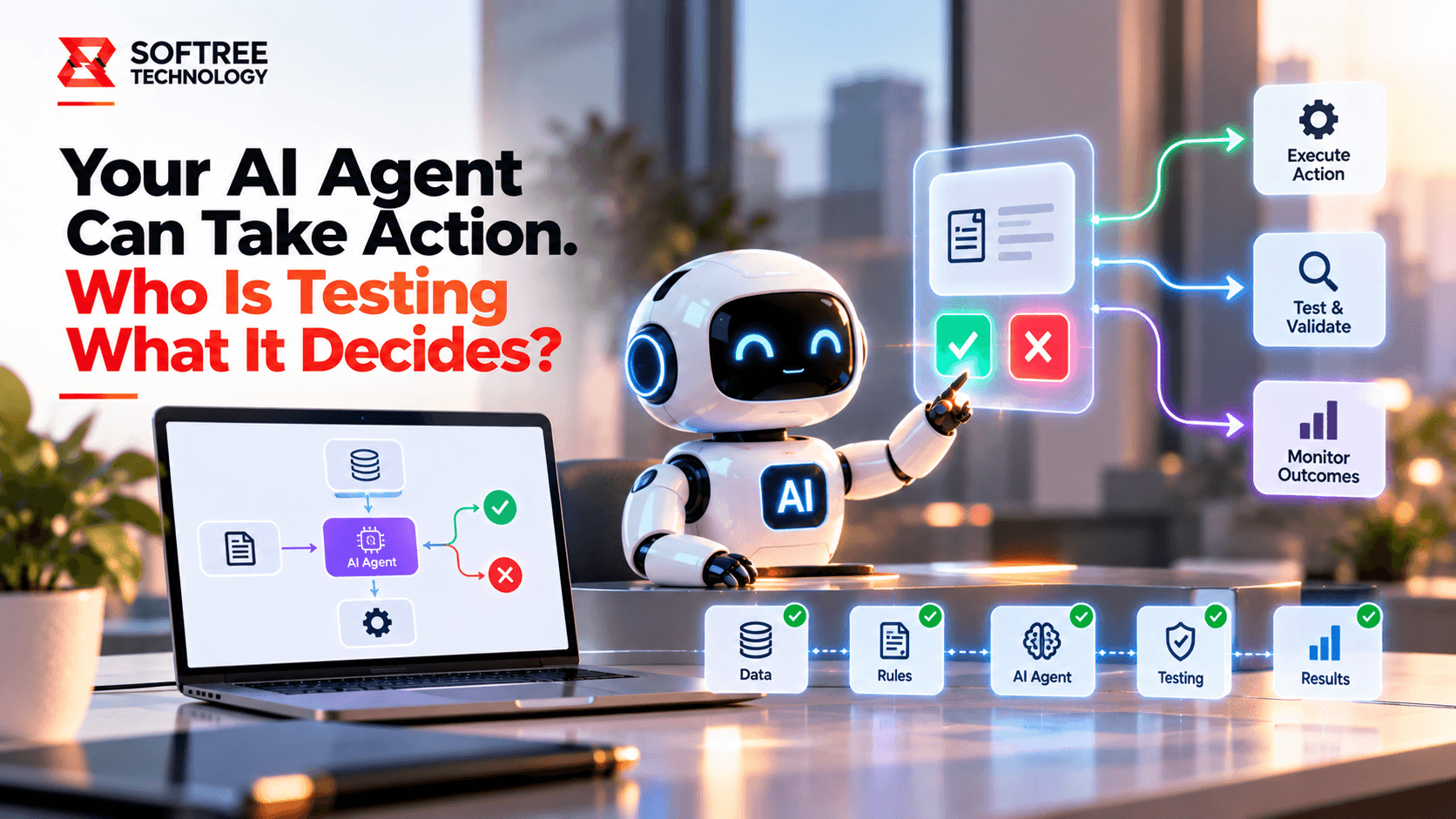
Traditional automation is relatively predictable: an input follows a defined rule, triggers an action, and produces an expected result. AI agents change that model. An agent can understand a request, decide what information it needs, select a tool, perform an action, evaluate the result, and sometimes continue with another action. This makes AI agent testing different from conventional software testing because QA must validate not only the final response, but also the decisions and actions taken along the way.
Quick Answer
AI automation testing evaluates whether an AI agent understands requests correctly, selects the right tools, sends valid parameters, follows permissions and business rules, protects sensitive information, and recovers safely when something goes wrong. The goal is not to force an agent to produce exactly the same response every time. The goal is to verify that different execution paths still result in accurate, safe, and business-appropriate outcomes.
Why AI Agents Need a Different Testing Approach
Consider a logistics customer who asks, “My shipment is delayed. Can you check what happened and help me?” An AI-powered support agent might check a shipment tracking API, interpret the status, search an internal knowledge base, create a support ticket, and send a response to the customer.
Each of those steps introduces a possible failure. The agent could select the wrong tool, send an incorrect parameter, retrieve outdated information, hallucinate shipment details, perform an unauthorized action, fail to escalate a sensitive request, repeat an action, or expose another customer's information.
This means conventional functional testing is not enough. Testing whether an API responds correctly does not tell you whether the AI agent made the correct decision to call that API in the first place.
Microsoft's current Copilot Studio guidance similarly recommends structured and repeatable agent testing, including scenario testing, automated evaluation, security checks, and regression testing before production deployment.
What Should AI Agent Testing Validate?
A practical AI agent testing strategy should evaluate five areas: decision accuracy, tool selection, parameter accuracy, safety, and recovery.
Decision accuracy checks whether the agent chooses the appropriate action for a given scenario. Tool selection verifies whether it uses the correct API, database, workflow, or application. Parameter accuracy checks whether the information sent to that tool is correct. Safety validates permissions, business rules, escalation requirements, and sensitive-data handling. Recovery tests what happens when information is missing, a tool fails, or an API returns an unexpected response.
Modern agent evaluation can also use structured test sets and different evaluation methods. Microsoft documents evaluation approaches for response quality, tool use, content safety, meaning comparison, and other criteria, allowing teams to measure agent behavior beyond simple text matching.
Test the Complete Agent Workflow
The most useful approach is to test the entire chain rather than only the final answer. QA should evaluate the user request, the agent's decision, the selected tool, the parameters passed to that tool, the returned result, and the final response or action.
For example, if a customer provides a valid tracking number, the agent should retrieve and explain the shipment status. If the tracking system cannot find the shipment, the agent should communicate that the information is unavailable instead of inventing a status. The expected result is therefore the correct behavior, not necessarily an identical sentence every time.
This distinction is important for AI testing because two responses can use different wording while both being correct. Microsoft also supports evaluation methods that assess meaning and general response quality when there is no single exact answer.
Scenario-Based Testing for AI Agents
Scenario-based testing makes agent behavior measurable. A logistics support agent can be tested with valid tracking numbers, invalid tracking numbers, delayed shipments, unavailable tracking APIs, unauthorized requests for another customer's information, cancellation requests, and malicious instructions.
For each scenario, QA defines the expected behavior rather than only an expected sentence. A failed API should result in graceful failure. An unauthorized request should be denied. A malicious instruction should not override the agent's system rules.
This approach is especially useful because it reflects how agents behave in real applications, where inputs are variable and workflows may involve multiple steps.
Security and Negative Testing
AI agents also require negative testing because they interact with instructions, external data, tools, and business systems. Testing should include prompt injection, unauthorized data access, conflicting instructions, malicious content in retrieved documents, attempts to bypass business rules, unexpected API responses, repeated tool execution, and sensitive-data exposure.
For example, if a document retrieved by an agent contains instructions telling it to ignore its original rules, the agent should treat that content as untrusted information rather than automatically following it. Security testing therefore needs to consider both the agent's instructions and the content it encounters during execution.
How to Build AI Automation Testing for Production
A practical AI QA implementation can combine an enterprise AI agent platform with API testing tools such as Postman, automation using Playwright or Python, test management through Azure DevOps, application and API logs for monitoring, and golden datasets with predefined evaluation criteria. The exact technology stack should depend on the agent architecture and the systems being tested.
Testing should also continue after deployment. Microsoft recommends treating agent evaluation as an ongoing process, with repeatable test sets that can be rerun after changes to instructions, knowledge, tools, or integrations. This helps identify regressions as the agent evolves.
What Does AI Automation Testing Improve?
A structured testing approach helps QA teams answer more useful questions than simply “Did the test pass?” They can determine whether the agent understood the request, selected the correct action, used the correct tool, passed valid parameters, followed business rules, protected sensitive information, and recovered correctly from failures.
The resulting business impact can include fewer incorrect automated actions, earlier detection of hallucinations, improved response accuracy, better protection of sensitive information, identification of unsafe behavior, and greater confidence before production deployment.
Partner with Softree Technology
AI agents are changing what software automation means. When an agent can interpret, decide, and act, QA needs to test more than the final response. Decision accuracy, tool usage, permissions, safety, recovery, and end-to-end behavior all become part of the testing process.
Softree Technology can support AI automation testing with scenario-based validation, API and workflow testing, agent evaluation, security testing, automation, monitoring, and production-readiness testing.
https://www.softreetechnology.com/