AI Testing Services: Complete Enterprise Guide
Learn how AI Testing Services help enterprises improve software quality, reduce testing costs, and accelerate software delivery.
Introduction
AI Testing Services
Introduction
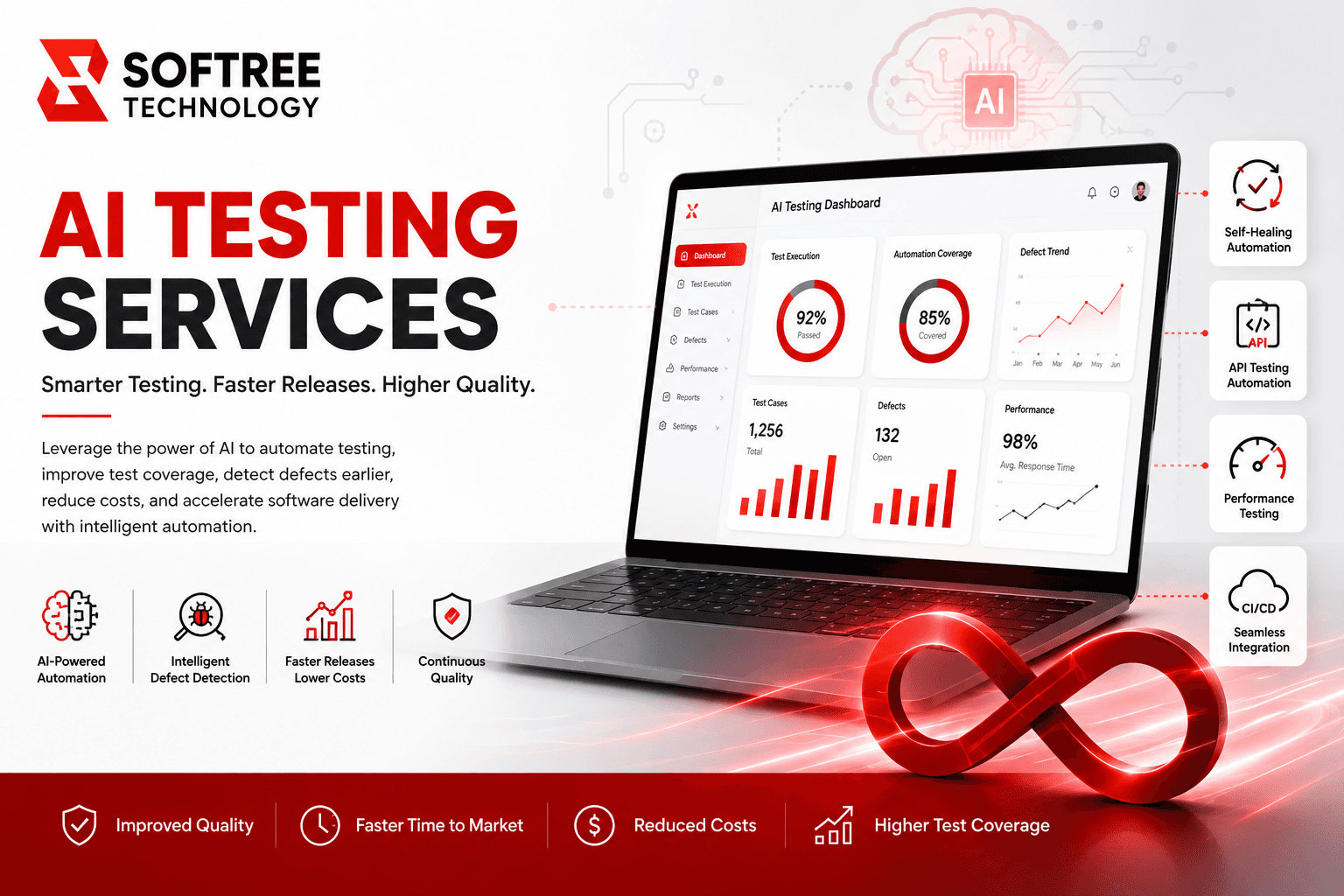
Software development is evolving rapidly as Agile, DevOps, cloud-native applications, and AI-powered development tools continue to shorten release cycles. While businesses can deliver new features faster than ever, maintaining software quality has become increasingly challenging. Traditional testing approaches often struggle to keep pace due to manual effort, frequent maintenance, and limited scalability. AI Testing Services address these challenges by combining artificial intelligence with modern testing frameworks to automate repetitive tasks, identify defects earlier, improve test coverage, and reduce overall testing costs. This guide explains how AI Testing Services work, their business benefits, implementation process, technologies, industry use cases, and best practices for successful adoption.
Understanding the Problem
Modern organizations develop and maintain web applications, mobile apps, SaaS platforms, enterprise systems, APIs, and cloud-native solutions, making quality assurance increasingly complex. Traditional testing methods require significant manual effort and continuous script maintenance, making it difficult to support rapid development cycles. As release frequency increases, businesses face higher risks of production defects, delayed deployments, increased operational costs, and reduced customer satisfaction. AI-powered testing helps organizations overcome these limitations by enabling intelligent automation, adaptive testing, and continuous quality validation throughout the software development lifecycle.
Key Takeaways
- AI automates repetitive testing activities and improves efficiency.
- Self-healing automation reduces maintenance effort.
- Intelligent regression testing accelerates release cycles.
- AI improves software quality while lowering testing costs.
- Continuous testing integrates seamlessly into modern DevOps pipelines.
- Predictive analytics helps identify defects before production.
The Solution
A successful AI Testing strategy begins with assessing the existing QA environment, identifying automation opportunities, defining testing priorities, and implementing scalable automation frameworks. AI capabilities such as self-healing automation, AI-generated test cases, intelligent regression testing, predictive analytics, and automated failure analysis enhance testing efficiency and accuracy. Modern AI Testing Services leverage technologies including Playwright, Selenium, Cypress, Appium, Postman, REST Assured, Azure DevOps, Jenkins, GitHub Actions, BrowserStack, and LambdaTest to support end-to-end quality engineering across diverse application environments.
Implementation & Real-World Use Cases
Implementing AI Testing Services typically starts with evaluating current QA maturity and defining business goals. Organizations then establish scalable automation frameworks, integrate AI-powered capabilities, and continuously optimize testing strategies based on execution insights. Industries such as healthcare, banking, retail, manufacturing, and telecommunications rely on AI Testing Services to improve software quality, accelerate releases, reduce maintenance effort, and enhance user experiences. Common challenges including legacy applications, incomplete automation, integration complexity, and skill gaps can be addressed through phased implementation and structured planning, resulting in improved productivity and lower operational costs.
Best Practices & Future Trends
Organizations achieve the greatest value from AI Testing Services by focusing on business-critical workflows, combining AI with traditional automation, continuously monitoring testing metrics, maintaining reusable automation frameworks, integrating testing early in the development lifecycle, investing in team training, and measuring success through business outcomes. As enterprise software continues to evolve, emerging innovations such as autonomous testing, AI-generated test scenarios, predictive defect analytics, intelligent root cause analysis, natural language test creation, and Generative AI for QA documentation are shaping the future of quality engineering.
Expert Insight
Successful AI Testing implementations do not replace traditional quality assurance practices overnight. Instead, they enhance existing testing processes by introducing intelligent automation where it delivers the highest business value. Organizations that adopt AI incrementally, align automation with business priorities, and continuously optimize testing strategies achieve faster releases, higher software quality, and more reliable digital experiences while maintaining long-term scalability.
Conclusion
AI Testing Services are transforming enterprise quality assurance by combining intelligent automation with modern testing practices to improve software quality, accelerate release cycles, and reduce operational costs. As applications become more complex and development cycles continue to shorten, AI-powered testing enables organizations to deliver reliable, secure, and scalable software with greater confidence. By adopting a structured implementation approach, integrating AI into existing QA processes, and continuously optimizing testing strategies, businesses can achieve faster delivery, improved test coverage, and long-term operational efficiency. Investing in AI Testing Services is no longer just a technology upgrade—it is a strategic step toward building resilient, future-ready software development processes.
AI Testing Services help organizations modernize quality assurance by combining intelligent automation with proven testing practices. From accelerating release cycles and improving test coverage to reducing maintenance effort and operational costs, AI-driven testing enables businesses to deliver reliable software at scale. As enterprise applications continue to grow in complexity, adopting AI-powered testing is becoming essential for maintaining speed, quality, and competitive advantage.
If you're looking to strengthen your software testing strategy with AI-powered quality engineering, visit Softree Technology to explore our AI Testing Services and discover how our experts can help you build faster, more reliable, and future-ready software solutions.
Frequently Asked Questions.
Question Answer:
AI Testing Services are widely used across healthcare, banking and financial services, retail and e-commerce, manufacturing, and telecommunications to ensure reliable, secure, and scalable software applications.