AI-Powered Knowledge Management for Enterprises
Discover how AI-powered knowledge management helps enterprises connect information, improve search, strengthen governance, and accelerate decision-making.
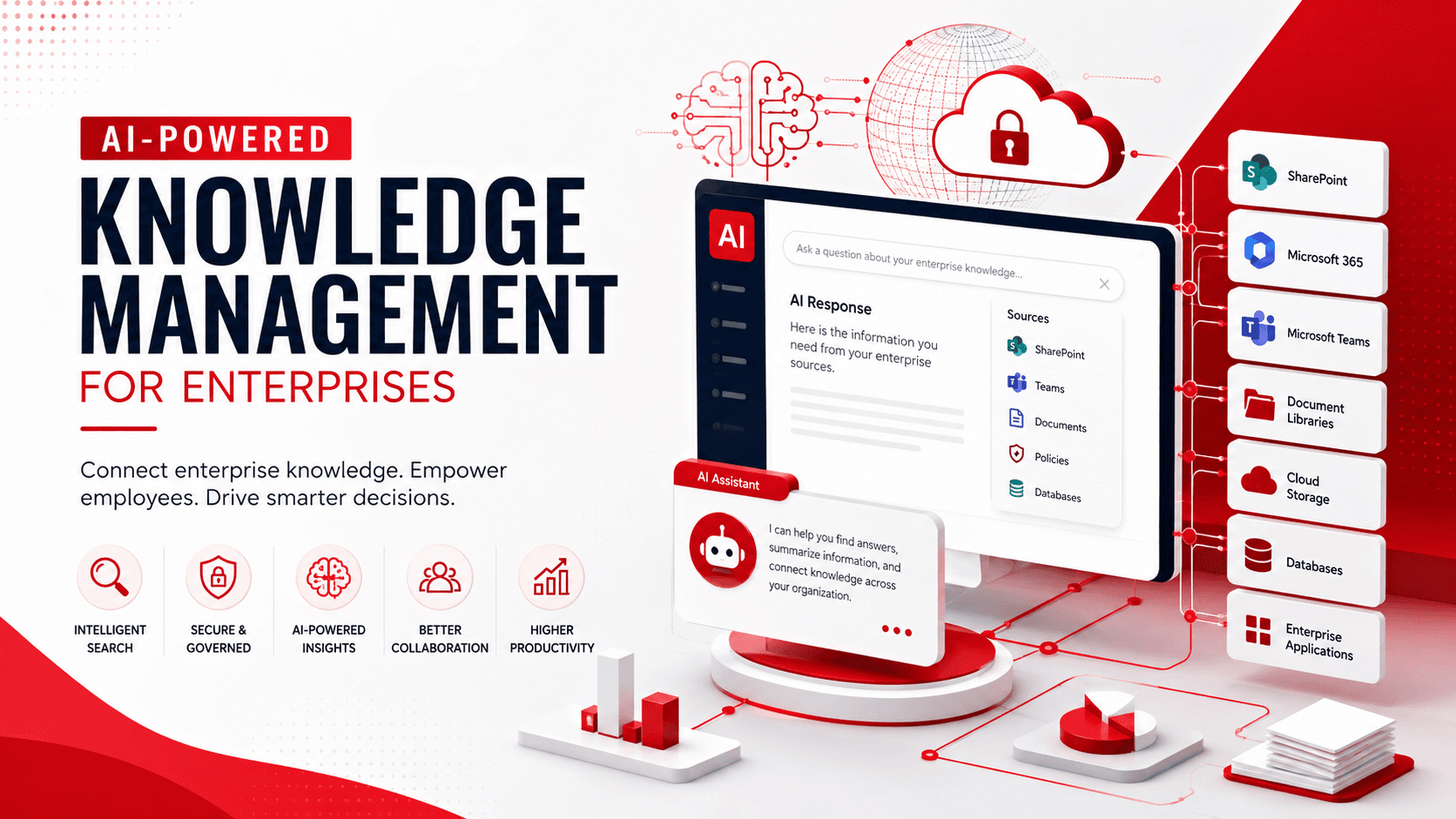
ENTERPRISE KNOWLEDGE MANAGEMENT
AI-Powered Knowledge Management for Enterprises
Introduction
- Enterprise knowledge is growing faster than organizations can effectively manage it.
- Business information is scattered across SharePoint, Teams, documents, emails, and enterprise applications, making it difficult for employees to find trusted information.
- This article explains AI-powered knowledge management, why it matters, how it works, its key components, best practices, and Microsoft's knowledge ecosystem.
Quick Answer
AI-powered knowledge management combines AI, enterprise search, automation, and governance to help employees find trusted business information faster, improve collaboration, and make informed decisions across the organization. (This section is derived from the introduction and definition.)
Table of Contents
- What is AI-Powered Knowledge Management?
- Why Enterprise Knowledge Management Matters
- How AI-Powered Knowledge Management Works
- Core Components
- Benefits
- Microsoft Knowledge Management Ecosystem
- Best Practices
- Frequently Asked Questions
- Key Takeaways
- Conclusion
What is AI-Powered Knowledge Management?
Definition
AI-powered knowledge management uses Artificial Intelligence, enterprise search, automation, and information governance to help organizations capture, organize, discover, and use enterprise knowledge more effectively.
Overview
Traditional knowledge management focuses on storing information, while AI adds intelligence that enables employees to interact with enterprise knowledge using natural language.
Employees no longer need to know where information is stored. Intelligent systems retrieve relevant information from approved enterprise sources while respecting governance and permissions.
Why is AI-Powered Knowledge Management Important?
- Eliminates knowledge silos
- Reduces time spent searching for information
- Improves collaboration
- Preserves institutional knowledge
- Supports faster decision-making
- Increases employee productivity
How Does AI-Powered Knowledge Management Work?
Step 1
Employees ask questions using natural language.
Step 2
The system searches approved enterprise knowledge sources.
Step 3
AI provides contextual answers and links to supporting documents while enforcing permissions and governance.
Knowledge Integration
Connects SharePoint, Teams, CRM, document repositories, databases, and enterprise applications.
Enterprise Search & Discovery
Allows employees to find information using natural-language queries instead of keywords.
Information Governance & Security
Applies permissions, identity management, retention policies, and compliance controls.
Benefits of AI-Powered Knowledge Management
- Faster information discovery
- Better collaboration
- Improved employee productivity
- Reduced duplicate work
- Better governance
- Stronger organizational resilience
Key Takeaways (Suggested summary based on the article)
- AI makes enterprise knowledge easier to discover.
- Governance and security remain essential.
- Enterprise search improves productivity and collaboration.
- Microsoft technologies provide a scalable knowledge management ecosystem.
Conclusion
AI-powered knowledge management transforms fragmented enterprise information into a connected, secure, and intelligent knowledge ecosystem. By combining AI, enterprise search, governance, and Microsoft technologies, organizations can improve productivity, strengthen collaboration, and enable better business decisions.
This structure closely matches your required blog template while staying faithful to the content in the uploaded document.