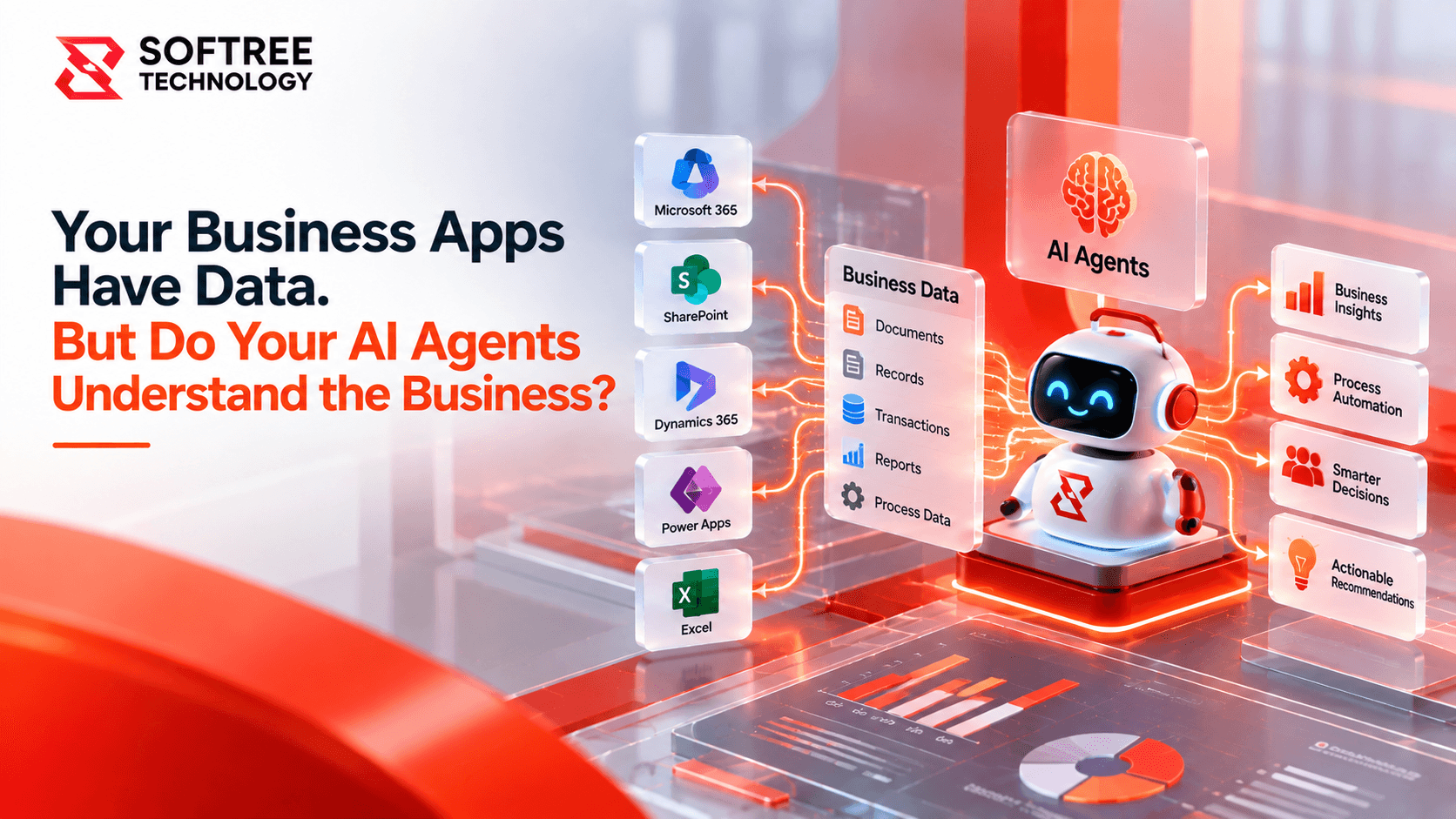
AI agents need more than access to business data. They need context about relationships, terminology, processes, rules, permissions, and approved actions. Dataverse can provide a structured business data foundation for AI agents, connecting business records and relationships with knowledge, workflows, security, and enterprise systems. Microsoft also describes Dataverse intelligence as a way to provide reusable business context that helps agents understand data, follow organizational processes, and work with Dataverse records.
Why Business Data Alone Is Not Enough
Most enterprises already have large amounts of business data: customers, orders, opportunities, employees, products, approvals, and service records. But simply connecting an AI agent to these records does not automatically give it an understanding of how the business operates.
An agent needs to understand how records relate to each other, what business terminology means, which rules apply, what processes should be followed, and what actions it is allowed to perform. Without this context, an agent may retrieve the right information but still fail to understand what that information means within a business process.
This is where Dataverse can become an important part of an AI agent architecture.
What Is Dataverse Business Context?
Dataverse can act as a business data foundation for AI agents by providing structured business information, relationships, security context, and connections to business processes.
Instead of exposing disconnected tables and documents to an agent, organizations can build a broader context layer around:
- Structured Dataverse data
- Relationships between business entities
- Business rules and processes
- Knowledge sources
- Security and permissions
- Actions and workflows
- Enterprise applications and APIs
The objective is straightforward: give the agent the context required to use business data correctly, not just access to the data itself.
Microsoft's current Dataverse intelligence documentation similarly describes reusable business context that can help agents understand what business data means and follow organizational processes when taking actions.
How Dataverse AI Agents Work
A basic AI integration may follow a simple flow:
User ↓ AI Agent ↓ Business Data
The limitation is that raw data may not explain the relationships, business rules, or processes behind that information.
A context-aware architecture adds a business context layer:
User ↓ AI Agent ↓ Business Context ↓ Business Actions
The business context can combine Dataverse data and relationships with business rules, knowledge, and processes. The action layer can then connect the agent to Power Automate, APIs, and applications.
This architecture allows an agent to move beyond retrieving information and toward understanding how that information fits into a business process.
Microsoft Copilot Studio also supports connecting agents to organizational data and systems, adding knowledge and tools, and using workflows to automate business processes.
Key Components of a Dataverse AI Agent Architecture
Dataverse stores structured business data and relationships.
Business Relationships connect entities such as customers, accounts, opportunities, orders, and cases.
Business Rules define constraints and expected business behavior.
Knowledge Sources provide policies, procedures, documentation, and organizational knowledge.
AI Agent interprets user requests and determines the required response or action.
Power Automate can execute workflows, approvals, notifications, and business processes.
APIs and Connectors connect the agent with external enterprise systems.
Security Controls determine what users and agents can access and execute.
Monitoring provides visibility into agent behavior, usage, failures, and operational performance.
Real-World Example: AI Sales Agent
Consider a salesperson asking:
“Why has this customer's revenue dropped, and what should I do next?”
A basic AI system might retrieve the customer's revenue numbers and provide a summary.
A context-aware AI agent can work with a broader business model. It can start with the customer record in Power Apps, access related Dataverse information such as opportunities, orders, and revenue history, apply relevant sales rules and customer policies, and then determine an appropriate next action.
The resulting flow can look like:
Salesperson ↓ Power Apps Customer Record ↓ AI Agent ↓ Dataverse ↓ Customer + Opportunities + Orders + Revenue History ↓ Business Context ↓ AI Analysis ↓ Recommended Action ↓ Power Automate ↓ Create Task / Notify Sales Manager
The important difference is context. Instead of simply reporting that revenue dropped by a certain amount, the agent can use related records, business knowledge, and approved processes to determine what information and actions are relevant.
When Should You Use Dataverse Business Context?
Dataverse business context can be useful when:
- AI agents need to work with structured business data.
- Relationships between records are important.
- Agents need customer, employee, product, or transaction context.
- Business processes span multiple records.
- AI needs to trigger controlled business actions.
- Enterprise applications already depend on Dataverse.
Dataverse should not be treated as the complete enterprise AI architecture when important information exists in disconnected documents or external systems, specialized APIs are required, business rules are undefined, or data quality is poor.
The broader architecture still needs appropriate knowledge sources, actions, security, governance, monitoring, and reliable data.
Recommended Production Architecture
For production AI agents, Dataverse should be treated as part of a broader business context architecture rather than simply as a database.
User ↓ AI Agent ↓ Business Context ↓ Action Layer ↓ Enterprise Systems
The business context layer can include Dataverse, relationships, business rules, and knowledge sources. The action layer can use Power Automate, APIs, and connectors, while enterprise systems can include ERP, CRM, SharePoint, and SaaS applications. Security, governance, and monitoring should operate across the architecture.
This separation is important because it distinguishes what the agent knows from what the agent can do.
Production Checklist
Before deploying a Dataverse-powered AI agent, validate:
Data
- Dataverse data model is clearly defined.
- Business relationships are represented correctly.
- Data quality has been validated.
- Required business context is available.
AI
- Agent responsibilities are clearly scoped.
- Instructions have been tested.
- Knowledge sources are validated.
- Agent responses are evaluated against real scenarios.
Actions
- Agent actions are explicitly defined.
- Power Automate workflows are tested.
- External API access is controlled.
- Human approval is available where required.
Security
- Identity and permissions are configured.
- Least-privilege access is applied.
- Sensitive business data is protected.
- Environment and connector policies are reviewed.
Operations
- Agent activity is monitored.
- Failure scenarios are tested.
- Feedback mechanisms are established.
- Production ownership is assigned.
Microsoft's current Copilot Studio guidance similarly emphasizes architecture, governance, security, testing, evaluation, monitoring, and lifecycle management when taking agents into production.
Key Takeaways
- AI agents need more than access to business data.
- Dataverse can provide structured business data and relationships that contribute to agent context.
- Business rules, knowledge, permissions, and processes are equally important.
- Power Automate and APIs can provide controlled business actions.
- Data quality directly affects the usefulness of AI-driven business experiences.
- Enterprise AI architecture should separate data, context, actions, security, and governance.
- Not every use case requires an agent; agentic capabilities are most relevant when contextual interpretation and action are actually needed.
Build AI Agents That Understand Your Business
Adding AI to an application is only the beginning. Enterprise AI agents need reliable data, meaningful business context, controlled actions, security, and governance.
Softree Technology helps enterprises design Dataverse-powered AI architectures, build Power Platform solutions, integrate Copilot and AI agents, automate business processes, and establish production-ready governance.
https://www.softreetechnology.com/services/amazon-bedrock-agentcore-development